SEO is one of the most effective long-term marketing channels for startups, but it is also one of the most misunderstood. One of the first questions founders ask after investing in SEO is simple: “When will we actually see results?”
The honest answer is that there is no universal deadline.
A new website targeting low-competition local keywords can begin gaining visibility relatively quickly, while a startup competing against established companies for highly competitive keywords may need considerably more time. Technical problems, website authority, content quality, competition, backlinks, search intent, and the consistency of optimization all affect how quickly results develop.
This is why understanding an SEO timeline is more useful than expecting a specific ranking within a specific number of days.
Professional SEO Services for Startups focus on building measurable progress at every stage rather than promising instant first-page rankings. The objective is to establish a technically strong website, target realistic keywords, publish useful content, build authority, and continuously improve based on performance data.
For founders, understanding the different stages of SEO makes it easier to set realistic expectations and evaluate whether an SEO campaign is moving in the right direction.
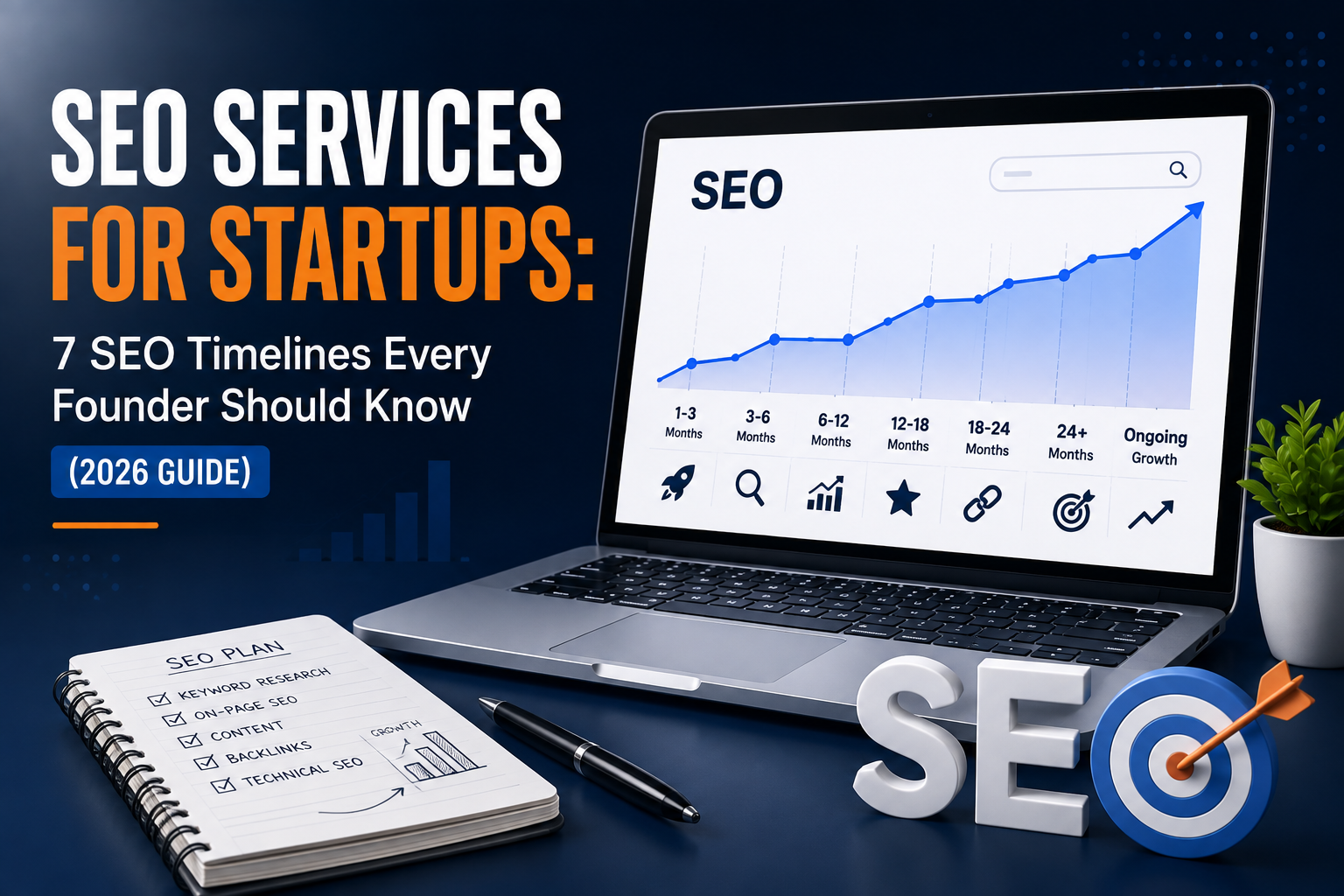
This guide explains 7 SEO timelines every startup founder should know, from the first technical improvements to long-term organic growth. It also explains what you should work on during each stage, which results you can realistically expect, and why some startups grow faster than others.
Table of Contents
- What Determines How Fast SEO Results Appear?
- Timeline #1: The First 30 Days — SEO Foundation
- Timeline #2: Days 31–60 — Content and On-Page Optimization
- Timeline #3: Days 61–90 — Initial Search Visibility
- Timeline #4: Months 4–6 — Ranking and Traffic Growth
- Timeline #5: Months 6–9 — Building Authority
- Timeline #6: Months 9–12 — Scaling Organic Growth
- Timeline #7: 12+ Months — Long-Term SEO Growth
- Why Some Startups Get SEO Results Faster
- Why SEO Rankings Can Fluctuate
- What Startups Should Measure Instead of Rankings Alone
- Common SEO Timeline Mistakes
- 12-Month Startup SEO Roadmap
- How to Speed Up SEO Without Using Risky Shortcuts
- Frequently Asked Questions
- Final Thoughts
What Determines How Fast SEO Results Appear?
Before looking at the seven timelines, it is important to understand that SEO results depend on multiple variables.
Two startups can invest in the same SEO strategy and experience completely different results.
The main factors include:
Website Age and Authority
A brand-new domain generally needs more time to establish credibility than an established website with a history of useful content and quality backlinks.
Competition
Ranking for a niche keyword with relatively low competition can be much easier than ranking for a broad keyword dominated by major companies.
Content Quality
Publishing genuinely useful content gives search engines stronger reasons to rank your pages.
Technical SEO
Issues involving crawling, indexing, website speed, mobile usability, or site architecture can limit performance.
Backlinks and Authority
Relevant, high-quality backlinks can help establish authority and improve the competitiveness of your pages.
Keyword Selection
Targeting realistic keywords is particularly important for startups. Going after highly competitive keywords immediately can delay visible results.
Consistency
SEO isn’t a campaign where you optimize a website once and stop. Search competitors continue publishing, updating pages, earning links, and improving their websites.
Professional SEO Services for Startups account for these variables when creating an SEO roadmap rather than using the same timeline for every business.
Timeline #1: The First 30 Days — Build the SEO Foundation
The first month is primarily about preparation and correction.
Don’t expect dramatic traffic increases during this stage. The goal is to make your website technically sound and establish a clear strategy.
What Happens During the First 30 Days?
A comprehensive SEO campaign may begin with:
- Website audit
- Technical SEO audit
- Keyword research
- Competitor analysis
- Search intent analysis
- Google Search Console setup
- Google Analytics setup
- Sitemap review
- Robots.txt review
- Website structure analysis
- Internal linking review
- Mobile usability checks
These tasks create the foundation for everything that follows.
Technical SEO Comes First
If Google can’t properly crawl or index your pages, content optimization won’t deliver its full potential.
Check:
- Indexing status
- Broken links
- Redirects
- HTTPS
- XML sitemap
- Robots.txt
- Mobile responsiveness
- Core Web Vitals
- URL structure
Fixing these issues can sometimes produce relatively quick improvements because you’re removing barriers that were preventing search engines from understanding your website.
Keyword Research
The first month is also the time to decide which keywords deserve attention.
A startup shouldn’t necessarily target the keyword with the highest search volume.
Instead, evaluate:
- Search volume
- Competition
- Search intent
- Commercial relevance
- Conversion potential
- Geographic relevance
For example, a startup may have a better chance of ranking for:
SEO Services for Startups in Hyderabad
before competing for a broad term such as:
SEO Services
The more realistic keyword can generate fewer searches but potentially deliver more qualified visitors.
Professional SEO Services for Startups use keyword research to balance ranking opportunity with business value.
Expected Results During Month One
You may see:
- More pages indexed
- Technical errors reduced
- Search impressions beginning to appear
- Initial keyword data
- Improved website structure
- Better page speed
These are foundation-level results. Don’t judge the entire SEO campaign based on traffic during the first few weeks.
timeline #2: Days 31–60 — Content and On-Page Optimization
Once the technical foundation is stronger, the next stage focuses heavily on content and on-page SEO.
This is when your website begins building relevance around your target topics.
Core Activities
During this stage, you may:
- Optimize service pages
- Create new landing pages
- Publish blog content
- Improve existing articles
- Add internal links
- Optimize images
- Improve title tags
- Rewrite meta descriptions
- Improve heading structures
- Create topic clusters
Build Content Around Search Intent
Don’t publish articles simply because a keyword has search volume.
Understand what users actually want.
For example:
“What is SEO?”
is primarily informational.
Someone searching:
“SEO Services for Startups”
may be evaluating providers and looking for a service.
The content should match that intent.
Create Topic Clusters
Instead of publishing unrelated articles, build connected groups of content.
For example:
Main Topic
SEO Services for Startups
Supporting Topics
- Startup keyword research
- Local SEO for startups
- Technical SEO
- SEO content strategy
- Google Business Profile optimization
- Link building
- SEO reporting
- SEO mistakes
- SEO timelines
Internal links between these pages help search engines understand your topical coverage.
Expected Results by Day 60
You may begin seeing:
- More impressions
- Early keyword movements
- Long-tail keyword rankings
- Additional indexed pages
- Increased organic visits
However, competitive keywords may still remain far from the first page.
That’s normal.
Professional SEO Services for Startups focus on building the conditions required for future growth instead of chasing short-term ranking changes.
Timeline #3: Days 61–90 — Initial Search Visibility
The third month is often when startups begin seeing clearer signs that their SEO strategy is gaining traction.
This doesn’t necessarily mean your most important keyword will reach position one.
Instead, look for broader signs of progress.
What Can Start Improving?
You may notice:
- More keywords appearing in Google Search Console
- Higher search impressions
- Long-tail keywords entering the top 50
- Some keywords moving toward page one
- Increased organic clicks
- More visibility for service pages
Why Long-Tail Keywords Matter
Long-tail searches are usually more specific.
For example:
SEO Services for Startups
is broad.
A longer query such as:
Affordable SEO Services for Technology Startups in India
is much more specific.
A new website may have an easier time gaining visibility for specific searches before competing successfully for broad, highly competitive terms.
Start Measuring Conversions
Traffic isn’t enough.
During this stage, begin tracking:
- Contact form submissions
- Calls
- Quote requests
- Demo requests
- Purchases
- Newsletter registrations
A page receiving 100 highly relevant visitors can be more valuable than one receiving 1,000 visitors with no business intent.
Professional SEO Services for Startups focus on qualified organic traffic rather than vanity metrics.
Timeline #4: Months 4–6 — Ranking and Traffic Growth
Between months four and six, many startups begin moving from initial visibility toward measurable organic growth.
This is often where consistent SEO work starts compounding.
What Changes During This Stage?
Your website may now have:
- More optimized pages
- A larger content library
- Better internal linking
- More indexed content
- Stronger topical relevance
- Initial backlinks
- More historical performance data
Search engines have more information with which to evaluate your website.
Content Starts Working Together
Suppose you’ve published 15 related articles about startup SEO.
Instead of each article functioning independently, internal links connect them.
This creates a stronger topical ecosystem.
A reader might move from:
SEO Services for Startups
to:
Startup Keyword Research
then:
Local SEO for Startups
and finally:
Google Business Profile Optimization
This improves navigation and gives search engines clearer context.
Expected Results
Depending on competition, you may experience:
- Increased organic traffic
- More first-page rankings for less competitive keywords
- Improved rankings for commercial terms
- More enquiries
- Better conversion data
Some startups may see significant results earlier, while others need considerably longer.
There is no guaranteed six-month ranking deadline.
Timeline #5: Months 6–9 — Building Authority
By the six-to-nine-month stage, your focus should shift from basic optimization toward authority and competitive growth.
This is where link building, content expansion, and content refreshes become particularly important.
Build Quality Backlinks
Focus on relevant websites rather than collecting large numbers of low-quality links.
Potential strategies include:
- Digital PR
- Industry publications
- Guest contributions
- Business partnerships
- Original research
- Useful resources
- Case studies
A relevant backlink can help establish credibility and increase referral traffic.
Refresh Existing Content
Look for pages that are:
- Ranking on page two
- Receiving impressions but few clicks
- Losing traffic
- Outdated
- Missing important subtopics
Improve them rather than automatically creating new pages.
For example, if an article ranks at position 12 for a valuable keyword, improving its depth, internal links, user experience, and relevance may help push it toward page one.
Professional SEO Services for Startups use performance data to identify these opportunities.
Timeline #6: Months 9–12 — Scaling Organic Growth
At this stage, your startup should have enough data to identify what’s working.
Now you can scale successful strategies.
Identify Your Winning Content
Look for pages generating:
- Organic traffic
- Leads
- High engagement
- Backlinks
- Multiple keyword rankings
Then create related content around those successful topics.
Example
Suppose your article about Local SEO for startups consistently generates leads.
You could expand the topic into:
- Google Maps SEO
- Local keyword research
- Local citations
- Review management
- Local landing pages
- Google Business Profile optimization
This creates a strong content cluster around a proven topic.
Improve Conversion Rates
At this stage, SEO should connect more closely with your sales process.
Improve:
- Calls-to-action
- Landing pages
- Contact forms
- Service page copy
- Trust signals
- Testimonials
- Case studies
More traffic isn’t useful if visitors don’t convert.
Professional SEO Services for Startups should increasingly focus on revenue contribution rather than rankings alone.
Timeline #7: 12+ Months — Long-Term SEO Growth
SEO becomes significantly more powerful when treated as a long-term business asset.
After 12 months, a startup may have:
- Hundreds of ranking keywords
- A substantial content library
- Stronger domain authority
- Quality backlinks
- Established topical relevance
- Consistent organic traffic
- Historical performance data
At this stage, you aren’t starting from zero every time you publish something new.
Your existing authority can help new content gain visibility more efficiently.
The Compounding Effect
Consider this simplified example:
Year 1
You publish and optimize 40 valuable pages.
Year 2
You improve those pages and add another 40.
Now you have:
- 80+ opportunities to rank
- More internal linking possibilities
- More backlinks
- More topical coverage
- More organic traffic
SEO compounds because successful content creates opportunities for additional growth.
Professional SEO Services for Startups focus on building this compounding effect instead of treating SEO as a short-term campaign.
7 SEO Timelines at a Glance
| Timeline | Main Focus | Typical Progress |
|---|
| 0–30 Days | Technical foundation | Indexing and technical improvements |
| 31–60 Days | Content & on-page SEO | More impressions and initial rankings |
| 61–90 Days | Search visibility | Long-tail rankings and growing clicks |
| 4–6 Months | Ranking growth | More traffic and page-one opportunities |
| 6–9 Months | Authority building | Stronger competitive rankings |
| 9–12 Months | Scaling | More traffic, leads, and conversions |
| 12+ Months | Long-term growth | Compounding organic visibility |
These are planning ranges, not guarantees. Competition and website quality can significantly change the timeline.
Why Some Startups Get SEO Results Faster
Not every startup follows the same growth curve.
Some factors can accelerate progress.
1. Low-Competition Keywords
A startup targeting specific niche keywords may gain rankings faster than one competing for extremely broad terms.
2. Strong Website Foundation
A technically sound website gives search engines fewer obstacles.
3. High-Quality Content
Useful content that fully satisfies search intent can gain visibility more effectively.
4. Existing Authority
An established domain with backlinks and historical trust may outperform a brand-new domain.
5. Consistent Publishing
Regularly adding useful content creates more opportunities for ranking.
6. Strong Internal Linking
A logical website structure helps search engines discover and understand content.
7. Quality Backlinks
Relevant backlinks can strengthen authority and improve competitiveness.
8. Strong Brand Signals
Consistent business information and a recognizable brand can support trust and visibility.
Professional SEO Services for Startups evaluate these factors before setting expectations for a campaign.
Why SEO Rankings Can Fluctuate
Don’t panic if a keyword moves from position 8 to position 14 one week and returns to position 9 later.
Ranking fluctuations are normal.
Changes can occur because of:
- Google algorithm updates
- New competitor content
- Content updates
- Search intent changes
- SERP layout changes
- New backlinks
- Website changes
- Increased competition
This is why SEO should be evaluated using trends over weeks and months rather than daily ranking movements.
What Startups Should Measure Instead of Rankings Alone
Rankings are useful, but they shouldn’t be the only KPI.
Track these metrics:
Organic Impressions
Are more people seeing your website in search results?
Organic Clicks
Are those impressions turning into visitors?
Qualified Traffic
Are the visitors actually relevant to your business?
Conversion Rate
Are visitors taking valuable actions?
Leads
How many enquiries are generated?
Revenue
How much business can be attributed to organic search?
Customer Acquisition Cost
How much does acquiring an organic customer cost compared with paid channels?
Professional SEO Services for Startups should connect SEO activity with business outcomes wherever measurement allows.
Common SEO Timeline Mistakes
Expecting Results in Two Weeks
SEO requires search engines to discover, evaluate, and compare your website.
Two weeks is rarely enough to judge a long-term strategy.
Stopping After Three Months
Three months is often the beginning of meaningful SEO progress, not the end.
Stopping at this point can prevent your investment from reaching its full potential.
Chasing Every Algorithm Update
Don’t change your entire strategy because of one ranking fluctuation.
Look at long-term trends before making major decisions.
Targeting Only High-Volume Keywords
High search volume doesn’t automatically mean high business value.
Target keywords based on relevance and conversion potential.
Publishing Without Measuring
If you don’t know which pages generate traffic and leads, you can’t intelligently scale your strategy.
Buying Cheap Backlinks
Thousands of low-quality links are not a shortcut to authority.
Focus on relevance and quality.
12-Month Startup SEO Roadmap
Months 1–3
Foundation
- Technical SEO
- Keyword research
- Search intent
- Core pages
- Initial content
- Internal linking
- Analytics setup
Months 4–6
Growth
- Expand content
- Improve rankings
- Build quality backlinks
- Refresh existing content
- Optimize conversions
Months 7–9
Authority
- Digital PR
- Content clusters
- Competitive analysis
- Link acquisition
- Local SEO expansion
Months 10–12
Scaling
- Double down on successful topics
- Improve conversion rates
- Expand keyword targeting
- Refresh high-performing content
- Strengthen commercial pages
12+ Months
Compounding Growth
- Continue publishing
- Maintain technical SEO
- Expand topical authority
- Earn quality links
- Improve existing pages
- Track ROI
How to Speed Up SEO Without Using Risky Shortcuts
You can’t force Google to rank a website overnight, but you can avoid wasting time.
Prioritize High-Intent Keywords
Instead of targeting extremely competitive keywords immediately, find relevant opportunities with realistic competition.
Fix Technical Problems Early
Don’t spend months creating content while important indexing problems remain unresolved.
Create Better Content Than Competitors
Study the search results and identify what existing pages fail to explain.
Then create a more useful resource.
Build Internal Links From Existing Pages
When you publish new content, add links from relevant older pages.
Improve Underperforming Pages
Pages ranking between positions 5–20 can be excellent optimization opportunities.
Track Leads
Understanding which pages generate actual business helps you invest resources more intelligently.
Professional SEO Services for Startups focus on these high-impact activities rather than promising shortcuts.
Frequently Asked Questions
How long does SEO take for a startup?
There is no universal timeline. Many startups begin seeing measurable improvements within 3–6 months, while competitive industries and new websites may require 6–12 months or longer to achieve significant organic growth.
Can SEO results appear within 30 days?
Yes, some improvements can happen quickly, particularly technical fixes, indexing improvements, and low-competition keywords. However, significant organic growth generally takes longer.
Why isn’t my new website ranking?
New websites usually need time to establish authority. Other possible issues include weak content, poor keyword targeting, technical problems, limited backlinks, or strong competition.
Should I stop SEO after 90 days?
No. SEO is a long-term process. The first 90 days generally establish the foundation, while continued optimization allows the strategy to compound.
Can startups rank without backlinks?
Some low-competition keywords can rank without many backlinks, particularly when the content strongly satisfies search intent. However, backlinks can become increasingly important as competition increases.
How long does it take to reach Google’s first page?
It depends entirely on the keyword and competition. Some low-competition keywords can reach page one relatively quickly, while competitive commercial keywords may take many months.
Is SEO worth it for a startup?
Yes, when approached strategically. SEO can create a sustainable source of organic traffic and qualified leads without requiring payment for every individual visitor.
Final Thoughts
SEO doesn’t have a single finish line.
For startups, the most useful way to think about SEO is as a sequence of stages. The first month establishes the technical foundation. The next two months build content and search relevance. Months four through six can bring stronger ranking momentum, while the following months focus increasingly on authority, conversions, and scaling.
The exact timeline will vary, but the principle remains the same: consistent, high-quality SEO work compounds over time.
Founders should avoid agencies or freelancers promising guaranteed first-page rankings within a few weeks. Sustainable SEO requires research, optimization, content, technical improvements, authority building, measurement, and patience.
Professional SEO Services for Startups can make this process more structured by identifying realistic opportunities, prioritizing high-impact tasks, monitoring performance, and continuously improving the strategy.
The goal isn’t simply to rank for one keyword.
The goal is to build an online presence that consistently attracts people who need what your startup offers.
When SEO is treated as a long-term investment rather than a quick marketing experiment, the results can become increasingly valuable over time—more visibility, more qualified traffic, more leads, and ultimately more customers.
Grow Your Startup with Gowenza Digital
Gowenza Digital provides SEO Services for Startups focused on building sustainable organic growth. Our approach combines keyword research, technical SEO, on-page optimization, content strategy, local SEO, internal linking, authority building, and performance tracking.
Instead of promising unrealistic overnight rankings, Gowenza Digital focuses on building the foundations that allow your website to grow consistently in search results.
Whether you’re launching a new website or trying to increase organic traffic to an existing business, a structured SEO strategy can help you compete more effectively and build long-term search visibility.
Helpful Resources
- Google Search Central – SEO Starter Guide
Google SEO Starter Guide — Google’s official guidance on making websites easier to crawl, index, and understand. - Google Search Console
Google Search Console — Use it to monitor impressions, clicks, search queries, rankings, indexing, and technical issues.
- Google Search Console Help
Search Console Help Center — Official documentation for indexing, sitemaps, URL inspection, and Search Console reports.
Conclusion
There is no magic number of days after which SEO suddenly starts working. Results develop progressively as search engines discover your website, understand your content, evaluate its quality, and compare it with competing pages.
Understanding the 7 SEO timelines gives startup founders a realistic framework for measuring progress:
0–30 days: Build the foundation.
31–60 days: Create and optimize content.
61–90 days: Build initial visibility.
4–6 months: Grow rankings and traffic.
6–9 months: Build authority.
9–12 months: Scale what works.
12+ months: Compound organic growth.
The most important thing is consistency.
By investing in professional SEO Services for Startups, tracking meaningful performance metrics, and continuously improving your website, you can turn organic search into a sustainable acquisition channel rather than relying entirely on paid advertising.
SEO takes time—but the right work done consistently can continue creating value long after the initial optimization is complete.