Launching a startup is challenging enough without having to compete for visibility on Google. Many founders invest significant time in building a great product, designing a professional website, and creating social media profiles, yet they overlook one of the most effective long-term marketing strategies—search engine optimization (SEO).
A common misconception is that simply publishing a website is enough to start attracting customers. In reality, search engines evaluate hundreds of factors before deciding which websites deserve to appear at the top of search results. Without a clear SEO strategy, even the best startup websites can remain invisible to potential customers.
The good news is that most SEO issues are preventable. Understanding the mistakes that commonly affect new businesses can save months of lost traffic, poor rankings, and missed opportunities.
This is where SEO Services for Startups become valuable. Rather than relying on guesswork, professional SEO focuses on improving website structure, keyword targeting, content quality, technical performance, and user experience. These improvements help startups build a strong online presence and compete with larger businesses without depending entirely on paid advertising.
Whether you run a SaaS startup, an eCommerce store, a healthcare business, a digital agency, or a local service company, avoiding common SEO mistakes can significantly improve your website’s visibility and long-term growth.
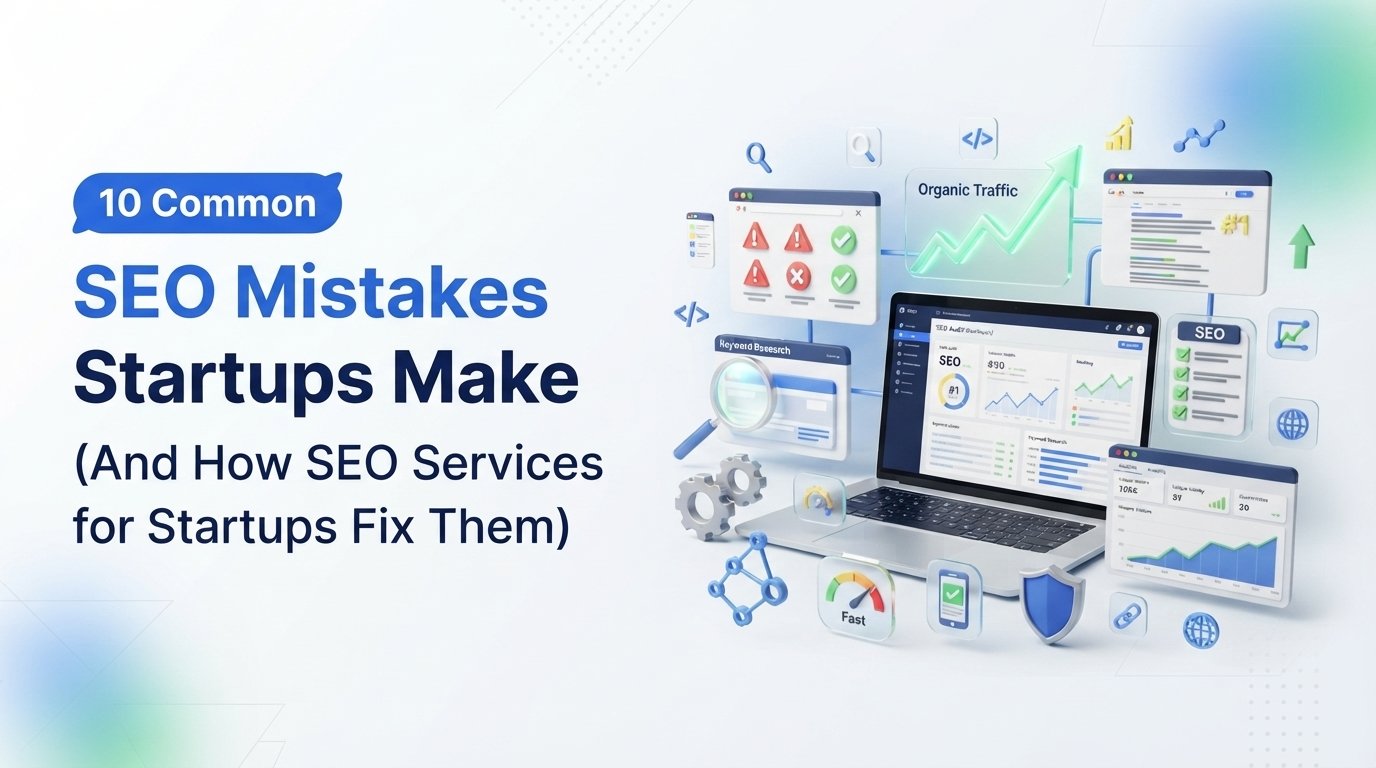
In this guide, you’ll learn the 10 most common SEO mistakes startups make, why they affect your rankings, and how SEO Services for Startups help solve each challenge with practical, proven strategies.
Table of Contents
- Why SEO Is Critical for Startups
- Mistake #1: Skipping Keyword Research
- Mistake #2: Targeting the Wrong Keywords
- Mistake #3: Ignoring Search Intent
- Mistake #4: Weak On-Page SEO
- Mistake #5: Slow Website Speed
- Mistake #6: Poor Mobile Optimization
- Mistake #7: Publishing Thin or Duplicate Content
- Mistake #8: Weak Internal Linking
- Mistake #9: Ignoring Technical SEO
- Mistake #10: Not Tracking SEO Performance
- Startup SEO Checklist
- Frequently Asked Questions
- Final Thoughts
Why SEO Is Critical for Startups
Every day, millions of people search Google to find products, services, and solutions. If your startup doesn’t appear in those search results, you’re missing potential customers who are actively looking for what you offer.
Unlike paid advertising, SEO focuses on earning long-term visibility. A well-optimized website continues attracting visitors even when you’re not spending money on ads.
Professional SEO Services for Startups help businesses:
- Improve Google rankings
- Increase organic traffic
- Generate qualified leads
- Build trust and authority
- Improve website performance
- Reduce customer acquisition costs
However, these results are only possible when common SEO mistakes are avoided.
Let’s look at the biggest ones.
Mistake #1: Skipping Keyword Research
Keyword research is the foundation of every successful SEO strategy.
Unfortunately, many startups create websites based on assumptions rather than understanding what their audience is actually searching for.
For example, imagine a startup offering website development services.
Instead of targeting phrases like:
- website development company
- website design services
- web development agency
they create pages with generic headings like:
“Our Amazing Digital Solutions.”
Although this sounds appealing, almost nobody searches Google using those words.
As a result, the page struggles to rank.
Why This Hurts Your Rankings
Without keyword research:
- Google struggles to understand your page.
- You attract irrelevant traffic.
- Important pages remain invisible.
- Blog topics don’t match user demand.
- Competitors outrank you.
How SEO Services for Startups Fix This
Professional SEO Services for Startups begin with comprehensive keyword research.
SEO experts identify:
- High-volume keywords
- Low-competition opportunities
- Commercial keywords
- Informational keywords
- Local search terms
- Long-tail keywords
Instead of guessing what customers search for, your content is built around real search demand.
Best Practices
 Use one primary keyword per page.
Add related keywords naturally.
Understand search intent before creating content.
Update keyword research regularly.
Strong keyword research provides a roadmap for every future blog, landing page, and service page on your website.
Mistake #2: Targeting the Wrong Keywords
Even startups that perform keyword research often make another mistake—they target keywords that are either too competitive or unrelated to their business goals.
For example, a brand-new startup trying to rank for a broad keyword like:
“Digital Marketing”
will compete against websites that have been building authority for years.
This makes ranking extremely difficult.
Instead, startups should focus on more specific search terms that better match user intent.
Examples include:
- affordable SEO services for startups
- SEO agency for SaaS startups
- local SEO for healthcare startups
- website SEO audit for startups
These keywords may have lower search volume, but they often attract visitors who are much closer to making a purchase.
Signs You’re Targeting the Wrong Keywords
- High impressions but very few clicks
- Traffic that doesn’t convert
- High bounce rates
- Low rankings after several months
- Visitors leaving quickly
How SEO Services for Startups Solve This
Professional SEO specialists analyze:
- Keyword competition
- Search intent
- Monthly search volume
- Ranking difficulty
- Conversion potential
This helps startups focus on keywords that deliver qualified traffic instead of vanity metrics.
A balanced keyword strategy improves both rankings and lead generation.
Mistake #3: Ignoring Search Intent
One of the biggest reasons startup websites fail to rank is because they create content that doesn’t answer the user’s question.
Google’s primary goal is to provide the most helpful result for every search.
If someone searches:
“How much do SEO services cost?”
they expect pricing information.
If your article only explains what SEO is without discussing costs, visitors will leave—and Google notices this behavior.
The Four Types of Search Intent
Informational
The user wants to learn something.
Example:
“What is SEO?”
Navigational
The user is searching for a specific website or brand.
Example:
“Gowenza SEO Services”
Commercial Investigation
The user is comparing options.
Example:
“Best SEO agency for startups”
Transactional
The user is ready to take action.
Example:
“Hire SEO services for startups”
Why Ignoring Search Intent Is a Problem
Content that doesn’t satisfy user intent often results in:
- Lower rankings
- Higher bounce rates
- Less engagement
- Poor conversion rates
- Missed business opportunities
How SEO Services for Startups Improve Search Intent
Experienced SEO professionals map content to each stage of the customer journey.
They create:
- Educational blogs
- Buying guides
- Service pages
- FAQs
- Comparison articles
- Case studies
This ensures every page serves a clear purpose and provides the information users expect.
When your content matches search intent, visitors stay longer, interact more, and are more likely to become customers.
Key Takeaways So Far
Avoiding these first three mistakes can significantly improve your startup’s visibility on Google.
So far, we’ve covered how SEO Services for Startups help businesses:
- Conduct effective keyword research
- Target realistic, high-converting keywords
- Align content with user search intent
- Build a stronger SEO foundation
- Attract qualified organic traffic
These steps form the basis of every successful SEO strategy and make it easier for startups to compete in search results.
Mistake #4: Weak On-Page SEO
One of the most common reasons startup websites struggle to rank is poor on-page optimization. Many businesses publish excellent content but fail to optimize the elements that help search engines understand what each page is about.
On-page SEO includes everything you can optimize directly on your website, from page titles and headings to images and internal links.
Without proper optimization, even high-quality content may never reach its full ranking potential.
Professional SEO Services for Startups focus on optimizing every important on-page element so search engines can accurately index and rank your content.
Common On-Page SEO Mistakes
Many startup websites have issues like:
- Missing or duplicate title tags
- Weak meta descriptions
- Multiple H1 tags on one page
- Poor heading hierarchy
- Keyword stuffing
- Missing image alt text
- Very short content
- No internal links
- Broken links
- Unoptimized URLs
Each of these issues makes it harder for Google to understand your page and can reduce your chances of ranking well.
Example
Instead of using a title like:
Home
Use something descriptive such as:
Affordable SEO Services for Startups | Grow Your Business with Gowenza
The second title tells both users and search engines exactly what the page offers.
How SEO Services for Startups Fix This
Professional SEO specialists optimize:
- SEO title tags
- Meta descriptions
- H1, H2, and H3 headings
- Keyword placement
- URL structure
- Image optimization
- Internal linking
- External references
- Schema markup
Every page is optimized around a clear topic while maintaining a natural reading experience.
On-Page SEO Checklist
| Element | Why It Matters |
|---|---|
| SEO Title | Helps Google understand the page |
| Meta Description | Improves click-through rate |
| Headings | Organizes content for readers and search engines |
| Internal Links | Passes authority across pages |
| Image Alt Text | Improves accessibility and image SEO |
| URL Structure | Makes pages easier to crawl |
| Keyword Placement | Reinforces page relevance |
Good on-page SEO improves both rankings and user experience.
Mistake #5: Slow Website Speed
Website speed directly affects user satisfaction, conversions, and search rankings.
Modern users expect websites to load almost instantly. If a page takes several seconds to load, many visitors leave before they even see the content.
Google considers page speed an important ranking factor because slow websites create a poor user experience.
For startups, every lost visitor represents a missed opportunity.
This is why SEO Services for Startups often include website performance optimization as a core part of the strategy.
What Causes Slow Websites?
Common reasons include:
- Large image files
- Poor-quality hosting
- Too many plugins
- Unoptimized code
- Excessive JavaScript
- Heavy animations
- Multiple redirects
- No browser caching
Even visually attractive websites can perform poorly if these issues aren’t addressed.
Why Speed Matters
A faster website can lead to:
- Lower bounce rates
- Higher engagement
- Better search rankings
- More completed inquiries
- Improved user satisfaction
Visitors are far more likely to stay on a website that responds quickly.
How SEO Services for Startups Improve Website Speed
SEO professionals typically:
- Compress images
- Enable browser caching
- Minify CSS and JavaScript files
- Optimize server response time
- Remove unnecessary plugins
- Improve Core Web Vitals
- Use modern image formats
- Reduce page size
These technical improvements help websites load faster across desktops, tablets, and smartphones.
Website Speed Comparison
| Slow Website | Optimized Website |
|---|---|
| High bounce rate | Lower bounce rate |
| Frustrated visitors | Better user experience |
| Lower rankings | Improved rankings |
| Fewer conversions | Higher conversion potential |
| Poor mobile performance | Faster mobile browsing |
Improving speed benefits both SEO and customer satisfaction.
Mistake #6: Poor Mobile Optimization
More than half of all web searches now happen on mobile devices.
If your website doesn’t perform well on smartphones, you’re potentially losing a significant portion of your audience.
Google uses mobile-first indexing, meaning it primarily evaluates the mobile version of your website when determining search rankings.
Unfortunately, many startup websites are still designed mainly for desktop users.
Professional SEO Services for Startups ensure websites provide an excellent experience across all screen sizes.
Signs Your Website Isn’t Mobile Friendly
- Text is difficult to read
- Buttons are too small
- Images don’t resize properly
- Navigation is confusing
- Pages load slowly on mobile
- Forms are difficult to complete
- Users need to zoom in
These issues often lead visitors to leave the website without taking action.
Mobile SEO Best Practices
A mobile-friendly website should include:
- Responsive design
- Fast loading pages
- Readable font sizes
- Touch-friendly buttons
- Simple navigation
- Optimized images
- Easy-to-use contact forms
The goal is to make browsing effortless regardless of the device being used.
How SEO Services for Startups Solve Mobile Issues
SEO professionals test websites on multiple devices and optimize:
- Mobile responsiveness
- Layout consistency
- Navigation
- Touch interactions
- Loading speed
- Mobile usability
- Core Web Vitals
By improving mobile performance, startups create a better experience for visitors while increasing their chances of ranking higher in Google search results.
Why These Three Mistakes Matter
Weak on-page SEO, slow website speed, and poor mobile optimization often work together to reduce a website’s overall performance.
Even if your content is excellent, visitors may never read it if your pages load slowly or are difficult to use on mobile devices.
Investing in SEO Services for Startups helps address these technical and on-page issues before they affect rankings, user experience, and lead generation.
Quick Action Checklist
Before publishing any page, ask yourself:
- Is the SEO title optimized?
- Does the page have a compelling meta description?
- Are headings structured correctly?
- Is the primary keyword used naturally?
- Are images compressed and optimized?
- Is the page mobile-friendly?
- Does it load quickly?
- Have I added relevant internal links?
- Is the content helpful and easy to read?
If you can answer “yes” to each of these questions, your page is already stronger than many startup websites competing online.
Mistake #7: Publishing Thin or Duplicate Content
One of the fastest ways to limit your website’s growth is by publishing content that offers little value. Many startups focus on publishing as many pages as possible instead of creating content that genuinely answers users’ questions.
Google’s ranking systems prioritize content that is helpful, original, comprehensive, and created for people—not just search engines.
Thin content refers to pages with very little useful information, while duplicate content occurs when the same or nearly identical content appears on multiple pages.
For example, creating separate service pages for different cities but using the same text with only the location name changed provides little value to users and can weaken your SEO performance.
Professional SEO Services for Startups focus on creating unique, high-quality content that solves specific problems and matches user intent.
Signs of Thin Content
Your content may be considered thin if it:
- Barely answers the user’s question
- Repeats information without adding value
- Contains excessive keyword repetition
- Has very little original insight
- Exists only to target a keyword
- Offers no practical examples or actionable advice
Visitors quickly recognize low-quality content, and they often leave without exploring the rest of your website.
Why Duplicate Content Is a Problem
Duplicate or near-duplicate pages can:
- Confuse search engines
- Split ranking signals between multiple pages
- Reduce crawl efficiency
- Lower the authority of important pages
- Make it harder for Google to determine which page should rank
This doesn’t always lead to penalties, but it often results in weaker rankings.
How SEO Services for Startups Fix This
Experienced SEO professionals create content strategies that prioritize quality over quantity.
They:
- Perform topic research before writing
- Identify user intent
- Cover topics in depth
- Eliminate duplicate pages
- Refresh outdated content
- Improve readability
- Add relevant examples and visuals
- Optimize content around one primary topic
Instead of publishing dozens of weak articles, startups build a library of valuable resources that continue attracting traffic over time.
Content Comparison
| Thin Content | High-Quality Content |
|---|---|
| Short and generic | Detailed and informative |
| Little original value | Solves real problems |
| Keyword stuffing | Natural keyword usage |
| Few examples | Practical examples and tips |
| Low engagement | Higher engagement and longer sessions |
| Poor rankings | Better ranking potential |
Creating helpful content is one of the most effective long-term SEO strategies.
Mistake #8: Weak Internal Linking
Internal links are one of the simplest yet most overlooked SEO opportunities.
An internal link connects one page of your website to another. These links help search engines understand your site’s structure while guiding visitors toward additional relevant content.
Many startup websites publish blogs without linking them to service pages or related articles. As a result, valuable pages remain isolated and receive little authority.
A well-planned internal linking strategy is a core part of effective SEO Services for Startups because it improves both user experience and search engine crawling.
Why Internal Links Matter
Internal links help:
- Search engines discover new pages
- Distribute page authority across your website
- Keep visitors engaged longer
- Reduce bounce rates
- Guide users toward important conversion pages
For example, if you publish a blog about startup SEO, you should naturally link to:
- Your SEO Services page
- A keyword research guide
- A technical SEO article
- A content marketing blog
- A contact page
These links provide additional value for readers while strengthening your overall website structure.
Common Internal Linking Mistakes
- No links between related articles
- Linking only to the homepage
- Using generic anchor text like “Click Here”
- Orphan pages with no internal links
- Too many unnecessary links on one page
Each of these issues reduces the effectiveness of your website.
How SEO Services for Startups Improve Internal Linking
SEO specialists create logical content clusters that connect related pages.
For example:
SEO Services Page
↓
Keyword Research Guide
↓
On-Page SEO Guide
↓
Technical SEO Guide
↓
Local SEO Guide
↓
Startup SEO Checklist
This structure improves topical authority and makes navigation easier for both users and search engines.
Best Practices
- Use descriptive anchor text.
- Link to relevant pages only.
- Prioritize high-value service pages.
- Update older blogs with links to newer content.
- Build topic clusters around your core services.
Strong internal linking improves rankings while helping visitors discover more of your content.
Mistake #9: Ignoring Technical SEO
Many startups invest heavily in website design but overlook the technical foundation that supports search engine visibility.
Technical SEO ensures your website is easy for search engines to crawl, index, and understand.
Without proper technical optimization, even excellent content may struggle to rank.
Professional SEO Services for Startups include regular technical audits to identify and fix issues that limit performance.
Common Technical SEO Problems
Some of the most common issues include:
- Broken links
- Missing XML sitemap
- Incorrect robots.txt configuration
- Duplicate title tags
- Crawl errors
- Indexing issues
- Redirect chains
- Missing canonical tags
- Poor Core Web Vitals
- HTTPS security problems
Many startups don’t notice these issues because they occur behind the scenes, but search engines do.
Why Technical SEO Matters
Technical optimization helps search engines:
- Crawl pages efficiently
- Index important content
- Understand website structure
- Display pages correctly in search results
- Deliver a better user experience
A technically sound website provides a stronger foundation for every other SEO activity.
How SEO Services for Startups Solve Technical Issues
Professional SEO teams typically:
- Perform comprehensive technical audits
- Fix crawl errors
- Submit XML sitemaps
- Improve Core Web Vitals
- Resolve duplicate content issues
- Optimize website architecture
- Implement structured data
- Improve page indexing
- Monitor Search Console reports
These improvements make it easier for search engines to access and evaluate your website.
Technical SEO Checklist
| Task | Benefit |
|---|---|
| XML Sitemap | Helps search engines discover pages |
| HTTPS | Builds trust and security |
| Canonical Tags | Prevent duplicate content issues |
| Structured Data | Improves search result appearance |
| Core Web Vitals | Enhances user experience |
| Broken Link Fixes | Improves crawl efficiency |
| Mobile Optimization | Supports mobile-first indexing |
| Crawl Error Monitoring | Prevents indexing problems |
Technical SEO isn’t always visible to users, but it plays a crucial role in achieving sustainable rankings.
Key Takeaways
Publishing valuable content, building a strong internal linking structure, and maintaining a technically optimized website are essential for long-term success.
By investing in SEO Services for Startups, businesses can avoid these common mistakes and create a website that performs well for both users and search engines.
Mistake #10: Not Tracking SEO Performance
One of the biggest mistakes startups make is investing time and money into SEO without measuring the results. SEO is not a one-time activity—it requires continuous monitoring, analysis, and improvement.
Without tracking performance, it’s impossible to know:
- Which pages are generating traffic
- Which keywords are improving rankings
- Where visitors are coming from
- Which pages need optimization
- Which content generates leads
- Whether your SEO strategy is producing a positive return on investment
Professional SEO Services for Startups rely on data rather than assumptions. Every optimization is backed by measurable insights that help improve future performance.
Important SEO Metrics Every Startup Should Monitor
Tracking the right metrics allows startups to identify opportunities and fix issues before they affect rankings.
Organic Traffic
Measure how many visitors arrive through search engines.
A steady increase usually indicates that your SEO strategy is working.
Keyword Rankings
Monitor the position of your target keywords.
Improving rankings generally lead to greater visibility and more clicks.
Click-Through Rate (CTR)
CTR measures how often users click your page after seeing it in search results.
Low CTR often means your title or meta description needs improvement.
Bounce Rate
A high bounce rate may indicate:
- Slow website speed
- Poor user experience
- Irrelevant content
- Weak search intent alignment
Conversion Rate
Traffic alone doesn’t grow a business.
Measure how many visitors:
- Submit contact forms
- Request quotations
- Book consultations
- Purchase products
- Subscribe to newsletters
Core Web Vitals
Google also evaluates website performance through Core Web Vitals.
These include:
- Loading performance
- Visual stability
- Responsiveness
Improving these metrics enhances both user experience and search rankings.
How SEO Services for Startups Improve Performance Over Time
SEO is an ongoing process rather than a one-time project.
Professional agencies continually analyze data and make improvements based on real user behavior.
Typical monthly SEO activities include:
- Updating existing content
- Publishing new articles
- Monitoring keyword rankings
- Fixing technical issues
- Improving internal links
- Building quality backlinks
- Optimizing service pages
- Reviewing competitor performance
- Updating metadata
- Tracking conversions
These consistent improvements help startups maintain and improve their rankings over time.
Complete Startup SEO Checklist
Use this checklist to evaluate whether your website follows SEO best practices.
| SEO Task | Complete |
|---|---|
| Keyword research completed |  |
| One primary keyword per page | |
| Search intent matches the content | |
| SEO title optimized | |
| Meta description written | |
| Proper H1, H2, and H3 structure | |
| Images optimized with alt text | |
| Mobile-friendly website | |
| Fast page loading speed | |
| Internal links added | |
| External authoritative links included | |
| XML sitemap submitted | |
| HTTPS enabled | |
| Google Search Console connected | |
| Google Analytics installed | |
| Core Web Vitals optimized | |
| Regular content updates | |
| SEO performance tracked monthly | |
If several items are missing, your website has opportunities for improvement.
Frequently Asked Questions
How long does it take for SEO to work for a startup?
SEO is a long-term strategy. While some improvements can appear within a few weeks, most startups begin seeing meaningful growth in three to six months. Highly competitive industries may require more time, but consistent optimization produces lasting results.
Can startups do SEO without hiring professionals?
Yes, startups can learn the basics of SEO and optimize their websites themselves. However, technical SEO, comprehensive keyword research, content strategy, backlink building, and ongoing analysis often require specialized expertise. Many startups choose SEO Services for Startups to avoid costly mistakes and accelerate growth.
Is SEO better than paid advertising?
SEO and paid advertising serve different purposes.
Paid ads provide immediate visibility but stop generating traffic when the budget ends.
SEO requires patience but creates long-term organic traffic, stronger brand credibility, and lower acquisition costs over time.
Many successful startups use both strategies together.
Which SEO mistake affects rankings the most?
There isn’t one single mistake that has the biggest impact. Poor keyword research, weak content, technical issues, slow website speed, and ignoring user intent can all reduce your visibility. Addressing these areas together creates the strongest SEO foundation.
How often should startups update their SEO strategy?
SEO should be reviewed regularly. Monitoring performance every month and updating content periodically helps maintain rankings, adapt to search engine changes, and meet evolving customer needs.
Final Thoughts
SEO is one of the most valuable long-term investments a startup can make. Unlike marketing channels that require continuous spending, a well-executed SEO strategy continues attracting qualified visitors long after the initial work is complete.
The ten mistakes discussed in this guide are common, but they are also avoidable. From skipping keyword research and publishing low-value content to neglecting technical SEO and failing to monitor performance, each issue can limit your website’s ability to grow.
By addressing these challenges early, startups can build a stronger online presence, improve user experience, increase search visibility, and generate more qualified leads.
Investing in SEO Services for Startups allows businesses to focus on growth while experienced professionals manage the technical, strategic, and content-related aspects of search engine optimization. Whether you’re launching a new company or looking to scale an existing business, a consistent SEO strategy creates a solid foundation for sustainable success.
Grow Your Startup with Gowenza
If your startup is struggling to attract organic traffic or rank higher on Google, Gowenza can help. Our SEO Services for Startups are designed to improve search visibility through in-depth keyword research, technical SEO, on-page optimization, content strategy, local SEO, and ongoing performance monitoring. We create customized SEO strategies that align with your business goals, helping you attract qualified leads and build long-term online authority. Whether you’re starting from scratch or improving an existing website, our team is committed to delivering measurable, sustainable results.
Helpful External Resources
For readers who want to explore SEO further, these trusted resources provide reliable guidance and best practices:
- Google Search Central SEO Starter Guide – Learn Google’s official recommendations for optimizing websites.
- Google Search Console Help Center – Understand how to monitor and improve your website’s presence in Google Search.