SEO Services for Startups: 12 Content Marketing Mistakes That Hurt Rankings
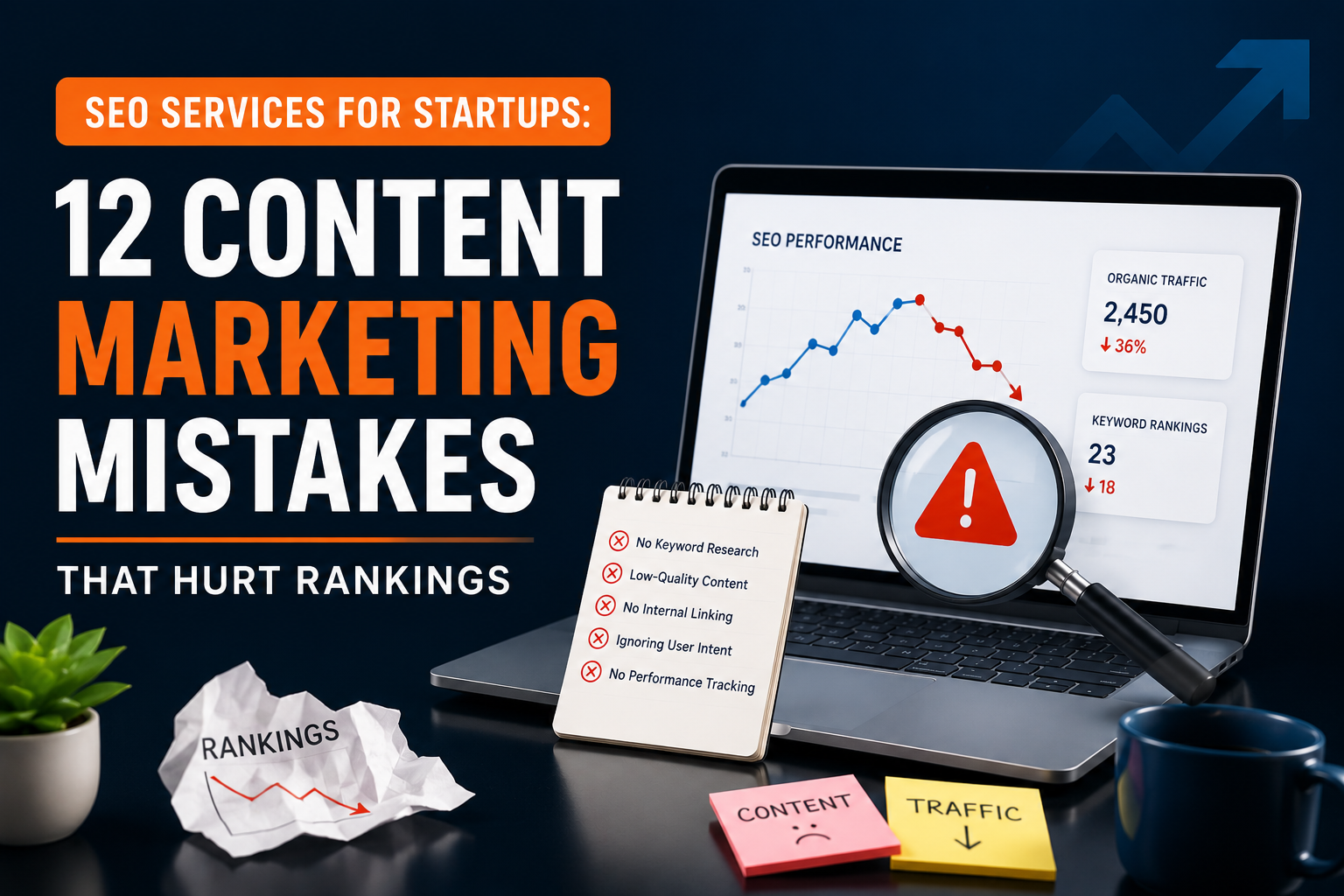
SEO Services for Startups: 12 Content Marketing Mistakes That Hurt Rankings
Content marketing is one of the most powerful ways for startups to attract organic traffic, build authority, and generate qualified leads. However, simply publishing blog posts isn’t enough to achieve high search engine rankings. Many startups invest significant time creating content only to discover that it receives little traffic, few backlinks, and almost no conversions.
The reason is simple: content without a strategy rarely succeeds.
Google’s search algorithms have evolved dramatically over the past few years. Today, search engines prioritize content that is genuinely helpful, trustworthy, relevant, and written to satisfy user intent. Thin articles, keyword stuffing, duplicate content, and poorly optimized pages no longer perform well. Instead, businesses that consistently publish valuable, well-structured, and user-focused content earn better rankings and long-term organic growth.
For startups, content marketing is particularly important because it provides a cost-effective way to compete with larger brands. Unlike paid advertising, quality content continues attracting visitors long after it’s published, making it one of the highest-return digital marketing investments.
Professional SEO Services for Startups combine content strategy, keyword research, on-page optimization, technical SEO, and performance tracking to ensure every article contributes to measurable business growth. Rather than creating content randomly, experienced SEO professionals develop structured content plans that build topical authority and support your startup’s long-term objectives.
In this guide, you’ll learn the 12 most common content marketing mistakes that prevent startups from ranking well on Google—and, more importantly, how to avoid them.
Table of Contents
- Introduction
- Why Content Marketing Matters for SEO
- Mistake #1: Publishing Content Without Keyword Research
- Mistake #2: Writing for Search Engines Instead of People
- Mistake #3: Ignoring Search Intent
- Mistake #4: Creating Thin or Low-Value Content
- Mistake #5: Publishing Content Inconsistently
- Mistake #6: Ignoring On-Page SEO
- Mistake #7: Poor Internal Linking
- Mistake #8: Forgetting to Update Existing Content
- Mistake #9: Publishing Duplicate or Similar Content
- Mistake #10: Writing Weak Headlines and Meta Descriptions
- Mistake #11: Ignoring Content Performance
- Mistake #12: Not Including a Clear Call-to-Action (CTA)
- Content Marketing Best Practices for Startups
- Content Marketing Checklist
- Frequently Asked Questions (FAQs)
- Final Thoughts
- Grow Your Startup with Gowenza
- Helpful External Resources
- Conclusion
Why Content Marketing Matters for SEO
Content is the foundation of every successful SEO strategy.
Every page you publish creates another opportunity to rank for valuable keywords, answer customer questions, and attract potential buyers.
Effective content marketing helps startups:
- Increase organic traffic
- Build topical authority
- Generate qualified leads
- Improve brand awareness
- Earn high-quality backlinks
- Support sales teams
- Reduce advertising costs
- Build customer trust
Professional SEO Services for Startups don’t just create blog posts—they develop comprehensive content strategies that align with business goals and customer needs.
Without a structured content strategy, even excellent products and services can remain invisible in search results.
Mistake #1: Publishing Content Without Keyword Research
One of the biggest mistakes startups make is creating content based solely on assumptions.
Many founders write about topics they find interesting instead of researching what their audience is actually searching for.
As a result, they publish articles that receive little or no organic traffic.
Why This Hurts Rankings
Without keyword research:
- Google struggles to understand your page’s relevance.
- Your content may target phrases nobody searches for.
- You miss valuable ranking opportunities.
- Competitors capture more organic traffic.
Before writing any article:
- Identify one primary keyword.
- Find supporting secondary keywords.
- Research long-tail keyword variations.
- Analyze competitor content.
- Understand search intent.
For example:
Primary keyword:
SEO Services for Startups
Supporting keywords:
- Startup SEO
- Content marketing
- Organic traffic
- Keyword research
- Search rankings
Professional SEO Services for Startups always begin content planning with detailed keyword research instead of guessing what customers want.
Mistake #2: Writing for Search Engines Instead of People
Some businesses focus so heavily on keywords that they forget real people are reading the content.
This often leads to:
- Awkward sentences
- Keyword stuffing
- Poor readability
- Low engagement
Google increasingly rewards content that provides an excellent user experience.
If readers quickly leave your page because the content feels unnatural, rankings often decline over time.
How to Fix It
Write for people first.
Then optimise naturally.
Good content should:
- Answer questions clearly.
- Use conversational language.
- Provide practical advice.
- Include examples.
- Be easy to scan.
Professional SEO Services for Startups balance SEO best practices with engaging writing that keeps visitors on the page.
Mistake #3: Ignoring Search Intent
Even perfectly optimized content may fail if it doesn’t satisfy user intent.
Search intent explains why someone performs a search.
Consider these examples:
“What is Local SEO?”
The user wants information.
“Best SEO Services for Startups”
The user is comparing providers.
“Hire SEO agency”
The user is ready to purchase.
Writing an informational article for a transactional keyword usually produces poor results.
Types of Search Intent
- Informational
- Navigational
- Commercial
- Transactional
Each requires different content.
How to Fix It
Before writing:
- Examine the top-ranking pages.
- Identify the searcher’s goal.
- Match your content to that intent.
- Deliver the information users expect.
Professional SEO Services for Startups carefully analyze search intent before developing content strategies, ensuring each article aligns with what potential customers are actually looking for.
Mistake #4: Creating Thin or Low-Value Content
One of the fastest ways to hurt your SEO performance is publishing content that provides little value to readers. Many startups focus on publishing as many articles as possible instead of creating content that genuinely solves problems.
Thin content usually contains very little original information, lacks depth, and often repeats what hundreds of other websites have already published.
Google’s Helpful Content System is designed to reward websites that provide comprehensive, trustworthy, and useful information. Pages with shallow or repetitive content struggle to rank because they fail to satisfy user intent.
Professional SEO Services for Startups focus on producing high-quality, in-depth content that answers readers’ questions completely rather than publishing a large number of low-quality articles.
Signs of Thin ContentYour content may be considered thin if it:
- Contains very little useful information.
- Doesn’t answer the user’s question completely.
- Repeats the same ideas throughout the article.
- Includes excessive filler paragraphs.
- Is written only to target keywords.
- Offers no unique insights or examples.
Readers should leave your page feeling that they have learned something valuable.
How to Fix It
Create content that demonstrates expertise by including:
- Step-by-step instructions
- Practical examples
- Industry insights
- Statistics from reliable sources
- Actionable checklists
- Frequently asked questions
- Visuals where appropriate
Instead of writing a 500-word article that barely covers a topic, publish a comprehensive guide that becomes a valuable resource for your audience.
Professional SEO Services for Startups help businesses produce evergreen content that continues attracting organic traffic for months or even years after publication.
Mistake #5: Publishing Content Inconsistently
Consistency is one of the most overlooked aspects of content marketing.
Many startups publish several blog posts in one month and then stop creating content for weeks or even months. This irregular approach makes it difficult to build topical authority and maintain audience engagement.
Although Google doesn’t reward websites simply for publishing frequently, consistent updates help demonstrate that your website is active and continuously providing fresh information.
Professional SEO Services for Startups develop content calendars that maintain a steady publishing schedule without sacrificing quality.
Why Consistency Matters
Regular publishing helps you:
- Build topical authority.
- Increase indexed pages.
- Target more keywords.
- Keep visitors returning.
- Strengthen internal linking.
- Improve overall website freshness.
Consistency also allows search engines to crawl your website more frequently.
Create a Content Calendar
Instead of publishing randomly, plan your content several weeks or months in advance.
For example:
| Week | Content Type |
|---|---|
| Week 1 | Comprehensive guide |
| Week 2 | Industry tips |
| Week 3 | Case study |
| Week 4 | Frequently asked questions |
A structured calendar ensures that every article supports your overall SEO strategy.
Focus on Quality Over Quantity
Publishing two exceptional articles each month is generally more effective than publishing ten poorly researched posts.
Every article should contribute meaningful value while supporting your broader content strategy.
Professional SEO Services for Startups prioritise consistency, quality, and strategic planning over sheer publishing volume.
Mistake #6: Ignoring On-Page SEO
Even the best content may struggle to rank if it isn’t properly optimised.
On-page SEO helps search engines understand your content while improving the experience for visitors.
Many startups spend hours writing articles but forget to optimise essential elements such as titles, headings, URLs, images, and internal links.
Professional SEO Services for Startups ensure every page follows on-page SEO best practices before publication.
Optimise Your SEO Title
Your title should:
- Include the primary keyword.
- Clearly describe the page.
- Encourage users to click.
- Stay within recommended length.
Example:
SEO Services for Startups: 12 Content Marketing Mistakes That Hurt Rankings
This title clearly communicates the topic while naturally including the target keyword.
Write an Effective Meta Description
Although meta descriptions aren’t a direct ranking factor, they significantly influence click-through rates.
A good meta description should:
- Summarise the article.
- Include the primary keyword.
- Encourage users to click.
- Stay around 150–160 characters.
Structure Your Headings
Use headings logically.
Example:
- H1: Article title
- H2: Main sections
- H3: Supporting points
Clear headings improve readability and help search engines understand your content.
Optimise Images
Every image should include:
- Descriptive file names.
- Alt text.
- Appropriate dimensions.
- Compressed file sizes.
Optimised images improve accessibility while contributing to image search visibility.
Improve URL Structure
Use short, descriptive URLs.
Example:
seo-services-for-startups-content-marketing-mistakes
Avoid unnecessary numbers, dates, or random characters.
Add Internal Links
Every article should connect naturally to related pages.
For example, this article can link to:
- SEO Services for Startups: Keyword Research Guide
- SEO Services for Startups: Local SEO Guide
- SEO Services for Startups: Technical SEO Explained
- SEO Services for Startups: SEO Content Strategy
- SEO Services for Startups: Google Business Profile Optimization
Internal linking strengthens topical authority while helping readers discover additional valuable resources.
Professional SEO Services for Startups optimise every on-page element to maximise search visibility and user engagement.
Mistake #7: Poor Internal Linking
Internal linking is one of the simplest yet most effective SEO techniques, but it’s often overlooked by startups. Many businesses publish blog posts without connecting them to related pages on their website. As a result, search engines struggle to understand the relationship between pages, and visitors miss opportunities to explore more of your content.
Professional SEO Services for Startups use strategic internal linking to strengthen topical authority, improve crawlability, and guide users toward conversion-focused pages.
Why Internal Links Matter
Internal links help:
- Improve website navigation.
- Distribute page authority across your website.
- Help Google discover new pages.
- Increase average session duration.
- Reduce bounce rates.
- Support keyword relevance.
- Guide visitors to important service pages.
For example, if someone is reading a blog about keyword research, you can naturally link them to articles about Local SEO, Technical SEO, or your SEO Services page.
Best Practices for Internal Linking
- Link to relevant pages naturally.
- Use descriptive anchor text.
- Connect pillar pages with supporting blogs.
- Update older blogs with links to newer articles.
- Avoid excessive linking in a single paragraph.
A well-planned internal linking strategy improves both SEO performance and user experience.
Example
If this article discusses content marketing, you could link to:
- SEO Services for Startups: SEO Content Strategy
- SEO Services for Startups: Local SEO Guide
- SEO Services for Startups: Technical SEO Explained
- SEO Services for Startups: Google Business Profile Optimization
- SEO Services for Startups: Common SEO Myths
These connections help Google recognise your expertise across the broader topic of startup SEO.
Professional SEO Services for Startups build content clusters where every article supports related pages, increasing the overall authority of the website.
Mistake #8: Forgetting to Update Existing Content
Publishing new content is important, but maintaining your existing content is equally valuable.
Many startups write a blog once and never revisit it. Over time, statistics become outdated, links break, screenshots change, and competitors publish more comprehensive resources.
Google prefers content that remains accurate, relevant, and helpful.
Professional SEO Services for Startups include regular content audits to identify opportunities for updating existing pages rather than constantly creating new ones.
Why Updating Content Matters
Refreshing content can:
- Improve search rankings.
- Increase organic traffic.
- Enhance user experience.
- Keep information accurate.
- Strengthen internal linking.
- Improve click-through rates.
Updating a high-performing article is often quicker and more effective than creating a completely new one.
What Should You Update?
Review your content every few months and update:
- Statistics
- Industry trends
- Screenshots
- Examples
- FAQs
- Internal links
- External references
- Calls-to-action
- Meta titles and descriptions
Even small improvements can make a noticeable difference in rankings.
Perform a Content Audit
Create a spreadsheet listing all your blog posts and review:
- Organic traffic
- Keyword rankings
- Last updated date
- Conversion rate
- Bounce rate
Prioritise pages that already receive traffic but have started declining in performance.
Professional SEO Services for Startups regularly refresh high-value content to maintain strong search visibility over the long term.
Mistake #9: Publishing Duplicate or Similar Content
Duplicate content doesn’t always lead to penalties, but it can confuse search engines and reduce your website’s ability to rank effectively.
This often happens when startups create multiple articles covering nearly identical topics without adding unique value.
For example:
- “SEO Tips for Startups”
- “SEO Advice for New Businesses”
- “Startup SEO Guide”
If these articles contain almost the same information, Google may struggle to determine which version should rank.
Problems Caused by Duplicate Content
Duplicate or highly similar content can:
- Divide ranking signals.
- Reduce page authority.
- Cause keyword cannibalisation.
- Confuse search engines.
- Create a poor user experience.
Instead of publishing multiple similar articles, create one comprehensive guide that fully addresses the topic.
How to Avoid Duplicate Content
Consolidate Similar Articles
If you already have multiple articles covering the same subject, merge them into one stronger resource.
Target Different Search Intent
Rather than repeating information, create articles with unique objectives.
For example:
- Beginner’s Guide to SEO
- Technical SEO Checklist
- Local SEO Guide
- SEO Audit Guide
- Keyword Research Tutorial
Each article serves a different purpose while supporting your overall content strategy.
Build Topic Clusters
Rather than writing several nearly identical posts, organise your content into pillar pages and supporting articles.
Example:
Pillar Page
- SEO Services for Startups
Supporting Content
- Local SEO
- Technical SEO
- Keyword Research
- Content Marketing
- Google Business Profile
- Link Building
- SEO Reporting
This structure improves topical authority while avoiding unnecessary duplication.
Professional SEO Services for Startups use content mapping to ensure every article has a unique purpose and targets a specific search intent.
Quick Content Audit Checklist
Before publishing a new article, ask yourself:
- ✅ Does this topic already exist on my website?
- ✅ Does this article provide unique value?
- ✅ Is it targeting a different keyword?
- ✅ Does it satisfy a different search intent?
- ✅ Have I linked it to related articles?
- ✅ Does it strengthen my topic cluster?
If the answer is “yes” to these questions, your content is much more likely to support your overall SEO strategy rather than compete with existing pages.
Mistake #10: Writing Weak Headlines and Meta Descriptions
Your headline and meta description are the first things users see in Google Search results. Even if your content ranks on the first page, a weak title or uninteresting meta description can significantly reduce your click-through rate (CTR).
Google wants to display results that users are most likely to click. If your page receives fewer clicks than competing pages, your rankings may gradually decline over time.
Professional SEO Services for Startups optimize every title and meta description to improve visibility and encourage more users to visit your website.
Common Headline Mistakes
Many startups use titles that are:
- Too generic
- Too long
- Missing the target keyword
- Not focused on user intent
- Uninteresting or vague
For example:
❌ Content Marketing Tips
This title provides very little information.
A stronger alternative is:
✅ SEO Services for Startups: 12 Content Marketing Mistakes That Hurt Rankings (2026 Guide)
It clearly explains the topic, includes the primary keyword, and gives readers a reason to click.
How to Write Better Headlines
A strong SEO title should:
- Include the primary keyword near the beginning.
- Clearly explain what the article covers.
- Create curiosity without using misleading clickbait.
- Stay within approximately 60 characters where practical.
- Include numbers when appropriate.
Examples:
- 10 Proven Strategies
- Complete Guide
- Step-by-Step Tutorial
- Ultimate Checklist
- Common Mistakes to Avoid
These formats generally attract more clicks because they communicate clear value.
Optimize Your Meta Description
Your meta description should summarize the article while encouraging users to click.
A good meta description:
- Includes the primary keyword naturally.
- Highlights the article’s value.
- Stays around 150–160 characters.
- Encourages action.
Example:
“Learn the 12 biggest content marketing mistakes that prevent startups from ranking on Google and discover practical strategies to improve your SEO performance.”
Professional SEO Services for Startups treat titles and meta descriptions as important conversion elements, not afterthoughts.
Mistake #11: Ignoring Content Performance
Publishing content without measuring results is like launching a marketing campaign without tracking sales.
Many startups never check how their articles perform after publication.
Instead, successful businesses continuously analyze their content and improve it based on real data.
Professional SEO Services for Startups rely on analytics to identify opportunities, measure ROI, and refine content strategies.
Important Metrics to Track
Organic Traffic
Measure how many visitors arrive from search engines.
Growing traffic usually indicates that your SEO strategy is working.
Keyword Rankings
Track your target keywords over time.
Don’t focus on only one keyword.
Monitor:
- Primary keyword
- Secondary keywords
- Long-tail keywords
Click-Through Rate (CTR)
A low CTR often means:
- Weak SEO title
- Poor meta description
- Unclear search intent
Improving these elements can significantly increase traffic without changing rankings.
Average Time on Page
Longer engagement often indicates valuable content.
If visitors leave quickly, review:
- Content quality
- Readability
- Page speed
- Search intent alignment
Conversion Rate
Traffic is valuable only when it contributes to business growth.
Track:
- Contact form submissions
- Quote requests
- Phone calls
- Newsletter sign-ups
- Product purchases
Professional SEO Services for Startups focus on generating qualified leads rather than simply increasing website visits.
Recommended SEO Tools
Use tools such as:
- Google Search Console
- Google Analytics 4
- Google Keyword Planner
- Google PageSpeed Insights
- Ahrefs
- SEMrush
Review these reports monthly to identify opportunities for improvement.
Mistake #12: Not Including a Clear Call-to-Action (CTA)
Many startups publish informative articles but fail to tell readers what to do next.
Even if someone finds your content helpful, they may leave your website without taking any action.
Every blog should guide readers toward the next step.
Professional SEO Services for Startups ensure each article includes relevant calls-to-action that support business objectives.
Effective CTA Examples
Depending on your goals, encourage readers to:
- Request a free consultation.
- Contact your team.
- Download a resource.
- Explore your services.
- Read related articles.
- Subscribe to your newsletter.
- Book a demo.
The CTA should feel like a natural continuation of the article rather than an aggressive sales pitch.
Place CTAs Strategically
Consider adding CTAs:
- After major sections.
- Near the conclusion.
- In the sidebar (if applicable).
- Within relevant content where appropriate.
Clear calls-to-action help convert readers into leads.
Content Marketing Checklist
Use this checklist before publishing every article.
| Task | Complete |
|---|---|
| Primary keyword researched | ✅ |
| Search intent identified | ✅ |
| High-quality content created | ✅ |
| Helpful examples included | ✅ |
| SEO title optimized | ✅ |
| Meta description written | ✅ |
| Proper heading structure used | ✅ |
| Images optimized | ✅ |
| Internal links added | ✅ |
| External authoritative links added | ✅ |
| Content proofread | ✅ |
| CTA included | ✅ |
| Performance tracking configured | ✅ |
Following this checklist ensures your content contributes to long-term SEO success.
Frequently Asked Questions
Why isn’t my content ranking on Google?
Common reasons include poor keyword research, weak search intent alignment, thin content, lack of backlinks, poor on-page SEO, or technical website issues.
How often should startups publish blog content?
Quality matters more than quantity. Publishing 2–4 high-quality articles each month consistently is generally more effective than publishing many low-quality posts.
Should I update old blog posts?
Yes. Refreshing existing content with updated information, improved internal links, and current examples often improves rankings faster than creating new articles.
Is keyword stuffing good for SEO?
No. Overusing keywords makes content difficult to read and can negatively affect rankings. Use keywords naturally throughout your content.
Can content marketing generate leads?
Absolutely. Well-optimized content attracts qualified visitors, builds trust, and guides potential customers toward enquiries, purchases, or consultations.
Final Thoughts
Content marketing is far more than publishing blog posts—it is a long-term strategy for building authority, attracting qualified traffic, and generating sustainable business growth. Avoiding these 12 common content marketing mistakes will help your startup create content that satisfies user intent, strengthens search visibility, and delivers measurable results.
Professional SEO Services for Startups bring together keyword research, content planning, on-page optimization, technical SEO, internal linking, and performance analysis into one cohesive strategy. Instead of producing content that simply fills your blog, you create valuable resources that educate readers, solve problems, and convert visitors into loyal customers.
Grow Your Startup with Gowenza
At Gowenza, we provide data-driven SEO Services for Startups that help businesses build content strategies designed for long-term success. From keyword research and content planning to technical SEO, on-page optimization, and performance tracking, our team creates search-optimized content that improves rankings, increases organic traffic, and generates qualified leads. Whether you’re launching a new startup or scaling an existing business, Gowenza helps you turn content into a powerful growth engine.
- Google Search Central SEO Starter Guide: https://developers.google.com/search/docs/fundamentals/seo-starter-guide
- Google Search Console Help Centre: https://support.google.com/webmasters/
- Google Analytics Help Centre: https://support.google.com/analytics/
- Google PageSpeed Insights: https://pagespeed.web.dev/
- Google Keyword Planner: https://ads.google.com/home/tools/keyword-planner/
Conclusion
High-performing content is built on strategy, not luck. By avoiding these 12 content marketing mistakes, startups can create articles that rank higher, attract targeted visitors, and convert more readers into customers. Every blog should begin with thorough keyword research, satisfy user intent, provide genuine value, and guide readers toward a meaningful next step.
When combined with professional SEO Services for Startups, a consistent, high-quality content marketing strategy becomes one of the most valuable long-term investments your business can make. Over time, it helps establish your startup as an industry authority, strengthens your online presence, and creates a reliable source of organic traffic and qualified leads.