7 Powerful Reasons SEO Services for Startups Matter More Than Paid Ads in 2026
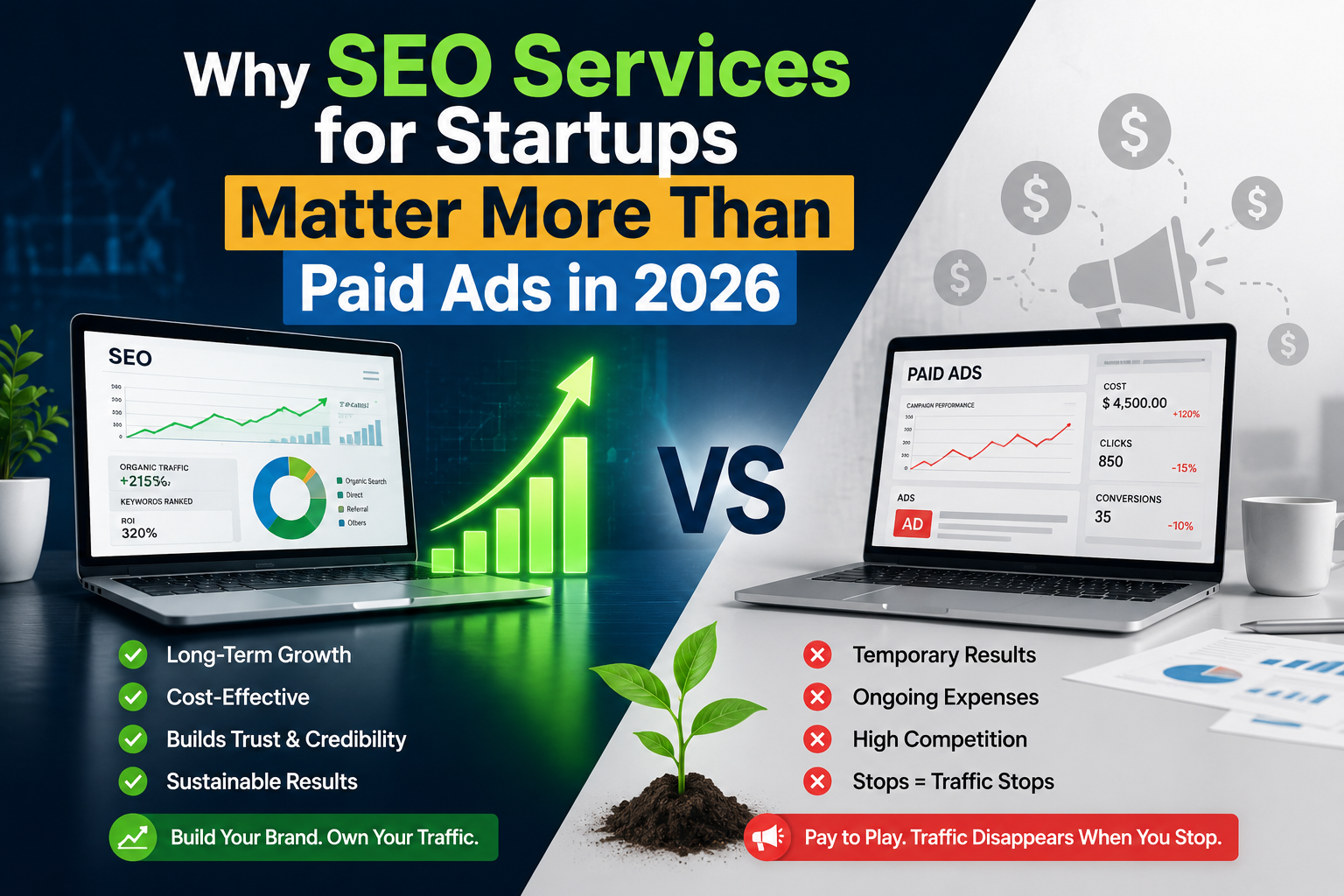
7 Powerful Reasons SEO Services for Startups Matter More Than Paid Ads in 2026
7 Powerful Reasons SEO Services for Startups Matter More Than Paid Ads in 2026
Every startup begins with one common goal—getting customers. Whether you’ve built a SaaS platform, launched an eCommerce store, started a local service business, or introduced an innovative product, success depends on your ability to reach the right audience at the right time.
The biggest challenge isn’t building a great product. It’s making sure people know your business exists.
For years, startups have relied heavily on paid advertising to generate leads quickly. Platforms like Google Ads, Facebook Ads, Instagram Ads, and LinkedIn Ads promise instant visibility, allowing businesses to appear in front of potential customers within hours of launching a campaign. While this sounds attractive, many founders soon discover a harsh reality: the moment they stop paying for ads, the traffic disappears.
In 2026, startups are becoming more strategic with their marketing budgets. Instead of spending thousands every month on advertisements, many are investing in SEO services for startups to create a long-term growth engine that continues delivering results even when advertising budgets fluctuate.
SEO is no longer just a marketing trend. It has become one of the most reliable ways to build brand authority, generate qualified leads, reduce customer acquisition costs, and create sustainable business growth.
This article explores why SEO has become more valuable than paid advertising for startups, how both strategies compare, and how founders can make smarter marketing decisions in today’s competitive digital landscape.
The Reality of Startup Marketing in 2026
Launching a startup has never been easier.
Launching a successful startup has never been harder.
Every industry is crowded with competitors. Whether you’re offering web development, digital marketing, accounting software, fitness coaching, or online education, dozens—sometimes hundreds—of businesses are competing for the same customers.
At the same time, customer expectations have changed dramatically.
Today’s buyers don’t usually purchase the first product they see. Instead, they research extensively before making a decision. A typical customer journey often looks like this:
-
They search on Google.
-
They read several blog articles.
-
They compare multiple companies.
-
They visit review websites.
-
They explore social media profiles.
-
They return to the companies they trust most.
This means visibility alone isn’t enough.
Your startup also needs credibility.
That’s exactly where SEO provides an advantage.
Instead of interrupting users with advertisements, SEO helps your business appear naturally when people are actively searching for solutions.
Understanding SEO
Search Engine Optimization (SEO) is the process of improving your website so that search engines like Google understand your content and rank it for relevant searches.
Unlike advertisements, SEO doesn’t involve paying for every visitor.
Instead, it focuses on creating valuable content and optimizing your website to earn organic rankings.
Professional SEO services for startups typically include:
-
Keyword research
-
Competitor analysis
-
Technical SEO
-
On-page optimization
-
Content strategy
-
Internal linking
-
Website speed optimization
-
Mobile optimization
-
Local SEO
-
Link building
-
Performance tracking
Each of these elements works together to increase your visibility on search engines.
When implemented correctly, SEO becomes a long-term business asset rather than a recurring marketing expense.
Understanding Paid Advertising
Paid advertising works differently.
Instead of earning visibility organically, businesses pay platforms to display their ads.
Some of the most popular advertising platforms include:
-
Google Ads
-
Facebook Ads
-
Instagram Ads
-
LinkedIn Ads
-
Microsoft Ads
-
YouTube Ads
The biggest benefit of paid advertising is speed.
A startup can launch a campaign today and begin receiving website visitors within hours.
However, every visitor comes at a cost.
Depending on your industry, each click could cost anywhere from a few rupees to several hundred rupees. In competitive industries such as software, finance, legal services, or digital marketing, the cost per click can become very expensive.
More importantly, your visibility exists only while you’re paying.
The moment your advertising budget runs out, your traffic often drops immediately.
For startups with limited budgets, this creates a difficult cycle of continuous spending.
SEO vs Paid Ads: What’s the Fundamental Difference?
Many founders think SEO and paid advertising compete with each other.
In reality, they solve different problems.
Paid ads are designed to buy immediate attention.
SEO is designed to earn long-term visibility.
Imagine opening a retail store.
Paid advertising is similar to renting a billboard every month. As long as you keep paying, people continue seeing your advertisement.
SEO is more like buying land and constructing your own store in a prime location. It requires more effort initially, but once established, people continue finding you without paying rent for every visitor.
This simple difference explains why startups that invest early in SEO often become less dependent on advertising over time.
Why Organic Search Builds More Trust
Trust is one of the biggest factors influencing purchasing decisions.
When users search on Google, they often distinguish between advertisements and organic search results.
Although paid advertisements appear at the top, many users intentionally scroll past them because they perceive organic results as more credible.
This happens because organic rankings cannot simply be purchased.
Websites earn these positions through relevance, quality, authority, and user experience.
When your startup consistently appears on the first page for valuable searches, customers naturally begin associating your business with expertise.
For example, if someone repeatedly finds your helpful articles whenever they search questions related to your industry, they become familiar with your brand before they even contact you.
That familiarity creates confidence.
Confidence leads to conversions.
Paid advertising may generate clicks.
SEO builds relationships.
Why SEO Creates Compounding Growth
One of the most powerful characteristics of SEO is its compounding effect.
Imagine publishing a high-quality article today targeting a keyword your audience searches every month.
Next month, you publish another.
Then another.
After one year, your startup could have dozens of optimized pages attracting visitors simultaneously.
Each article becomes another opportunity for potential customers to discover your business.
Unlike advertising campaigns that disappear when budgets stop, your content continues working around the clock.
A well-optimized guide published today can still generate traffic two or even three years later with periodic updates.
This is why experienced marketers often describe SEO as building a digital asset rather than simply running another marketing campaign.
Why SEO Delivers a Better Return on Investment (ROI)
One of the biggest reasons startups choose SEO over paid advertising is the return on investment (ROI).
Every startup operates with limited resources. Whether you’ve raised funding or are bootstrapping your business, every marketing dollar matters. Spending money on strategies that continue delivering results long after the initial investment is essential for sustainable growth.
Paid advertising delivers short-term ROI. SEO delivers long-term ROI.
Let’s understand why.
Imagine you spend ₹50,000 on Google Ads.
If your average cost per click is ₹100, you’ll receive around 500 visitors. Once your budget is exhausted, those visitors stop coming.
Now imagine investing the same ₹50,000 in SEO.
That investment could include:
- Comprehensive keyword research
- Technical website optimization
- High-quality blog content
- Service page optimization
- Internal linking
- Performance improvements
Instead of generating traffic for only one month, these improvements continue attracting visitors for months or even years.
This is why SEO services for startups are considered an investment rather than an expense.
The value keeps increasing over time.
Customer Acquisition Costs Continue Rising
One challenge many startups underestimate is the rising cost of paid advertising.
As more businesses compete for the same keywords, advertising platforms become more expensive.
For example:
- Digital marketing agencies compete against hundreds of agencies.
- Website development companies compete nationally and internationally.
- SaaS businesses bid on highly competitive keywords.
- E-commerce brands compete with large retailers.
Higher competition means higher advertising costs.
In many industries, customer acquisition costs have doubled over the past few years.
SEO helps reduce this dependency.
Instead of paying for every visitor, your website begins earning visitors organically.
Over time, your average cost per customer decreases significantly.
Organic Traffic Has Higher Purchase Intent
Not every website visitor becomes a customer.
The quality of your traffic matters just as much as the quantity.
Organic visitors often have stronger purchase intent because they’re actively searching for a solution.
Consider these search queries:
- best website development company
- affordable CRM software
- SEO agency for startups
- digital marketing services near me
These users aren’t casually browsing.
They’re looking for businesses that can solve their problem.
When your website ranks for these searches, you’re meeting customers exactly when they need your services.
That’s one reason why SEO services for startups often generate better-quality leads than broad social media advertising campaigns.
Paid Ads Interrupt. SEO Helps.
Think about how people use the internet.
When scrolling Instagram or Facebook, users are watching videos, chatting with friends, or browsing entertainment.
An advertisement interrupts that experience.
Some users click.
Many simply continue scrolling.
Google Search works differently.
Users already have a question.
They’re actively searching for answers.
Instead of interrupting their experience, SEO allows your website to become part of their solution.
This intent-driven behavior usually leads to higher engagement and stronger conversion rates.
SEO Strengthens Your Brand Authority
Successful startups don’t just sell products.
They become trusted brands.
Trust isn’t built overnight.
It develops through consistent visibility and valuable content.
Imagine two companies.
Company A appears only through advertisements.
Company B appears through:
- informative blogs
- helpful guides
- service pages
- comparison articles
- FAQs
- case studies
Which company appears more credible?
Most people naturally trust businesses that educate rather than simply advertise.
Every optimized article becomes another opportunity to demonstrate expertise.
This is why content marketing is a core component of professional SEO services for startups.
SEO vs Paid Ads Comparison
| Factor | SEO | Paid Advertising |
|---|---|---|
| Initial Results | Slow | Immediate |
| Long-Term Traffic | Excellent | Stops when budget ends |
| Cost Per Click | Free | Paid for every click |
| Brand Trust | High | Moderate |
| Long-Term ROI | Excellent | Moderate |
| Sustainability | High | Low |
| Lead Quality | High | Depends on targeting |
| Compounding Growth | Yes | No |
| Best For | Long-term growth | Immediate campaigns |
The best-performing startups don’t necessarily choose one over the other.
They understand when each strategy should be used.
Common Mistakes Startups Make
Many startups fail with SEO—not because SEO doesn’t work, but because they approach it incorrectly.
Here are some of the most common mistakes.
1. Expecting Overnight Results
SEO isn’t a shortcut.
It typically takes several months before rankings improve.
Many founders quit too early, missing the long-term benefits.
Patience and consistency are essential.
2. Ignoring Technical SEO
Even great content won’t rank if your website has technical issues.
Common problems include:
- slow loading speed
- broken links
- poor mobile experience
- missing meta tags
- duplicate content
- crawl errors
Fixing these issues improves both rankings and user experience.
3. Publishing Low-Quality Content
Google rewards content that genuinely helps users.
Publishing short articles filled with keywords no longer works.
Instead, focus on:
- answering real questions
- providing practical advice
- using examples
- keeping information up to date
Quality consistently outperforms quantity.
4. Targeting Extremely Competitive Keywords
A new startup shouldn’t immediately target broad keywords like:
- SEO
- Digital Marketing
- Website Development
Instead, focus on specific long-tail keywords such as:
- SEO services for startups
- affordable SEO agency for startups
- startup website SEO checklist
- local SEO for startup businesses
These keywords are often easier to rank for and attract highly targeted visitors.
5. Not Tracking Performance
SEO without measurement is guesswork.
Every startup should monitor:
- Organic traffic
- Keyword rankings
- Click-through rate (CTR)
- Conversion rate
- Bounce rate
- Time on page
- Lead generation
These insights help refine your strategy and maximize results.
Building an SEO Strategy That Works
A successful startup SEO strategy isn’t about publishing random blogs. It should follow a structured plan.
Start with keyword research to identify what your audience is actually searching for. Next, create service pages optimized around your core offerings. Support those pages with informative blog content that answers common customer questions.
Ensure your website loads quickly, works perfectly on mobile devices, and has a clear internal linking structure so visitors and search engines can easily navigate your content.
Finally, keep improving. SEO is an ongoing process, not a one-time task. Regularly updating older articles, adding fresh insights, and monitoring performance helps maintain and improve rankings over time.
Why the Smartest Startups Use SEO and Paid Ads Together
Throughout this article, we’ve compared SEO and paid advertising, but it’s important to understand that the best marketing strategy isn’t always choosing one over the other. The most successful startups in 2026 combine both approaches strategically.
Think of paid ads as a way to gain immediate visibility. If you’ve just launched your website or introduced a new service, advertising can help you attract your first visitors, test your messaging, and collect valuable customer data.
SEO, on the other hand, is what turns that early momentum into long-term growth. While your ads generate short-term traffic, your SEO efforts build a foundation that continues bringing in visitors long after the advertising campaign ends.
For example, imagine your startup offers website development and digital marketing services. You could run Google Ads targeting “website development company” to generate leads immediately. At the same time, you publish helpful blog posts such as:
- How to Choose the Right Website Development Company
- Website Development Mistakes Startups Should Avoid
- SEO Services for Startups: A Complete Guide
- Local SEO Tips for New Businesses
As these pages begin ranking on Google, you’ll gradually receive organic traffic without paying for every click. Over time, this reduces your dependence on advertising and improves your overall marketing return.
This balanced approach allows startups to enjoy immediate results while building a sustainable source of future leads.
The Future of SEO for Startups in 2026
Search engine optimization has evolved significantly over the past few years. Ranking on Google today is no longer about stuffing keywords into pages or creating hundreds of low-quality backlinks.
Google’s algorithms have become much better at understanding user intent, content quality, and website experience.
In 2026, startups that succeed with SEO focus on creating genuinely helpful content rather than trying to manipulate search rankings.
Some of the biggest SEO trends include:
Helpful, Experience-Based Content
Google increasingly rewards content that demonstrates real expertise and solves users’ problems. Articles should answer questions clearly, provide practical examples, and offer actionable advice instead of repeating information found on dozens of other websites.
User Experience Matters More Than Ever
A slow or confusing website can hurt both your rankings and conversions.
Visitors expect pages to load quickly, work flawlessly on mobile devices, and provide a smooth browsing experience. Improving navigation, reducing page load times, and making important information easy to find all contribute to better SEO performance.
Topical Authority Beats Random Content
Instead of writing about unrelated subjects, startups should focus on building authority around their niche.
For example, if your company provides SEO and website development services, your content should consistently cover topics such as:
- Website design
- Technical SEO
- Local SEO
- Keyword research
- Content marketing
- Google Search Console
- Website performance
- Digital marketing strategies
Publishing related content helps search engines understand your expertise, making it easier for multiple pages to rank.
Search Intent Is More Important Than Keywords Alone
Simply including the keyword SEO services for startups several times isn’t enough.
Your content must answer the exact questions users have when they search for that phrase.
Someone searching for SEO services for startups wants to know:
- Is SEO worth it?
- How much does it cost?
- How long does it take?
- How do I choose the right agency?
- Will it generate leads?
When your article answers these questions comprehensively, it becomes much more valuable to both readers and search engines.
Actionable SEO Tips for Startup Founders
If you’re just getting started, here are practical steps you can implement today:
1. Build a Fast Website
Website speed affects both rankings and user experience.
Compress images, remove unnecessary plugins, enable browser caching, and choose reliable hosting.
2. Target Long-Tail Keywords
Instead of trying to rank for extremely competitive terms, focus on more specific phrases that reflect user intent.
Examples include:
- affordable SEO services for startups
- startup website optimization
- local SEO for startup businesses
- SEO checklist for new websites
These keywords often have lower competition and attract highly relevant visitors.
3. Publish Helpful Content Consistently
Aim to publish at least two high-quality articles every month.
Each article should answer a real question your potential customers are searching for.
Consistency is more important than publishing large volumes of content.
4. Optimize Every Service Page
Many startups focus only on blogging.
Don’t overlook your core service pages.
Clearly explain:
- what you offer
- who it’s for
- how your process works
- why customers should choose you
- frequently asked questions
- clear calls to action
These pages are often where conversions happen.
5. Track Your Results
Use tools such as Google Search Console and Google Analytics to monitor:
- Organic traffic
- Keyword rankings
- Page performance
- User engagement
- Conversions
- Click-through rates
Regular analysis helps you understand what’s working and where improvements are needed.
Why SEO Is a Competitive Advantage for Startups
Large companies often have bigger advertising budgets, making it difficult for startups to compete through paid campaigns alone.
SEO levels the playing field.
A startup with excellent content, a well-optimized website, and a strong understanding of its audience can outrank much larger competitors for targeted search terms.
Instead of trying to outspend established businesses, startups can outperform them by being more helpful, more focused, and more relevant.
That’s one of the greatest strengths of SEO services for startups—they reward quality, consistency, and relevance rather than simply the size of your marketing budget.
Final Thoughts
Building a successful startup requires more than a great product or service—it requires a reliable way to attract customers consistently. While paid advertising can generate immediate traffic, it also creates an ongoing dependency on marketing budgets. Once the ads stop, so does the flow of visitors.
SEO offers a different path. By investing in high-quality content, technical optimization, and a strong user experience, startups can build a sustainable source of organic traffic that continues delivering results over time.
Choosing SEO services for startups isn’t about avoiding paid advertising altogether. It’s about creating a marketing strategy that balances short-term wins with long-term growth. As your website earns authority and your content ranks for valuable search terms, you’ll spend less on acquiring customers while increasing your visibility, credibility, and lead generation.
In 2026, startups that invest early in SEO are positioning themselves for lasting success. Every optimized page, every informative blog, and every satisfied visitor contributes to a stronger online presence that becomes increasingly valuable as your business grows.
If your goal is to build a startup that attracts customers consistently rather than relying solely on advertising budgets, SEO should be one of your highest marketing priorities.
Frequently Asked Questions (FAQ)
Is SEO better than paid ads for startups?
SEO is generally better for long-term growth because it builds sustainable organic traffic, while paid ads provide immediate but temporary visibility. The best approach is often to use both strategically.
How long does SEO take to show results?
Most startups begin seeing noticeable improvements within 3 to 6 months, depending on competition, website quality, and the consistency of their SEO efforts.
How often should startups publish SEO content?
Publishing 2–4 high-quality articles each month is a good starting point. The focus should always be on quality, relevance, and answering users’ questions rather than simply publishing more content.
What is the biggest advantage of SEO for startups?
The biggest advantage is that SEO continues generating traffic and leads over time, helping reduce customer acquisition costs and building trust with potential customers.
Are SEO services for startups worth the investment?
Yes. Professional SEO services for startups help improve search visibility, increase organic traffic, generate qualified leads, and create a long-term marketing asset that supports sustainable business growth.
….
7 Powerful Reasons SEO Services for Startups Matter More Than Paid Ads in 2026
Every startup begins with one common goal—getting customers. Whether you’ve built a SaaS platform, launched an eCommerce store, started a local service business, or introduced an innovative product, success depends on your ability to reach the right audience at the right time.
The biggest challenge isn’t building a great product. It’s making sure people know your business exists.
For years, startups have relied heavily on paid advertising to generate leads quickly. Platforms like Google Ads, Facebook Ads, Instagram Ads, and LinkedIn Ads promise instant visibility, allowing businesses to appear in front of potential customers within hours of launching a campaign. While this sounds attractive, many founders soon discover a harsh reality: the moment they stop paying for ads, the traffic disappears.
In 2026, startups are becoming more strategic with their marketing budgets. Instead of spending thousands every month on advertisements, many are investing in SEO services for startups to create a long-term growth engine that continues delivering results even when advertising budgets fluctuate.
SEO is no longer just a marketing trend. It has become one of the most reliable ways to build brand authority, generate qualified leads, reduce customer acquisition costs, and create sustainable business growth.
This article explores why SEO has become more valuable than paid advertising for startups, how both strategies compare, and how founders can make smarter marketing decisions in today’s competitive digital landscape.
The Reality of Startup Marketing in 2026
Launching a startup has never been easier.
Launching a successful startup has never been harder.
Every industry is crowded with competitors. Whether you’re offering web development, digital marketing, accounting software, fitness coaching, or online education, dozens—sometimes hundreds—of businesses are competing for the same customers.
At the same time, customer expectations have changed dramatically.
Today’s buyers don’t usually purchase the first product they see. Instead, they research extensively before making a decision. A typical customer journey often looks like this:
-
They search on Google.
-
They read several blog articles.
-
They compare multiple companies.
-
They visit review websites.
-
They explore social media profiles.
-
They return to the companies they trust most.
This means visibility alone isn’t enough.
Your startup also needs credibility.
That’s exactly where SEO provides an advantage.
Instead of interrupting users with advertisements, SEO helps your business appear naturally when people are actively searching for solutions.
Understanding SEO
Search Engine Optimization (SEO) is the process of improving your website so that search engines like Google understand your content and rank it for relevant searches.
Unlike advertisements, SEO doesn’t involve paying for every visitor.
Instead, it focuses on creating valuable content and optimizing your website to earn organic rankings.
Professional SEO services for startups typically include:
-
Keyword research
-
Competitor analysis
-
Technical SEO
-
On-page optimization
-
Content strategy
-
Internal linking
-
Website speed optimization
-
Mobile optimization
-
Local SEO
-
Link building
-
Performance tracking
Each of these elements works together to increase your visibility on search engines.
When implemented correctly, SEO becomes a long-term business asset rather than a recurring marketing expense.
Understanding Paid Advertising
Paid advertising works differently.
Instead of earning visibility organically, businesses pay platforms to display their ads.
Some of the most popular advertising platforms include:
-
Google Ads
-
Facebook Ads
-
Instagram Ads
-
LinkedIn Ads
-
Microsoft Ads
-
YouTube Ads
The biggest benefit of paid advertising is speed.
A startup can launch a campaign today and begin receiving website visitors within hours.
However, every visitor comes at a cost.
Depending on your industry, each click could cost anywhere from a few rupees to several hundred rupees. In competitive industries such as software, finance, legal services, or digital marketing, the cost per click can become very expensive.
More importantly, your visibility exists only while you’re paying.
The moment your advertising budget runs out, your traffic often drops immediately.
For startups with limited budgets, this creates a difficult cycle of continuous spending.
SEO vs Paid Ads: What’s the Fundamental Difference?
Many founders think SEO and paid advertising compete with each other.
In reality, they solve different problems.
Paid ads are designed to buy immediate attention.
SEO is designed to earn long-term visibility.
Imagine opening a retail store.
Paid advertising is similar to renting a billboard every month. As long as you keep paying, people continue seeing your advertisement.
SEO is more like buying land and constructing your own store in a prime location. It requires more effort initially, but once established, people continue finding you without paying rent for every visitor.
This simple difference explains why startups that invest early in SEO often become less dependent on advertising over time.
Why Organic Search Builds More Trust
Trust is one of the biggest factors influencing purchasing decisions.
When users search on Google, they often distinguish between advertisements and organic search results.
Although paid advertisements appear at the top, many users intentionally scroll past them because they perceive organic results as more credible.
This happens because organic rankings cannot simply be purchased.
Websites earn these positions through relevance, quality, authority, and user experience.
When your startup consistently appears on the first page for valuable searches, customers naturally begin associating your business with expertise.
For example, if someone repeatedly finds your helpful articles whenever they search questions related to your industry, they become familiar with your brand before they even contact you.
That familiarity creates confidence.
Confidence leads to conversions.
Paid advertising may generate clicks.
SEO builds relationships.
Why SEO Creates Compounding Growth
One of the most powerful characteristics of SEO is its compounding effect.
Imagine publishing a high-quality article today targeting a keyword your audience searches every month.
Next month, you publish another.
Then another.
After one year, your startup could have dozens of optimized pages attracting visitors simultaneously.
Each article becomes another opportunity for potential customers to discover your business.
Unlike advertising campaigns that disappear when budgets stop, your content continues working around the clock.
A well-optimized guide published today can still generate traffic two or even three years later with periodic updates.
This is why experienced marketers often describe SEO as building a digital asset rather than simply running another marketing campaign.
Why SEO Delivers a Better Return on Investment (ROI)
One of the biggest reasons startups choose SEO over paid advertising is the return on investment (ROI).
Every startup operates with limited resources. Whether you’ve raised funding or are bootstrapping your business, every marketing dollar matters. Spending money on strategies that continue delivering results long after the initial investment is essential for sustainable growth.
Paid advertising delivers short-term ROI. SEO delivers long-term ROI.
Let’s understand why.
Imagine you spend ₹50,000 on Google Ads.
If your average cost per click is ₹100, you’ll receive around 500 visitors. Once your budget is exhausted, those visitors stop coming.
Now imagine investing the same ₹50,000 in SEO.
That investment could include:
- Comprehensive keyword research
- Technical website optimization
- High-quality blog content
- Service page optimization
- Internal linking
- Performance improvements
Instead of generating traffic for only one month, these improvements continue attracting visitors for months or even years.
This is why SEO services for startups are considered an investment rather than an expense.
The value keeps increasing over time.
Customer Acquisition Costs Continue Rising
One challenge many startups underestimate is the rising cost of paid advertising.
As more businesses compete for the same keywords, advertising platforms become more expensive.
For example:
- Digital marketing agencies compete against hundreds of agencies.
- Website development companies compete nationally and internationally.
- SaaS businesses bid on highly competitive keywords.
- E-commerce brands compete with large retailers.
Higher competition means higher advertising costs.
In many industries, customer acquisition costs have doubled over the past few years.
SEO helps reduce this dependency.
Instead of paying for every visitor, your website begins earning visitors organically.
Over time, your average cost per customer decreases significantly.
Organic Traffic Has Higher Purchase Intent
Not every website visitor becomes a customer.
The quality of your traffic matters just as much as the quantity.
Organic visitors often have stronger purchase intent because they’re actively searching for a solution.
Consider these search queries:
- best website development company
- affordable CRM software
- SEO agency for startups
- digital marketing services near me
These users aren’t casually browsing.
They’re looking for businesses that can solve their problem.
When your website ranks for these searches, you’re meeting customers exactly when they need your services.
That’s one reason why SEO services for startups often generate better-quality leads than broad social media advertising campaigns.
Paid Ads Interrupt. SEO Helps.
Think about how people use the internet.
When scrolling Instagram or Facebook, users are watching videos, chatting with friends, or browsing entertainment.
An advertisement interrupts that experience.
Some users click.
Many simply continue scrolling.
Google Search works differently.
Users already have a question.
They’re actively searching for answers.
Instead of interrupting their experience, SEO allows your website to become part of their solution.
This intent-driven behavior usually leads to higher engagement and stronger conversion rates.
SEO Strengthens Your Brand Authority
Successful startups don’t just sell products.
They become trusted brands.
Trust isn’t built overnight.
It develops through consistent visibility and valuable content.
Imagine two companies.
Company A appears only through advertisements.
Company B appears through:
- informative blogs
- helpful guides
- service pages
- comparison articles
- FAQs
- case studies
Which company appears more credible?
Most people naturally trust businesses that educate rather than simply advertise.
Every optimized article becomes another opportunity to demonstrate expertise.
This is why content marketing is a core component of professional SEO services for startups.
SEO vs Paid Ads Comparison
| Factor | SEO | Paid Advertising |
|---|---|---|
| Initial Results | Slow | Immediate |
| Long-Term Traffic | Excellent | Stops when budget ends |
| Cost Per Click | Free | Paid for every click |
| Brand Trust | High | Moderate |
| Long-Term ROI | Excellent | Moderate |
| Sustainability | High | Low |
| Lead Quality | High | Depends on targeting |
| Compounding Growth | Yes | No |
| Best For | Long-term growth | Immediate campaigns |
The best-performing startups don’t necessarily choose one over the other.
They understand when each strategy should be used.
Common Mistakes Startups Make
Many startups fail with SEO—not because SEO doesn’t work, but because they approach it incorrectly.
Here are some of the most common mistakes.
1. Expecting Overnight Results
SEO isn’t a shortcut.
It typically takes several months before rankings improve.
Many founders quit too early, missing the long-term benefits.
Patience and consistency are essential.
2. Ignoring Technical SEO
Even great content won’t rank if your website has technical issues.
Common problems include:
- slow loading speed
- broken links
- poor mobile experience
- missing meta tags
- duplicate content
- crawl errors
Fixing these issues improves both rankings and user experience.
3. Publishing Low-Quality Content
Google rewards content that genuinely helps users.
Publishing short articles filled with keywords no longer works.
Instead, focus on:
- answering real questions
- providing practical advice
- using examples
- keeping information up to date
Quality consistently outperforms quantity.
4. Targeting Extremely Competitive Keywords
A new startup shouldn’t immediately target broad keywords like:
- SEO
- Digital Marketing
- Website Development
Instead, focus on specific long-tail keywords such as:
- SEO services for startups
- affordable SEO agency for startups
- startup website SEO checklist
- local SEO for startup businesses
These keywords are often easier to rank for and attract highly targeted visitors.
5. Not Tracking Performance
SEO without measurement is guesswork.
Every startup should monitor:
- Organic traffic
- Keyword rankings
- Click-through rate (CTR)
- Conversion rate
- Bounce rate
- Time on page
- Lead generation
These insights help refine your strategy and maximize results.
Building an SEO Strategy That Works
A successful startup SEO strategy isn’t about publishing random blogs. It should follow a structured plan.
Start with keyword research to identify what your audience is actually searching for. Next, create service pages optimized around your core offerings. Support those pages with informative blog content that answers common customer questions.
Ensure your website loads quickly, works perfectly on mobile devices, and has a clear internal linking structure so visitors and search engines can easily navigate your content.
Finally, keep improving. SEO is an ongoing process, not a one-time task. Regularly updating older articles, adding fresh insights, and monitoring performance helps maintain and improve rankings over time.
Why the Smartest Startups Use SEO and Paid Ads Together
Throughout this article, we’ve compared SEO and paid advertising, but it’s important to understand that the best marketing strategy isn’t always choosing one over the other. The most successful startups in 2026 combine both approaches strategically.
Think of paid ads as a way to gain immediate visibility. If you’ve just launched your website or introduced a new service, advertising can help you attract your first visitors, test your messaging, and collect valuable customer data.
SEO, on the other hand, is what turns that early momentum into long-term growth. While your ads generate short-term traffic, your SEO efforts build a foundation that continues bringing in visitors long after the advertising campaign ends.
For example, imagine your startup offers website development and digital marketing services. You could run Google Ads targeting “website development company” to generate leads immediately. At the same time, you publish helpful blog posts such as:
- How to Choose the Right Website Development Company
- Website Development Mistakes Startups Should Avoid
- SEO Services for Startups: A Complete Guide
- Local SEO Tips for New Businesses
As these pages begin ranking on Google, you’ll gradually receive organic traffic without paying for every click. Over time, this reduces your dependence on advertising and improves your overall marketing return.
This balanced approach allows startups to enjoy immediate results while building a sustainable source of future leads.
The Future of SEO for Startups in 2026
Search engine optimization has evolved significantly over the past few years. Ranking on Google today is no longer about stuffing keywords into pages or creating hundreds of low-quality backlinks.
Google’s algorithms have become much better at understanding user intent, content quality, and website experience.
In 2026, startups that succeed with SEO focus on creating genuinely helpful content rather than trying to manipulate search rankings.
Some of the biggest SEO trends include:
Helpful, Experience-Based Content
Google increasingly rewards content that demonstrates real expertise and solves users’ problems. Articles should answer questions clearly, provide practical examples, and offer actionable advice instead of repeating information found on dozens of other websites.
User Experience Matters More Than Ever
A slow or confusing website can hurt both your rankings and conversions.
Visitors expect pages to load quickly, work flawlessly on mobile devices, and provide a smooth browsing experience. Improving navigation, reducing page load times, and making important information easy to find all contribute to better SEO performance.
Topical Authority Beats Random Content
Instead of writing about unrelated subjects, startups should focus on building authority around their niche.
For example, if your company provides SEO and website development services, your content should consistently cover topics such as:
- Website design
- Technical SEO
- Local SEO
- Keyword research
- Content marketing
- Google Search Console
- Website performance
- Digital marketing strategies
Publishing related content helps search engines understand your expertise, making it easier for multiple pages to rank.
Search Intent Is More Important Than Keywords Alone
Simply including the keyword SEO services for startups several times isn’t enough.
Your content must answer the exact questions users have when they search for that phrase.
Someone searching for SEO services for startups wants to know:
- Is SEO worth it?
- How much does it cost?
- How long does it take?
- How do I choose the right agency?
- Will it generate leads?
When your article answers these questions comprehensively, it becomes much more valuable to both readers and search engines.
Actionable SEO Tips for Startup Founders
If you’re just getting started, here are practical steps you can implement today:
1. Build a Fast Website
Website speed affects both rankings and user experience.
Compress images, remove unnecessary plugins, enable browser caching, and choose reliable hosting.
2. Target Long-Tail Keywords
Instead of trying to rank for extremely competitive terms, focus on more specific phrases that reflect user intent.
Examples include:
- affordable SEO services for startups
- startup website optimization
- local SEO for startup businesses
- SEO checklist for new websites
These keywords often have lower competition and attract highly relevant visitors.
3. Publish Helpful Content Consistently
Aim to publish at least two high-quality articles every month.
Each article should answer a real question your potential customers are searching for.
Consistency is more important than publishing large volumes of content.
4. Optimize Every Service Page
Many startups focus only on blogging.
Don’t overlook your core service pages.
Clearly explain:
- what you offer
- who it’s for
- how your process works
- why customers should choose you
- frequently asked questions
- clear calls to action
These pages are often where conversions happen.
5. Track Your Results
Use tools such as Google Search Console and Google Analytics to monitor:
- Organic traffic
- Keyword rankings
- Page performance
- User engagement
- Conversions
- Click-through rates
Regular analysis helps you understand what’s working and where improvements are needed.
Why SEO Is a Competitive Advantage for Startups
Large companies often have bigger advertising budgets, making it difficult for startups to compete through paid campaigns alone.
SEO levels the playing field.
A startup with excellent content, a well-optimized website, and a strong understanding of its audience can outrank much larger competitors for targeted search terms.
Instead of trying to outspend established businesses, startups can outperform them by being more helpful, more focused, and more relevant.
That’s one of the greatest strengths of SEO services for startups—they reward quality, consistency, and relevance rather than simply the size of your marketing budget.
Final Thoughts
Building a successful startup requires more than a great product or service—it requires a reliable way to attract customers consistently. While paid advertising can generate immediate traffic, it also creates an ongoing dependency on marketing budgets. Once the ads stop, so does the flow of visitors.
SEO offers a different path. By investing in high-quality content, technical optimization, and a strong user experience, startups can build a sustainable source of organic traffic that continues delivering results over time.
Choosing SEO services for startups isn’t about avoiding paid advertising altogether. It’s about creating a marketing strategy that balances short-term wins with long-term growth. As your website earns authority and your content ranks for valuable search terms, you’ll spend less on acquiring customers while increasing your visibility, credibility, and lead generation.
In 2026, startups that invest early in SEO are positioning themselves for lasting success. Every optimized page, every informative blog, and every satisfied visitor contributes to a stronger online presence that becomes increasingly valuable as your business grows.
If your goal is to build a startup that attracts customers consistently rather than relying solely on advertising budgets, SEO should be one of your highest marketing priorities.
Frequently Asked Questions (FAQ)
Is SEO better than paid ads for startups?
SEO is generally better for long-term growth because it builds sustainable organic traffic, while paid ads provide immediate but temporary visibility. The best approach is often to use both strategically.
How long does SEO take to show results?
Most startups begin seeing noticeable improvements within 3 to 6 months, depending on competition, website quality, and the consistency of their SEO efforts.
How often should startups publish SEO content?
Publishing 2–4 high-quality articles each month is a good starting point. The focus should always be on quality, relevance, and answering users’ questions rather than simply publishing more content.
What is the biggest advantage of SEO for startups?
The biggest advantage is that SEO continues generating traffic and leads over time, helping reduce customer acquisition costs and building trust with potential customers.
Are SEO services for startups worth the investment?
Yes. Professional SEO services for startups help improve search visibility, increase organic traffic, generate qualified leads, and create a long-term marketing asset that supports sustainable business growth.
….