The Psychology Behind Brand Identity Design Services: 12 Principles That Influence Customer Decisions
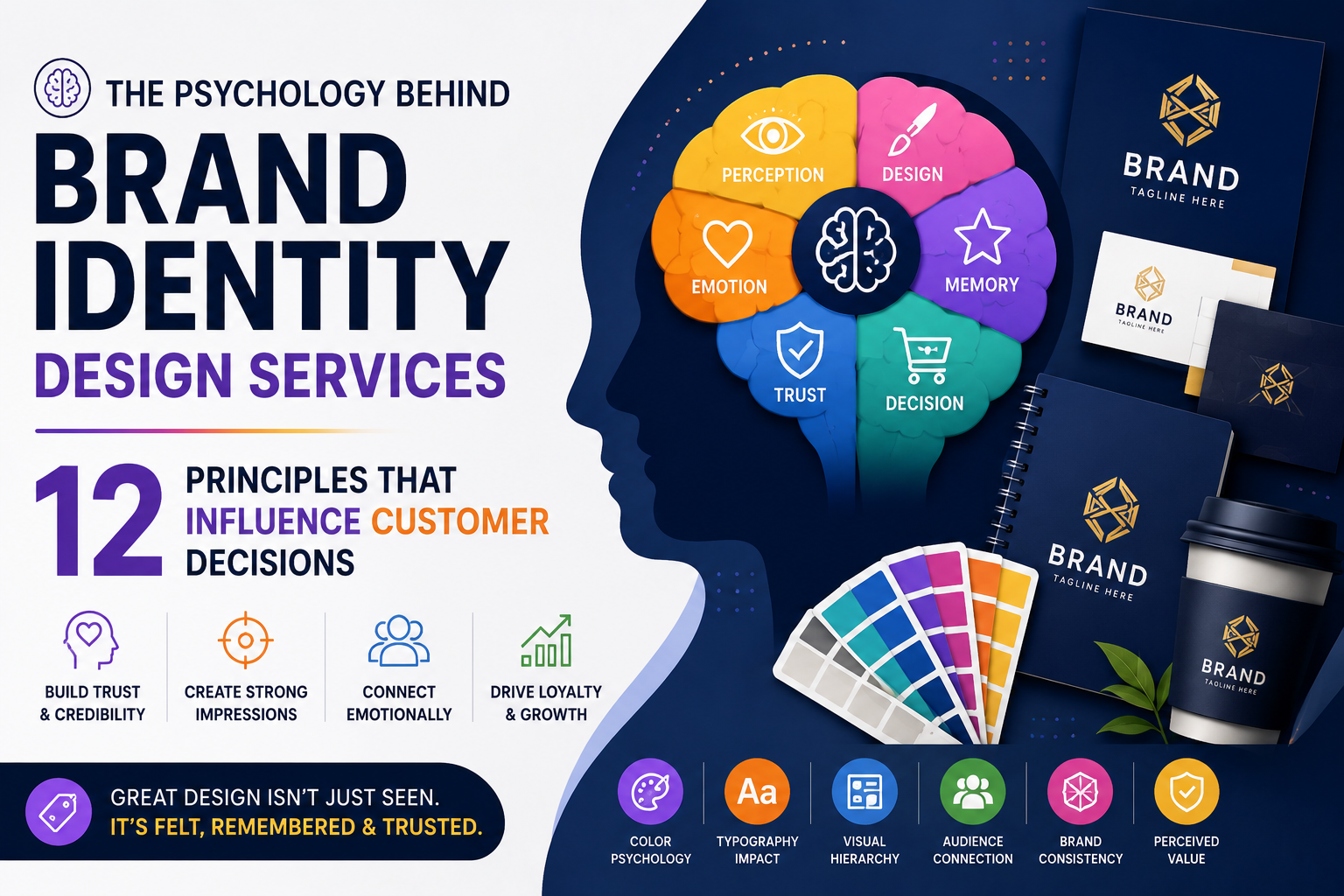
The Psychology Behind Brand Identity Design Services: 12 Principles That Influence Customer Decisions
Introduction
Every purchasing decision begins in the mind.
Whether someone is choosing a restaurant, comparing software providers, or hiring a marketing agency, emotions and perceptions influence the decision long before logic enters the picture. People like to believe they make rational choices, but research in psychology and consumer behavior consistently shows that trust, familiarity, emotion, and first impressions play a major role in what people buy.
This is why branding is much more than creating an attractive logo or choosing a modern color palette. A strong brand identity influences how customers feel about a business before they ever use its products or services.
Professional Brand Identity Design Services are built on this understanding. They combine design, psychology, communication, and strategy to create visual identities that inspire confidence, improve recognition, and encourage customer loyalty. Every element—from typography and colors to imagery and messaging—works together to shape perception and guide decision-making.
As markets become more competitive, businesses that understand customer psychology gain a significant advantage. A consistent and thoughtfully designed brand identity can help a company appear more trustworthy, memorable, and professional, even when competing against larger organizations.
In this guide, we’ll explore 12 psychological principles that successful Brand Identity Design Services use to influence customer decisions and build stronger brands. Whether you’re launching a startup or refreshing an established business, understanding these principles will help you create a brand that connects with people on a deeper level.
Table of Contents
- Why Psychology Matters in Branding
- Principle #1: First Impressions Shape Long-Term Perception
- Principle #2: The Psychology of Color
- Principle #3: Familiarity Builds Trust
- Principle #4: Visual Consistency Creates Confidence
- Principle #5: Emotional Branding Drives Decisions
- Principle #6: Simplicity Improves Recognition
- Principle #7: Social Proof Strengthens Credibility
- Principle #8: Storytelling Creates Emotional Connections
- Principle #9: Typography Influences Personality
- Principle #10: Authenticity Builds Loyalty
- Principle #11: Repetition Improves Brand Recall
- Principle #12: Cognitive Fluency Makes Brands Easier to Remember
- How Businesses Can Apply These Principles
- Frequently Asked Questions
- Conclusion
Why Psychology Matters in Branding
People rarely choose brands based only on features or price.
Imagine two companies offering nearly identical services. One has a polished website, consistent visuals, clear messaging, and professional branding. The other has an outdated website, mismatched colors, and inconsistent communication.
Even if both companies deliver the same quality of work, most customers will naturally feel more confident choosing the first.
Why?
Because our brains constantly make quick judgments based on visual cues and past experiences. These judgments help us decide who to trust, what feels familiar, and which businesses appear more reliable.
This is where Brand Identity Design Services become valuable. They are not simply about making a business look attractive. They are about shaping perception in a way that supports business goals and builds lasting customer relationships.
Understanding the psychology behind branding allows businesses to design experiences that communicate professionalism, credibility, and value from the very first interaction.
Principle #1: First Impressions Shape Long-Term Perception
People form first impressions incredibly quickly.
Within seconds of visiting a website, seeing an advertisement, or walking into a store, customers begin evaluating a business.
These early impressions often influence future decisions.
If a brand appears:
- Professional
- Organized
- Modern
- Consistent
- Trustworthy
customers are more likely to continue exploring.
If it appears outdated or inconsistent, many people leave before learning about the products or services being offered.
First impressions are difficult to change because of a psychological concept known as the primacy effect. Information encountered first tends to have a lasting influence on how we interpret everything that follows.
Professional Brand Identity Design Services focus on creating positive first impressions through:
- Clean visual design
- Consistent branding
- Professional typography
- Effective use of color
- Clear messaging
- High-quality imagery
When these elements work together, customers are more likely to believe they are dealing with a credible business.
Principle #2: The Psychology of Color
Color is one of the most influential elements of a brand identity.
Different colors can evoke different emotional responses.
While reactions vary across cultures and industries, certain patterns appear consistently in branding.
For example:
Blue
Often associated with:
- Trust
- Reliability
- Security
- Professionalism
This is why many technology, healthcare, and financial companies use blue extensively.
Green
Commonly linked with:
- Growth
- Health
- Sustainability
- Nature
Many environmental and wellness brands incorporate green into their identity.
Red
Frequently communicates:
- Energy
- Passion
- Excitement
- Urgency
Retailers and food brands often use red to attract attention and encourage action.
Black
Often represents:
- Luxury
- Sophistication
- Authority
- Exclusivity
Luxury fashion and premium service brands commonly rely on black branding.
Yellow
Can suggest:
- Optimism
- Creativity
- Warmth
- Positivity
Used carefully, it helps brands appear approachable and energetic.
Effective branding isn’t about selecting your favorite color.
It’s about choosing colors that reinforce your brand personality and resonate with your target audience.
Professional Brand Identity Design Services use color strategically to strengthen emotional connections rather than relying on personal preference.
Principle #3: Familiarity Builds Trust
People naturally feel more comfortable with things they recognize.
Psychologists call this the mere exposure effect.
The more often we encounter something, the more familiar—and trustworthy—it tends to feel.
This explains why consistent branding is so important.
Imagine seeing the same business across different platforms.
- A Google search result
- A LinkedIn post
- An Instagram advertisement
- A company website
- An email newsletter
If every interaction uses the same colors, typography, imagery, and messaging, customers begin recognizing the brand more easily.
Recognition reduces uncertainty.
Reduced uncertainty increases trust.
Professional Brand Identity Design Services help businesses maintain this consistency across every customer touchpoint, ensuring that each interaction reinforces previous experiences instead of creating confusion.
Over time, repeated exposure builds familiarity, and familiarity often influences purchasing decisions.
Why These Principles Matter Together
The first three psychological principles reveal something important.
Customers don’t simply evaluate businesses based on products or services.
They evaluate how those businesses make them feel.
A positive first impression encourages exploration.
Thoughtfully chosen colors influence emotional perception.
Consistent exposure strengthens recognition and trust.
When combined, these elements create a powerful foundation for long-term customer relationships.
This is why successful Brand Identity Design Services focus on psychology as much as design. Every visual decision is made with the goal of improving how customers perceive, remember, and interact with a brand.
Principle #4: Visual Consistency Creates Confidence
Imagine visiting a company’s website and seeing elegant blue branding with clean typography. Later, you follow the same company on social media, but the colors are different, the logo has changed, and the tone feels completely unrelated. Then you receive an email with another design style altogether.
Even if the business offers excellent products or services, these inconsistencies can make customers question its professionalism.
Human brains naturally look for patterns. When everything feels connected, we perceive it as organized and reliable. When visual elements constantly change, uncertainty increases.
Consistency doesn’t mean every design should look identical. It means every touchpoint should feel like it belongs to the same brand.
Professional Brand Identity Design Services establish clear standards for:
- Logo usage
- Color palette
- Typography
- Photography style
- Icons and illustrations
- Layout principles
- Tone of voice
- Marketing templates
When customers repeatedly encounter the same visual language, they begin to recognize the brand instantly.
Recognition leads to familiarity.
Familiarity strengthens trust.
This is why some businesses become memorable even without spending millions on advertising—they consistently present themselves in the same way wherever customers encounter them.
Principle #5: Emotional Branding Drives Customer Decisions
People often believe they make purchasing decisions logically.
In reality, emotions usually come first, while logic is used later to justify those choices.
Think about buying a luxury watch, choosing a favorite coffee shop, or selecting a travel destination.
These decisions are rarely based only on specifications or pricing.
They’re influenced by feelings such as:
- Trust
- Excitement
- Comfort
- Confidence
- Belonging
- Aspiration
Strong brands understand this.
Instead of simply promoting features, they communicate experiences and values.
For example:
A fitness brand may inspire determination.
A luxury hotel may evoke exclusivity and relaxation.
A children’s education company may focus on safety and confidence.
Professional Brand Identity Design Services help businesses identify the emotions they want customers to associate with their brand and translate those emotions into visual and verbal communication.
This includes:
- Color choices
- Photography
- Brand messaging
- Graphic style
- Website design
- Marketing campaigns
When customers feel emotionally connected to a brand, they are more likely to remember it, recommend it, and return in the future.
Principle #6: Simplicity Improves Recognition
One of the most common branding mistakes is trying to communicate too much at once.
Complex logos.
Crowded layouts.
Too many fonts.
Too many colors.
Long, confusing messages.
Instead of impressing customers, these elements often create mental overload.
Our brains naturally prefer information that is easy to process.
Psychologists refer to this as cognitive fluency—the easier something is to understand, the more positively people tend to perceive it.
That’s why many of the world’s most recognizable brands rely on simple visual systems.
Simple branding doesn’t mean boring branding.
It means removing unnecessary distractions so the most important message stands out.
Professional Brand Identity Design Services simplify visual communication by focusing on:
- Clean layouts
- Limited color palettes
- Readable typography
- Clear messaging
- Consistent spacing
- Balanced composition
The result is branding that customers recognize quickly and remember more easily.
In a world filled with constant digital distractions, simplicity has become a competitive advantage.
Principle #7: Social Proof Strengthens Credibility
People naturally look to others when making decisions.
This psychological tendency is known as social proof.
Imagine you’re choosing between two businesses.
One has:
- Customer testimonials
- Case studies
- Positive reviews
- Industry awards
- Client logos
- Active social media engagement
The other provides none of these.
Which business would you trust more?
For most people, the answer is obvious.
Seeing evidence that others have had positive experiences reduces uncertainty.
It reassures potential customers that they are making a safe decision.
Professional Brand Identity Design Services often incorporate social proof into branding by designing:
- Testimonial sections
- Review graphics
- Trust badges
- Portfolio presentations
- Client success stories
- Award showcases
Importantly, social proof should feel authentic.
Real customer stories, genuine reviews, and measurable results build far more trust than exaggerated marketing claims.
Why Trust Is Built Through Small Details
Many business owners assume trust depends on one major factor.
In reality, trust is built through dozens of small interactions.
Customers notice things like:
- Whether your logo appears consistently.
- If your website feels professional.
- How quickly pages load.
- Whether typography is easy to read.
- If emails match your website branding.
- Whether social media graphics follow a consistent style.
- How clearly information is presented.
Individually, these details may seem insignificant.
Together, they create an impression of competence and reliability.
Professional Brand Identity Design Services focus on these seemingly small elements because they collectively influence how customers perceive your business.
Strong branding isn’t created through one impressive design.
It’s created through consistent attention to detail over time.
The Psychology of Decision Fatigue
Today’s customers encounter thousands of marketing messages every day.
As choices increase, mental energy decreases.
Psychologists refer to this as decision fatigue.
Brands that make decisions easier often outperform those that overwhelm customers.
Clear branding helps by:
- Simplifying navigation
- Highlighting key information
- Creating visual hierarchy
- Reducing unnecessary choices
- Communicating value quickly
Customers appreciate businesses that help them understand what they offer without requiring extra effort.
Professional Brand Identity Design Services improve customer experiences by making interactions feel simple, intuitive, and stress-free.
This doesn’t just improve usability.
It also increases confidence during the buying process.
Bringing These Principles Together
The four principles covered in this section reveal a common theme.
Successful branding isn’t about making a business look expensive.
It’s about making customers feel confident.
Visual consistency builds familiarity.
Emotional branding creates meaningful connections.
Simplicity reduces mental effort.
Social proof reassures customers that others have already placed their trust in the business.
Combined, these psychological principles help transform casual visitors into loyal customers.
Principle #8: Storytelling Creates Emotional Connections
Facts explain what a business does.
Stories explain why it matters.
People naturally remember stories because they create emotional engagement. Instead of presenting a list of features, storytelling helps customers see themselves in the brand’s journey.
Think about the brands you admire. Chances are, you know more than just their products—you know their mission, values, or origin story.
A compelling brand story can include:
- Why the business was founded
- The problem it aims to solve
- The people behind the company
- Customer success stories
- Community initiatives
- Lessons learned through growth
Storytelling makes a business feel human.
Professional Brand Identity Design Services ensure that this story is reflected not only in written content but also through visual elements such as photography, illustrations, color choices, and overall design style.
When customers connect emotionally with a story, they are more likely to remember the brand and develop long-term loyalty.
Principle #9: Typography Influences Brand Personality
Most people notice typography without consciously thinking about it.
The style of a typeface immediately communicates a certain personality.
For example:
Serif Fonts
Often associated with:
- Tradition
- Trust
- Professionalism
- Heritage
These fonts are common among law firms, luxury brands, and educational institutions.
Sans-Serif Fonts
Often communicate:
- Simplicity
- Innovation
- Modernity
- Clean design
Technology companies and startups frequently use sans-serif fonts because they feel contemporary and easy to read.
Script Fonts
Can suggest:
- Creativity
- Elegance
- Personal connection
However, they should be used carefully to maintain readability.
Typography also affects user experience.
Small text, poor spacing, or difficult-to-read fonts can frustrate visitors and reduce engagement.
Professional Brand Identity Design Services select typography based on both aesthetics and functionality. The chosen typefaces should reflect the brand’s personality while remaining readable across websites, mobile devices, printed materials, and presentations.
Good typography doesn’t call attention to itself—it makes communication effortless.
Principle #10: Authenticity Builds Loyalty
Customers today have access to more information than ever before.
They can compare businesses, read reviews, watch videos, and research company values within minutes.
As a result, authenticity has become one of the strongest drivers of customer loyalty.
Authentic brands:
- Communicate honestly
- Admit mistakes
- Deliver on promises
- Maintain consistent values
- Prioritize customer relationships over short-term sales
Customers quickly recognize when branding feels forced or exaggerated.
If a company claims to value sustainability but uses excessive packaging, or promotes customer care while ignoring support requests, trust begins to disappear.
Professional Brand Identity Design Services help businesses create identities that accurately reflect who they are rather than who they pretend to be.
Authenticity builds confidence because customers know what to expect.
And when expectations are consistently met, loyalty follows.
Principle #11: Repetition Improves Brand Recall
Have you ever recognized a brand instantly because you’ve seen it repeatedly over time?
That’s no coincidence.
Repetition strengthens memory.
Every time customers encounter consistent branding, their brains reinforce that association.
This repetition occurs through:
- Website visits
- Social media posts
- Email newsletters
- Advertisements
- Packaging
- Business cards
- Presentations
- Events
The key is consistency.
If each interaction looks completely different, repetition loses its effect.
Professional Brand Identity Design Services create standardized visual systems that ensure every new customer interaction reinforces previous ones.
Over time, customers begin recognizing the business almost automatically.
This is known as brand recall, and it plays a major role in purchasing decisions.
When customers need a product or service, they often choose the first trustworthy brand that comes to mind.
Consistent repetition helps your business become that brand.
Principle #12: Cognitive Fluency Makes Brands Easier to Remember
One of the most powerful psychological concepts in branding is cognitive fluency.
Simply put, people prefer information that is easy to understand.
When a website is easy to navigate, a logo is easy to recognize, and messaging is easy to follow, customers experience less mental effort.
That positive experience influences how they feel about the business.
Cognitive fluency can be improved through:
- Clear layouts
- Logical navigation
- Readable typography
- Consistent colors
- Simple messaging
- Organized content
- Predictable user experiences
Businesses often believe complexity makes them appear sophisticated.
In reality, unnecessary complexity usually creates confusion.
Professional Brand Identity Design Services simplify communication without reducing quality.
The easier customers can understand your brand, the more likely they are to remember and trust it.
How Businesses Can Apply These Psychological Principles
Understanding branding psychology is valuable, but putting it into practice is what creates results.
Here are practical ways businesses can apply these principles.
1. Define Your Brand Personality
Ask yourself:
- How should customers describe your business?
- What emotions should people associate with your brand?
- What values guide your decisions?
Every design choice should support these answers.
2. Maintain Visual Consistency
Create brand guidelines covering:
- Logo usage
- Colors
- Typography
- Photography style
- Icons
- Social media graphics
- Tone of voice
Consistency strengthens recognition across every platform.
3. Simplify Customer Experiences
Review your website and marketing materials.
Can visitors quickly understand:
- Who you are?
- What you offer?
- Why they should trust you?
- How they can contact you?
If not, simplify the experience.
4. Build Genuine Trust
Rather than making exaggerated claims, demonstrate credibility through:
- Testimonials
- Case studies
- Certifications
- Awards
- Client success stories
- Transparent communication
Trust grows through evidence, not promises.
5. Tell Stories, Not Just Facts
People remember stories far longer than product specifications.
Share:
- Your business journey
- Customer transformations
- Team achievements
- Community involvement
- Lessons learned
Stories create emotional connections that traditional advertising often cannot.
6. Review Your Branding Regularly
Customer expectations change.
Technology evolves.
Your branding should adapt while maintaining recognition.
Regular reviews help ensure your identity remains relevant without requiring complete redesigns.
Why Psychology Will Continue Shaping Branding
Technology will continue changing how businesses communicate.
AI, immersive experiences, voice search, and personalized marketing will all influence branding in the years ahead.
However, the underlying psychology of human decision-making is unlikely to change significantly.
People will continue seeking:
- Trust
- Familiarity
- Simplicity
- Authenticity
- Emotional connection
Professional Brand Identity Design Services succeed because they combine creative design with an understanding of these timeless human behaviors.
Businesses that recognize this balance will build stronger brands regardless of changing trends or technologies.
Frequently Asked Questions (FAQs)
1. What are Brand Identity Design Services?
Brand Identity Design Services involve creating a complete visual and communication system for a business. This includes logo design, color palette selection, typography, brand guidelines, messaging, and marketing assets that work together to create a consistent and memorable brand experience.
2. Why is psychology important in branding?
Psychology helps businesses understand how customers think, feel, and make purchasing decisions. Applying psychological principles to branding improves trust, recognition, emotional connection, and customer loyalty, making the brand more effective in competitive markets.
3. How do colors influence customer decisions?
Colors can evoke different emotions and associations. For example, blue is often linked with trust and professionalism, while green suggests growth and sustainability. Choosing colors strategically helps businesses communicate the right message and strengthen their brand identity.
4. Can small businesses benefit from Brand Identity Design Services?
Yes. Professional branding helps small businesses establish credibility, compete with larger companies, attract the right audience, and create memorable customer experiences that encourage repeat business.
5. How does storytelling improve a brand?
Storytelling helps customers connect emotionally with a business by communicating its purpose, values, and journey. A compelling brand story makes a company more relatable, memorable, and trustworthy than simply promoting products or services.
6. What role does consistency play in branding?
Consistency helps customers recognize a brand across different platforms and marketing channels. Repeated exposure to the same visual identity and messaging builds familiarity, which increases trust and brand recall over time.
7. How often should a business update its brand identity?
Businesses should review their branding periodically, especially when expanding, entering new markets, launching new services, or adapting to changing customer expectations. Updates should modernize the brand while preserving its core identity.
8. What is the biggest psychological factor in successful branding?
There isn’t a single factor, but trust is one of the most influential. Customers are more likely to choose businesses that appear reliable, authentic, and consistent. Strong branding supports these perceptions at every customer touchpoint.
Conclusion
Great branding is not created by chance. Behind every memorable logo, every recognizable color palette, and every trusted business is a deep understanding of human psychology.
Throughout this guide, we’ve explored 12 psychological principles that influence how customers perceive brands and make purchasing decisions. From first impressions and color psychology to storytelling, consistency, authenticity, and cognitive fluency, each principle demonstrates that successful branding is about much more than visual appeal. It’s about shaping how people feel, what they remember, and why they choose one business over another.
Professional Brand Identity Design Services combine creative design with strategic thinking to build identities that resonate with customers on both emotional and practical levels. Every design element—whether it’s typography, imagery, messaging, or layout—contributes to the overall perception of a brand. When these elements work together consistently, businesses become easier to recognize, easier to trust, and more likely to be remembered.
In today’s competitive marketplace, customers have countless choices. Often, they don’t have the time to evaluate every detail before making a decision. Instead, they rely on the signals a brand sends through its visual identity, communication, and overall professionalism. A thoughtfully designed brand identity reduces uncertainty, inspires confidence, and creates positive first impressions that can influence long-term customer relationships.
However, branding should never be static. Consumer expectations evolve, markets change, and technology continues to reshape the way businesses interact with their audiences. Companies that regularly review and refine their branding while remaining true to their core values are better positioned for sustainable growth.
If you’re building a new business or strengthening an existing one, don’t view branding as a one-time creative project. View it as a long-term investment in how customers perceive your company. Understanding the psychology behind branding allows you to create meaningful experiences that go beyond attracting attention—they encourage trust, loyalty, and lasting connections.
The businesses that succeed over the next decade won’t simply have attractive designs. They’ll have brands that understand people
explore gowenza
Your brand is often the first interaction customers have with your business, and first impressions matter. At Gowenza, we combine creativity with strategy to deliver Brand Identity Design Services that help businesses build trust, improve recognition, and create lasting customer connections. Our services include brand strategy, logo design, visual identity systems, typography, color palette development, brand guidelines, marketing collateral, and digital branding. To create a complete online presence, you can also explore our Website Development Services, SEO Services, Graphic Design Services, Google Ads Services, and Digital Marketing Services. Whether you’re launching a startup or refreshing an established brand, Gowenza is here to help you Create. Innovate. Elevate.
Trusted External Resources
To learn more about branding, psychology, and customer experience, explore these trusted resources:
- Nielsen Norman Group – Research and articles on user experience, usability, and design psychology.
- Interaction Design Foundation – Educational content covering UX, branding, accessibility, and visual communication.
- Google Search Central – Best practices for creating high-quality, search-friendly websites.
- HubSpot Marketing Blog – Practical guides on branding, customer behavior, and marketing strategy.
- Adobe Creative Cloud – Professional tools and resources for graphic design and brand development.
- Canva Design School – Free lessons on branding, design principles, and visual storytelling.