Table of Contents
- Introduction
- What Are Google Ads Keyword Match Types?
- Why Keyword Match Types Matter for Small Businesses
- Broad Match Explained
- Phrase Match Explained
- Exact Match Explained
- Broad vs Phrase vs Exact Match
- How Negative Keywords Fit Into Your Strategy
- How to Choose the Right Match Type
- Common Keyword Match Type Mistakes
- Practical Keyword Match Type Strategy for Small Businesses
- Keyword Optimization Checklist
- Frequently Asked Questions
- Final Thoughts
Introduction
Google Ads can put a small business in front of potential customers at the exact moment they are searching for a product or service. But getting that visibility does not automatically mean getting profitable leads.
One of the most important parts of a Search campaign is deciding which searches should be eligible to trigger your advertisements. This is where keyword match types become important.
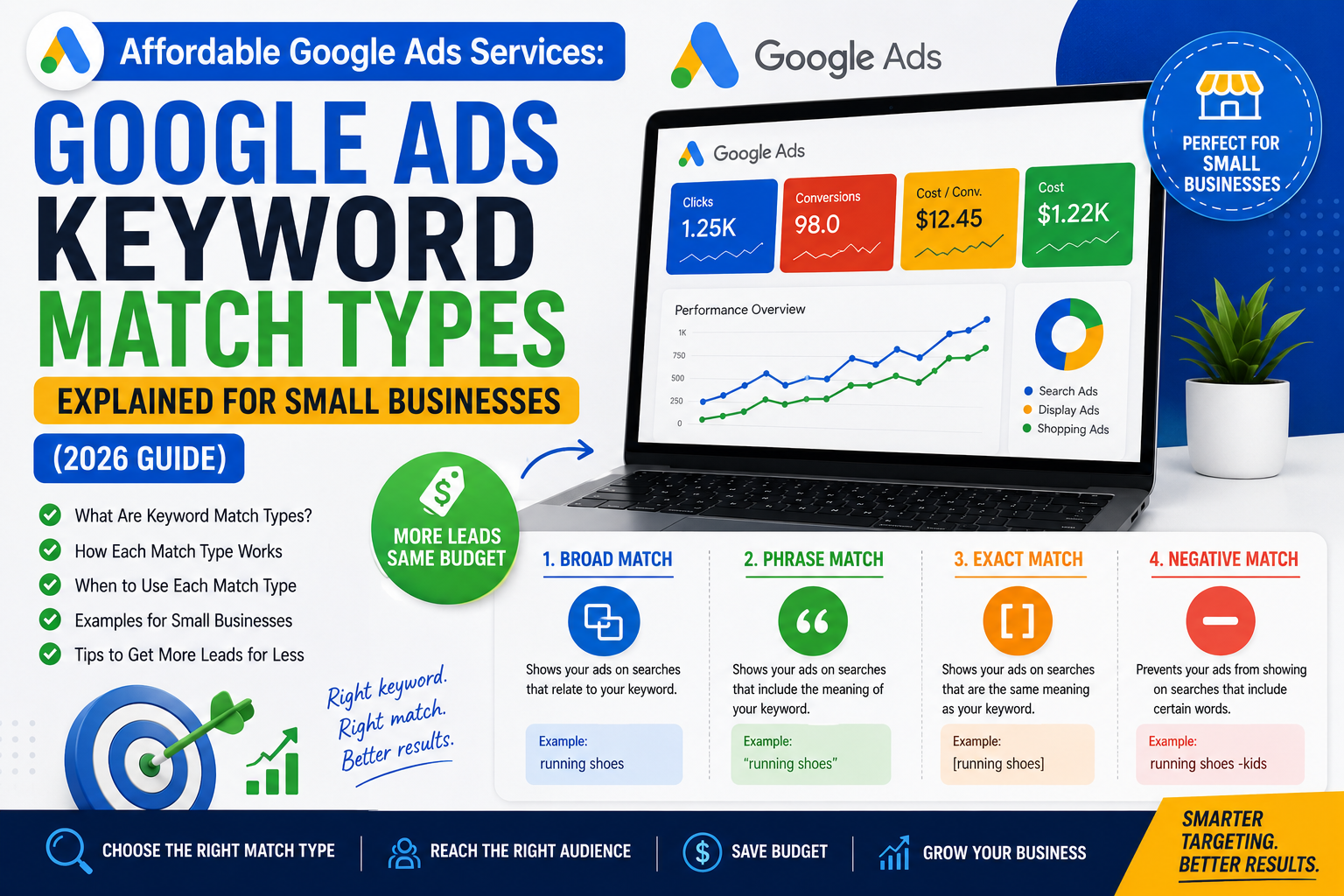
Google Ads currently provides three primary keyword match types: broad match, phrase match, and exact match. Each gives Google a different level of flexibility when determining whether a user’s search is relevant to your keyword.
For a small business with a limited advertising budget, this decision matters because poorly targeted traffic can consume your budget without producing meaningful enquiries.
For example, a business selling professional advertising management may want to appear for searches such as:
- Google Ads management company
- Google Ads agency for small business
- Google Ads management services
- Affordable Google Ads Services
But it may not want to pay for searches such as:
- Google Ads course
- Google Ads jobs
- Free Google Ads training
- Google Ads tutorial
Understanding match types helps you control how broadly your keywords can match customer searches.
This guide explains how each match type works, when to use it, what its limitations are, and how small businesses can combine match types with conversion tracking, Smart Bidding, and negative keywords to make their campaigns more efficient.
What Are Google Ads Keyword Match Types?
Keyword match types determine how closely a user’s search needs to relate to your keyword before your ad can be considered for the auction. Google currently uses broad, phrase, and exact match for Search keywords.
The three match types can be thought of as different levels of reach:
| Match Type | Reach | Control | Syntax |
|---|
| Broad | Highest | Lower | google ads services |
| Phrase | Medium | Medium | "google ads services" |
| Exact | More restricted | Higher | [google ads services] |
However, modern Google Ads matching is not simply about whether the exact words appear in a search.
Google uses meaning and intent when determining eligibility. Phrase and exact match can also match searches with the same meaning or intent rather than requiring a literal word-for-word match.
This means advertisers should not build enormous keyword lists simply to cover every possible spelling or wording variation.
Why Keyword Match Types Matter for Small Businesses
Large companies may have substantial advertising budgets that allow them to test a wide range of traffic.
Small businesses usually have less room for wasted clicks.
If you have a ₹20,000 monthly budget, every irrelevant click takes money away from searches that could have generated a customer.
For example:
Campaign A
- 500 clicks
- ₹20,000 spent
- 10 leads
- ₹2,000 cost per lead
Campaign B
- 350 clicks
- ₹20,000 spent
- 20 leads
- ₹1,000 cost per lead
Campaign B generated fewer clicks but twice as many leads.
That is why campaign performance should not be judged by traffic alone.
Keyword match types can influence the type and volume of searches your ads are eligible to reach. Combined with strong ad relevance, landing pages, conversion tracking, and bidding, they can help you make better use of your advertising budget.
This is an important part of professional Affordable Google Ads Services because campaign managers need to balance reach, relevance, lead quality, and cost rather than simply maximize impressions.
1. Broad Match Explained
Broad match provides the widest reach of the three primary match types.
You enter the keyword without quotation marks or brackets.
Example
google ads services
Google may show your ad for searches related to the meaning of the keyword, even when the search does not contain the exact words.
Google states that broad match can use additional signals such as the user’s recent searches, landing-page content, assets, and other keywords in the ad group to understand intent.
When Broad Match Can Be Useful
Broad match can be useful when you want to:
- Discover new relevant searches.
- Expand campaign reach.
- Generate additional conversion opportunities.
- Allow Google’s systems to identify related queries.
- Use Smart Bidding with conversion-focused goals.
Google specifically recommends using Smart Bidding with broad match because the system can use auction-time signals to adjust bids based on the likelihood of conversion.
Example
Suppose your keyword is:
website development company
A broad match campaign may reach searches related to website development and associated commercial intent.
The important point is that broad match gives Google more freedom to identify relevant searches.
The Risk
More reach also means you need stronger monitoring.
You should regularly review your Search Terms Report to identify searches that generated impressions or clicks. Google notes that the match type shown in the Search Terms Report can differ from the selected keyword’s match type because broader keywords can match searches that are more narrowly related.
For small businesses, broad match should therefore be used with appropriate conversion tracking, Smart Bidding where suitable, and active search-term management.
2. Phrase Match Explained
Phrase match sits between broad and exact match in terms of reach.
The syntax is:
"google ads services"
Google explains that phrase match can show ads on searches that include the meaning of the keyword, including searches that are more specific versions of that meaning.
Example
Suppose your phrase match keyword is:
"Google Ads Services"
Potentially relevant searches could include variations such as:
- affordable Google Ads services
- Google Ads services for small business
- Google Ads management services
- Google Ads services near me
The exact queries eligible to match will depend on Google’s interpretation of meaning and the campaign context.
When Phrase Match Can Be Useful
Phrase match can be useful when you want:
- More control than broad match.
- More reach than exact match.
- Stronger alignment with a particular service or product.
- A balance between traffic volume and relevance.
For a small business that is still learning which searches generate qualified leads, phrase match can be a practical starting point.
However, it should still be monitored. Don’t assume that every search triggered by a phrase keyword will be valuable.
Review search terms and add negative keywords when necessary.
3. Exact Match Explained
Exact match provides the most control over which searches your keyword can match among the three primary options, although it does not mean the user’s search must be literally identical.
The syntax is:
[google ads services]
Google describes exact match as matching searches with the same meaning or intent as the keyword. It generally reaches fewer searches than phrase and broad match.
When Exact Match Is Useful
Exact match can be valuable when you want to focus on specific high-intent searches.
For example:
[google ads management]
could be used when you know that a particular search theme consistently generates qualified enquiries.
Advantages
- Greater control over targeting.
- Easier analysis of specific search themes.
- Useful for important high-intent terms.
- Can help concentrate budget on proven searches.
Limitation
The biggest limitation is reach.
If you rely exclusively on exact match, you may miss relevant searches that use different wording or express the same intent.
Therefore, exact match should not automatically be considered “better” than broad or phrase match.
The best option depends on your campaign goals, data, conversion volume, and bidding strategy.
Broad vs Phrase vs Exact Match
The differences become clearer when you compare them directly.
| Factor | Broad Match | Phrase Match | Exact Match |
|---|
| Reach | Highest | Medium | Lower |
| Control | Lower | Medium | Higher |
| Search Discovery | Excellent | Good | Limited |
| Budget Control | Requires monitoring | Good | Stronger |
| Best For | Expansion | Balanced targeting | High-intent targeting |
| Smart Bidding | Particularly important | Recommended | Recommended |
Google states that broader match types can encompass searches covered by narrower match types plus additional related searches.
So the decision isn’t simply:
“Which match type is best?”
Instead ask:
“Which match type best fits my campaign objective?”
How Negative Keywords Fit Into Your Strategy
Keyword match types determine which searches you may reach.
Negative keywords help determine which searches you don’t want to reach.
This distinction is critical.
For example, imagine you’re promoting Affordable Google Ads Services.
You may want searches related to:
- Google Ads management
- Google Ads agency
- PPC management
- Google Ads services
But you may want to exclude searches related to:
- Google Ads jobs
- Google Ads course
- Google Ads tutorial
- Free Google Ads training
- Google Ads salary
Adding appropriate negative keywords can help reduce irrelevant traffic.
Google also notes that negative keyword match types behave differently from positive keyword match types, so they should be managed separately rather than assuming the same rules apply.
Make Search-Term Reviews Part of Your Routine
Regularly check:
- Which searches generated clicks?
- Which searches generated conversions?
- Which searches were irrelevant?
- Which searches should become negative keywords?
- Which valuable searches should be added to your strategy?
This creates a feedback loop that improves campaign targeting over time.
How to Choose the Right Match Type
There isn’t one universal match-type strategy for every business.
Consider these factors.
If You Need More Reach
Broad match may help discover additional relevant searches, particularly when combined with conversion-based Smart Bidding.
If You Want a Balance
Phrase match can provide a middle ground between reach and control.
If You Have Proven High-Intent Terms
Exact match can help focus on specific searches and maintain greater steering over which queries trigger your ads.
If Your Budget Is Very Limited
Don’t automatically assume exact match is the answer.
Instead, identify the searches that produce profitable conversions, use appropriate match types, and actively remove irrelevant traffic.
Your conversion data should guide your decisions.
This is where Affordable Google Ads Services can add value: instead of selecting match types based purely on theory, campaigns can be adjusted according to actual search-term, conversion, and cost data.
Common Keyword Match Type Mistakes
Mistake 1: Using Only Broad Match Without Monitoring
Broad match can expand reach, but businesses should monitor search terms and conversion performance.
Mistake 2: Using Only Exact Match
Exact match provides control but may limit your ability to discover new relevant searches.
Mistake 3: Ignoring Negative Keywords
Even well-structured campaigns can attract irrelevant searches.
Mistake 4: Optimizing for Clicks Instead of Leads
A cheap click isn’t necessarily a valuable click.
Measure qualified conversions.
Mistake 5: Creating Huge Lists of Near-Duplicate Keywords
Google’s current matching system can cover variations in meaning, so creating dozens of nearly identical keywords may add unnecessary complexity. Google specifically advises against adding very similar keywords such as reordered versions when they are effectively duplicates.
Mistake 6: Choosing Match Types Without Considering Bidding
Your keyword strategy should work alongside your bidding strategy and conversion goals.
Practical Keyword Match Type Strategy for Small Businesses
A practical campaign can use a combination of approaches.
Step 1: Identify High-Intent Keywords
Start with terms that directly describe what you sell.
For example:
- Google Ads management
- Google Ads agency
- PPC management services
- Affordable Google Ads Services
Step 2: Identify Proven Terms
Once campaigns collect data, identify which search themes generate qualified leads.
Step 3: Expand Carefully
Use phrase or broad match where additional relevant traffic could help growth.
Step 4: Review Search Terms
Look for irrelevant searches and add appropriate negative keywords.
Step 5: Improve Ads
Make advertisements closely relevant to the search intent.
Step 6: Optimize Landing Pages
The landing page should deliver exactly what the advertisement promises.
Step 7: Measure Business Results
Track leads, sales, cost per lead, and return on ad spend—not just clicks.
This approach is much more effective than choosing one match type and leaving the campaign untouched.
Keyword Optimization Checklist
Before launching or restructuring a Google Ads Search campaign, review the following:
Frequently Asked Questions
What are the three Google Ads keyword match types?
The three primary keyword match types are broad match, phrase match, and exact match. They determine how closely a user’s search needs to relate to your keyword before your advertisement can be considered.
Which Google Ads match type gives the most control?
Exact match provides the most steering over which searches your advertisement can match among the three primary match types, although Google can still match searches with the same meaning or intent.
Is broad match good for small businesses?
It can be, particularly when paired with conversion-based Smart Bidding and accurate conversion tracking. Google recommends Smart Bidding with broad match because it can use additional signals to determine appropriate bids for different searches.
Should I use all three match types?
Not necessarily. Your choice should depend on your goals, budget, conversion data, and campaign structure. A combination can work well, but adding every match type to every keyword isn’t automatically better.
What are negative keywords?
Negative keywords prevent your ads from showing for searches containing specified terms. They are useful for filtering out irrelevant traffic and protecting your advertising budget.
Do keyword match types affect Quality Score?
Match types themselves are not the only factor determining campaign quality. Google says Quality Score is based on expected CTR, ad relevance, and landing page experience. Closely aligning keywords, ads, and landing pages can therefore support stronger campaign performance.
Final Thoughts
Keyword match types are not simply technical settings inside Google Ads. They influence how your campaign finds potential customers and how much control you have over the searches your advertisements can reach.
Broad match is designed for greater reach and can help discover additional relevant searches when paired with appropriate conversion-based Smart Bidding.
Phrase match provides a middle ground between reach and control.
Exact match provides greater steering over searches with the same meaning or intent as your keyword.
None of these options is automatically the best choice for every campaign.
For small businesses, the better strategy is to connect match types with actual business objectives. Monitor search terms, exclude irrelevant traffic, track conversions, improve advertisements, and optimize landing pages. Then use performance data to decide where your budget should go.
The goal isn’t to get the maximum number of impressions or clicks.
The goal is to reach the right people at the right time and turn valuable searches into measurable business results.
When managed correctly, Affordable Google Ads Services can help small businesses build structured campaigns, control wasted spend, identify high-value searches, and improve their return on advertising investment.
For businesses that don’t have the time or expertise to monitor keyword performance continuously, professional Affordable Google Ads Services can provide the campaign management, optimization, conversion tracking, and ongoing analysis needed to make Google Ads more efficient.
Grow Your Business with Gowenza Digital
Gowenza Digital provides Affordable Google Ads Services focused on practical campaign management and measurable results. From keyword research and match-type selection to ad creation, conversion tracking, landing page recommendations, and ongoing optimization, the goal is to make your existing advertising budget work harder.
Instead of simply increasing ad spend, a well-managed campaign focuses on finding better opportunities within the budget you already have.
To learn more about Google Ads keyword targeting and campaign optimization, explore Google’s official resources. Visit the Google Ads Help Center to understand campaign management, read Google’s Keyword Match Types Guide for detailed information on broad, phrase, exact, and negative keywords, and use Google Keyword Planner to research relevant keywords and plan your campaigns.

One Response