Website Development Company Guide: 10 Website Development Mistakes That Hurt Your Google Rankings
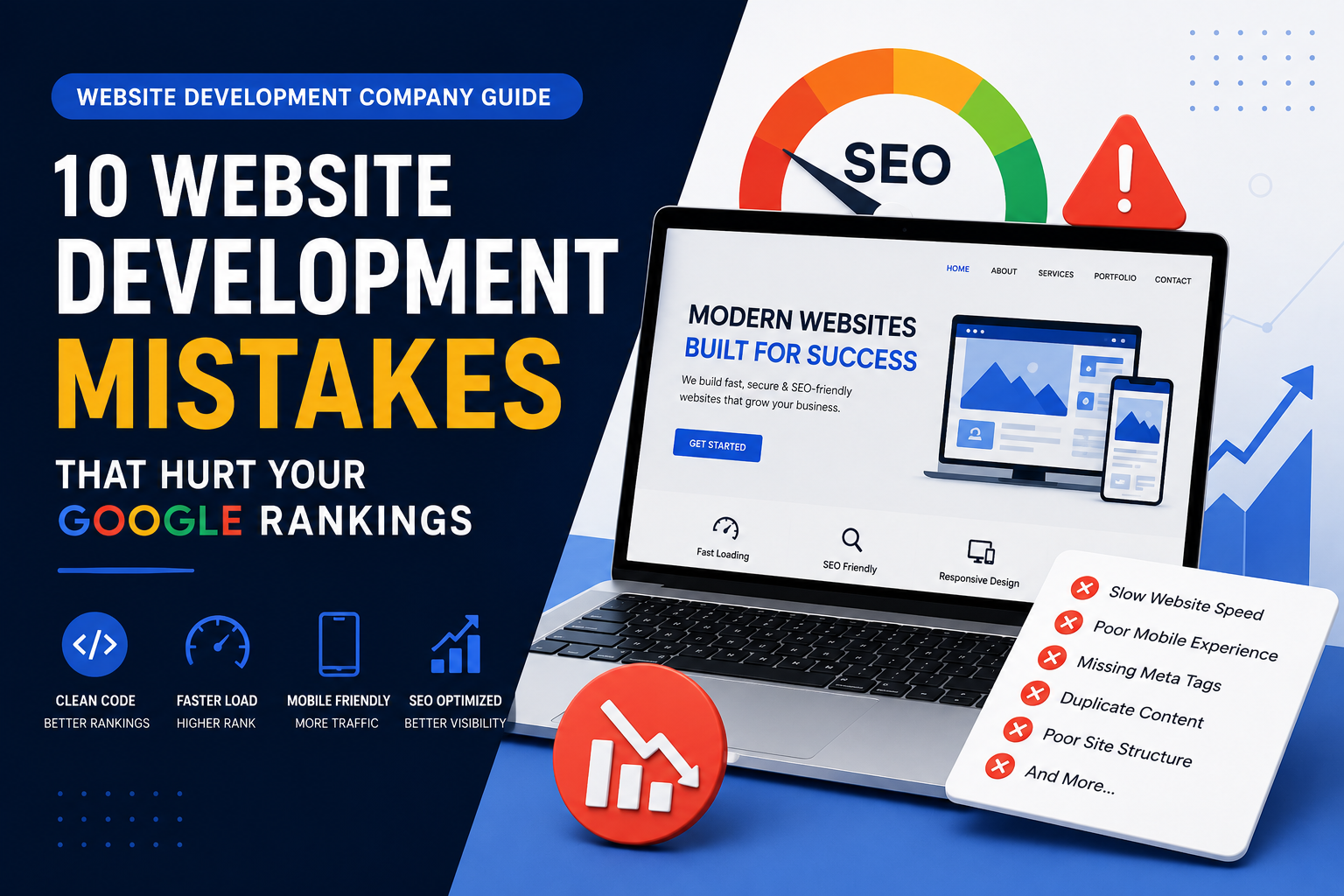
Website Development Company Guide: 10 Website Development Mistakes That Hurt Your Google Rankings
Table of Contents
- Introduction
- Why Website Development Directly Affects SEO
- Mistake #1: Building a Website That Isn’t Mobile-Friendly
- Mistake #2: Ignoring Website Speed and Performance
- Mistake #3: Poor Website Structure and Navigation
- Conclusion to Part 1
Introduction
Many business owners believe that Google rankings depend only on keywords and backlinks. While these are important, your website’s development plays an equally significant role in determining where your pages appear in search results.
A beautifully designed website that loads slowly, has poor navigation, or contains technical issues can struggle to rank, no matter how good the content is. Google’s algorithms evaluate hundreds of ranking factors, many of which are directly influenced by how a website is developed. Search engines reward websites that are fast, secure, mobile-friendly, and easy to navigate because these qualities create a better experience for users.
Unfortunately, many businesses unknowingly make development mistakes that limit their online visibility. These problems often remain hidden until website traffic begins to decline or potential customers stop converting.
Working with an experienced Website Development Company helps prevent these costly issues from the beginning. Professional developers understand how technical development, user experience, and SEO work together to build websites that satisfy both visitors and search engines.
In this guide, you’ll discover the ten most common website development mistakes that negatively affect Google rankings and learn practical ways to fix them before they damage your business.
Why Website Development Directly Affects SEO
Google’s goal is simple: deliver the best possible results for every search query. To achieve this, Google’s algorithms evaluate not only the relevance of your content but also the overall quality of your website.
Several technical factors influence rankings, including:
- Website speed
- Mobile responsiveness
- Website security
- User experience
- Crawlability
- Site architecture
- Core Web Vitals
- Internal linking
- Structured data
- Clean code
These elements are all part of website development.
A professional Website Development Company builds websites with SEO in mind from the very beginning rather than trying to fix technical problems after launch. This proactive approach improves rankings, enhances user satisfaction, and supports long-term business growth.
Let’s explore the mistakes that often prevent websites from reaching the first page of Google.
Mistake #1: Building a Website That Isn’t Mobile-Friendly
Today, most users browse the internet using smartphones and tablets. Google also uses mobile-first indexing, meaning it primarily evaluates the mobile version of your website when determining rankings.
If visitors have difficulty reading text, clicking buttons, or navigating pages on a mobile device, they are likely to leave quickly. High bounce rates send negative signals to search engines, making it harder for your pages to rank.
Common Mobile Development Problems
Many websites still suffer from issues such as:
- Text that is too small to read
- Buttons placed too close together
- Images that don’t resize properly
- Horizontal scrolling
- Slow loading on mobile networks
- Poor touchscreen usability
Each of these problems creates frustration for users and reduces your website’s ability to compete in search results.
Why Mobile Optimization Matters
Mobile-friendly websites offer several important advantages:
- Better Google rankings
- Lower bounce rates
- Longer visitor sessions
- Higher engagement
- More inquiries and sales
- Improved accessibility
Google wants users to enjoy browsing websites regardless of their device. A responsive website helps achieve exactly that.
How a Website Development Company Solves This
An experienced Website Development Company develops websites using responsive frameworks that automatically adapt to different screen sizes.
Professional developers ensure that:
- Every page displays correctly on smartphones
- Navigation remains simple
- Images scale properly
- Fonts remain readable
- Buttons are easy to tap
- Forms work smoothly on mobile devices
Instead of maintaining separate desktop and mobile versions, responsive development creates a consistent experience across all devices.
Best Practices
To improve mobile performance:
- Use responsive layouts.
- Optimize touch-friendly navigation.
- Compress images.
- Avoid intrusive pop-ups.
- Test on multiple screen sizes.
- Keep forms short and easy to complete.
A mobile-first approach improves both user experience and SEO performance.
Mistake #2: Ignoring Website Speed and Performance
Website speed is one of Google’s confirmed ranking factors.
Visitors expect websites to load almost instantly. Even a delay of a few seconds can increase bounce rates and reduce conversions.
Slow websites also waste Google’s crawl budget, meaning fewer pages may be indexed efficiently.
Common Causes of Slow Websites
Performance problems usually come from poor development practices rather than content itself.
Examples include:
- Oversized images
- Unoptimized code
- Too many plugins
- Slow hosting
- Large JavaScript files
- Excessive CSS
- Unnecessary animations
- Poor caching configuration
While each issue may seem small individually, together they significantly slow your website.
Business Impact
Slow websites often experience:
- Lower Google rankings
- Reduced organic traffic
- Poor user engagement
- Lower conversion rates
- Increased bounce rates
- Lost sales opportunities
Customers rarely wait for slow pages to load when faster competitors are available.
How a Website Development Company Improves Speed
A professional Website Development Company focuses on performance optimization throughout the development process rather than treating speed as an afterthought.
Typical optimization techniques include:
- Image compression
- Lazy loading
- Code minification
- Browser caching
- Content Delivery Networks (CDNs)
- Database optimization
- Server-side caching
- Modern image formats such as WebP
Developers also eliminate unnecessary scripts and optimize page resources to reduce loading times.
Speed Optimization Checklist
To keep your website fast:
- Compress every image before uploading.
- Remove unused plugins.
- Minify CSS and JavaScript.
- Enable browser caching.
- Upgrade hosting if necessary.
- Reduce unnecessary redirects.
- Limit third-party scripts.
- Regularly test website speed.
Fast websites create happier visitors and stronger search rankings.
Mistake #3: Poor Website Structure and Navigation
Google needs to understand how your website is organized before it can properly index your pages.
A confusing website structure makes it difficult for both users and search engine crawlers to locate important information.
When navigation becomes complicated, visitors leave earlier, reducing engagement signals that influence rankings.
Signs of Poor Website Structure
Common structural problems include:
- Disorganized menus
- Broken navigation
- Too many dropdown levels
- Pages buried deep within the website
- Inconsistent URLs
- Orphan pages without internal links
- Duplicate categories
- Missing breadcrumbs
These issues make websites harder to crawl and more difficult for users to explore.
Why Site Architecture Matters
A clear website hierarchy helps Google understand relationships between pages.
Well-organized websites also:
- Improve crawling efficiency
- Strengthen internal linking
- Increase page authority
- Help users find information faster
- Encourage visitors to view more pages
Good architecture benefits both SEO and user experience.
How a Website Development Company Creates Better Structure
An experienced Website Development Company plans website architecture before writing a single line of code.
Professional developers typically organize websites using a logical hierarchy such as:
- Home
- Services
- Industries
- Portfolio
- About
- Blog
- Contact
Each section connects naturally through clear navigation and internal links.
Developers also implement breadcrumb navigation, SEO-friendly URLs, XML sitemaps, and clean menu structures that help search engines crawl the website efficiently.
Best Practices
Follow these guidelines:
- Keep navigation simple.
- Limit menu levels.
- Use descriptive page names.
- Create SEO-friendly URLs.
- Add breadcrumbs.
- Maintain logical content categories.
- Link related pages together.
- Make important pages accessible within three clicks.
A properly structured website makes it easier for Google to understand your business while helping visitors find exactly what they need.
Mistake #4: Weak Internal Linking Strategy
Internal linking is one of the most overlooked aspects of SEO, yet it plays a major role in helping Google understand your website. Internal links connect one page to another within your website, creating a logical path for both visitors and search engine crawlers.
Many websites publish excellent content but fail to connect related pages. As a result, Google struggles to discover important content, and users often leave after viewing just one page.
A professional Website Development Company builds a strategic internal linking structure that improves navigation, distributes authority across pages, and helps search engines understand how different topics relate to each other.
Common Internal Linking Mistakes
Many websites suffer from problems such as:
- Pages with no internal links
- Broken internal links
- Using “Click Here” instead of descriptive anchor text
- Linking only to the homepage
- Important service pages receiving very few links
- Blog articles not linking to related content
- Excessive links on a single page
These mistakes reduce crawl efficiency and prevent search engines from identifying your most valuable pages.
Why Internal Links Matter
A strong internal linking strategy helps to:
- Improve website crawling
- Pass authority between pages
- Increase page views
- Reduce bounce rate
- Help users discover related content
- Improve keyword relevance
- Strengthen topical authority
For example, if your blog discusses website speed, it should naturally link to your Website Development Services page, performance optimization resources, and related blog articles.
Best Practices
To improve internal linking:
- Link related pages naturally.
- Use descriptive anchor text.
- Connect blogs with service pages.
- Fix broken links regularly.
- Avoid excessive linking.
- Update older articles with new internal links.
- Create topic clusters around your services.
An experienced Website Development Company considers internal linking during website planning instead of adding links randomly after publishing content.
Mistake #5: Publishing Duplicate or Thin Content
Google values original, informative, and useful content. Unfortunately, many websites publish duplicate pages or thin content that offers little value to visitors.
Thin content refers to pages with minimal information, while duplicate content appears when similar or identical information exists on multiple URLs.
Neither automatically results in a penalty, but both make it difficult for Google to determine which page deserves to rank.
Common Examples
Examples include:
- Copying content from competitors
- Reusing the same service description across multiple pages
- Duplicate product pages
- Location pages with only city names changed
- Very short blog posts with little useful information
- Auto-generated pages without meaningful edits
These practices reduce your website’s credibility and weaken its SEO performance.
How It Hurts Rankings
Duplicate and thin content can lead to:
- Keyword cannibalization
- Lower rankings
- Reduced crawl efficiency
- Poor user engagement
- Lower authority
- Fewer indexed pages
Google prefers websites that demonstrate expertise through comprehensive and original information.
How a Website Development Company Helps
An experienced Website Development Company works closely with SEO specialists and content writers to ensure every page has a unique purpose.
Professional developers also:
- Create clean URL structures
- Implement canonical tags
- Prevent duplicate indexing
- Optimize category pages
- Improve content organization
This technical foundation supports stronger search visibility over time.
Best Practices
- Write unique content for every page.
- Expand thin pages with valuable information.
- Use canonical URLs where necessary.
- Merge duplicate pages.
- Regularly audit website content.
- Avoid copying competitor websites.
Quality always outperforms quantity when it comes to long-term SEO success.
Mistake #6: Ignoring Technical SEO During Development
Many businesses invest heavily in design while overlooking technical SEO. A website may look impressive, but if search engines cannot crawl and understand it efficiently, rankings will suffer.
Technical SEO ensures that search engines can access, interpret, and index your website correctly.
A reliable Website Development Company incorporates technical SEO throughout the development process rather than attempting to fix issues after launch.
Common Technical SEO Problems
Some of the most common issues include:
- Missing XML sitemap
- Missing robots.txt file
- Broken redirects
- Incorrect canonical tags
- Duplicate meta information
- Crawl errors
- Poor URL structure
- Broken links
- Improper heading hierarchy
- Missing schema markup
Even a few technical issues can significantly impact search visibility.
Why Technical SEO Matters
Technical optimization helps Google:
- Crawl pages efficiently
- Understand website hierarchy
- Discover new content
- Index pages correctly
- Avoid duplicate content
- Display rich search results
Without proper technical optimization, even excellent content may remain invisible in search results.
Technical SEO Checklist
Professional developers usually include:
- XML Sitemap
- Robots.txt
- Canonical URLs
- Structured Data (Schema)
- HTTPS implementation
- Redirect management
- Clean URL structure
- Optimized heading hierarchy
- Image optimization
- Error monitoring
Each element contributes to stronger indexing and improved rankings.
Best Practices
During development:
- Keep URLs short and descriptive.
- Use proper redirects.
- Remove crawl errors.
- Submit XML sitemaps to Google.
- Implement schema markup.
- Optimize images.
- Maintain clean code.
- Monitor indexing regularly.
Technical SEO forms the backbone of a successful website.
Mistake #7: Ignoring Google’s Core Web Vitals
Core Web Vitals are Google’s performance metrics that measure real user experience.
Since becoming official ranking signals, these metrics have become essential for websites that want to compete in search results.
A skilled Website Development Company optimizes these performance indicators during development rather than trying to improve them after the website goes live.
The Three Core Web Vitals
Largest Contentful Paint (LCP)
Measures how quickly the largest visible element loads.
Target:
- Under 2.5 seconds
Interaction to Next Paint (INP)
Measures how responsive your website feels after user interaction.
Target:
- Under 200 milliseconds
Cumulative Layout Shift (CLS)
Measures unexpected layout movement while a page loads.
Target:
- Less than 0.1
Poor scores frustrate users and reduce trust.
What Causes Poor Scores?
Common causes include:
- Large images
- Slow servers
- Heavy JavaScript
- Poor caching
- Third-party scripts
- Ads loading unexpectedly
- Unoptimized fonts
- Dynamic content pushing elements around
Benefits of Optimizing Core Web Vitals
Improving these metrics leads to:
- Better user experience
- Higher Google rankings
- Lower bounce rates
- Increased conversions
- Faster page loading
- Improved customer satisfaction
Google rewards websites that provide smooth and stable browsing experiences.
Best Practices
Improve Core Web Vitals by:
- Compressing images.
- Using modern image formats.
- Minimizing JavaScript.
- Enabling caching.
- Reducing server response time.
- Reserving space for images and ads.
- Optimizing fonts.
- Monitoring performance regularly.
A professional Website Development Company continuously tests these metrics to ensure the website performs well across devices and browsers.
Mistake #8: Poor User Experience (UX) and Confusing Design
Your website may have excellent content and solid SEO, but if visitors struggle to use it, Google notices. Search engines prioritize websites that provide a smooth, intuitive, and enjoyable experience because they want users to find answers quickly and efficiently.
A poor user experience often results in visitors leaving your website within seconds. High bounce rates, low engagement, and short session durations can negatively impact your search performance over time.
A professional Website Development Company designs websites around user behavior, ensuring every page is easy to navigate and encourages visitors to take action.
Common User Experience Mistakes
Many websites unknowingly create frustration through:
- Cluttered page layouts
- Too many pop-ups
- Difficult navigation
- Poor readability
- Inconsistent design
- Tiny buttons and links
- Complicated forms
- Distracting animations
- Weak call-to-action buttons
- Poor accessibility
These issues make it difficult for users to accomplish their goals, whether they’re looking for information, requesting a quote, or making a purchase.
Why User Experience Matters for SEO
Google measures how users interact with your website. While it doesn’t use every engagement metric directly as a ranking factor, poor user behavior often signals that a page isn’t meeting visitor expectations.
A positive user experience can lead to:
- Longer session durations
- Higher page views
- Lower bounce rates
- More conversions
- Better customer satisfaction
- Increased return visitors
These improvements contribute to stronger long-term SEO performance.
How a Website Development Company Improves UX
A skilled Website Development Company focuses on creating websites that are both visually appealing and functional.
Professional developers and designers work together to:
- Create clean layouts
- Improve readability
- Simplify navigation
- Optimize page spacing
- Design mobile-friendly interfaces
- Place clear call-to-action buttons
- Reduce unnecessary distractions
- Improve accessibility for all users
The result is a website that keeps visitors engaged and encourages them to explore more pages.
Best Practices
Improve user experience by:
- Keeping designs clean and uncluttered.
- Using readable fonts.
- Maintaining consistent branding.
- Making navigation simple.
- Highlighting important information.
- Using clear call-to-action buttons.
- Reducing unnecessary animations.
- Testing user behavior regularly.
A better user experience benefits both visitors and search engines.
Mistake #9: Neglecting Website Security
Website security is essential for protecting your business, customer data, and search engine visibility. Google favors secure websites because they provide a safer browsing experience for users.
If your website becomes infected with malware or is compromised by hackers, Google may display security warnings or remove affected pages from search results altogether.
Partnering with a trusted Website Development Company helps ensure your website follows modern security standards from day one.
Common Security Mistakes
Many websites remain vulnerable because they fail to:
- Install SSL certificates
- Update CMS software
- Update plugins
- Remove unused themes
- Use strong passwords
- Enable two-factor authentication
- Schedule regular backups
- Monitor suspicious activity
Even one vulnerability can expose your website to serious risks.
How Security Affects SEO
Security issues can lead to:
- Google security warnings
- Loss of rankings
- Reduced organic traffic
- Lower customer trust
- Website downtime
- Data breaches
Recovering from a hacked website often requires significant time and resources, making prevention the better approach.
How a Website Development Company Protects Your Website
Professional developers implement multiple layers of protection, including:
- HTTPS encryption
- Secure hosting environments
- Firewall configuration
- Malware scanning
- Regular software updates
- Backup systems
- Secure coding practices
- Access control management
These measures reduce vulnerabilities and improve website reliability.
Best Practices
Maintain strong website security by:
- Using HTTPS on every page.
- Updating plugins and themes promptly.
- Creating regular backups.
- Using strong passwords.
- Limiting administrator access.
- Monitoring website activity.
- Installing security tools.
- Removing outdated software.
A secure website builds confidence with both Google and your customers.
Mistake #10: Failing to Maintain and Update Your Website
Launching a website is only the beginning. Many businesses assume that once their website is live, no further work is required. In reality, search engines favor websites that are actively maintained and continuously improved.
An experienced Website Development Company treats website maintenance as an ongoing process rather than a one-time task.
Common Maintenance Mistakes
Many businesses neglect to:
- Update website content
- Fix broken links
- Refresh outdated information
- Improve existing pages
- Monitor website performance
- Review analytics
- Update plugins
- Check for technical errors
- Add new content
- Test website functionality
Over time, these neglected issues accumulate and reduce overall website quality.
Why Ongoing Maintenance Matters
Regular maintenance helps:
- Keep content accurate
- Improve website security
- Fix technical problems
- Increase website speed
- Maintain compatibility
- Improve user experience
- Strengthen SEO performance
Google prefers websites that remain relevant and continue providing value to users.
How a Website Development Company Supports Long-Term Success
A reliable Website Development Company provides ongoing maintenance services such as:
- Software updates
- Security monitoring
- Performance optimization
- SEO audits
- Backup management
- Broken link monitoring
- Technical issue resolution
- Continuous improvements
This proactive approach prevents small issues from becoming major problems.
Website Maintenance Checklist
Review your website regularly to:
- Update content.
- Check page speed.
- Fix broken links.
- Review Core Web Vitals.
- Monitor Google Search Console.
- Refresh outdated pages.
- Update plugins and software.
- Test forms and contact pages.
- Verify mobile responsiveness.
- Monitor website security.
Consistent maintenance helps protect your rankings and ensures your website continues to meet user expectations.
Conclusion
Your website is one of your business’s most valuable digital assets, and its development has a direct impact on your Google rankings. While many companies focus solely on content and keywords, technical development, user experience, performance, and security play equally important roles in SEO success.
The ten mistakes covered in this guide—from poor mobile responsiveness and slow loading speeds to weak internal linking, technical SEO issues, poor user experience, security vulnerabilities, and neglected maintenance—can significantly reduce your website’s visibility in search results.
Avoiding these problems requires more than occasional updates. It requires a strategic approach to website planning, development, optimization, and ongoing improvement. This is where partnering with an experienced Website Development Company makes a measurable difference. Professional developers understand how to build websites that satisfy Google’s technical requirements while delivering an exceptional experience for users.
Whether you’re launching a new website or improving an existing one, investing in professional website development helps create a faster, more secure, and SEO-friendly online presence that supports sustainable business growth. By addressing these common mistakes early, your website will be better positioned to attract more organic traffic, generate qualified leads, and maintain strong Google rankings for years to come.
Frequently Asked Questions (FAQs)
1. How does website development affect Google rankings?
Website development influences important SEO factors such as website speed, mobile responsiveness, security, Core Web Vitals, user experience, crawlability, and technical optimization. A professionally built website is easier for Google to crawl and provides a better experience for visitors.
2. Why should I hire a Website Development Company instead of building a website myself?
A professional Website Development Company has the expertise to create websites that follow modern development standards, implement technical SEO correctly, optimize performance, and build scalable solutions that support long-term business growth.
3. What is the biggest website development mistake that affects SEO?
Slow website speed is one of the most damaging issues because it negatively affects user experience, increases bounce rates, and is a confirmed Google ranking factor.
4. How often should I update my website?
You should review your website regularly, publish fresh content, update software and plugins, fix technical issues, and perform SEO audits throughout the year to maintain strong performance.
5. Can technical SEO improve my rankings?
Yes. Technical SEO helps search engines crawl, understand, and index your website efficiently. Improvements such as XML sitemaps, structured data, optimized URLs, and proper redirects contribute to better visibility.
6. Do Core Web Vitals still matter for SEO?
Yes. Core Web Vitals remain an important part of Google’s page experience evaluation and directly influence how users interact with your website.
7. Is website security important for SEO?
Absolutely. Secure HTTPS websites are trusted by both users and search engines. Poor security can lead to malware warnings, reduced rankings, and loss of customer confidence.
8. What services does a Website Development Company provide?
Most professional companies offer custom website development, responsive design, eCommerce development, website redesign, technical SEO implementation, performance optimization, website maintenance, security enhancements, and ongoing support.
explore gowenza
Avoiding common development mistakes is essential for building a website that ranks well and delivers a great user experience. At Gowenza, we specialize in creating fast, secure, responsive, and SEO-friendly websites that help businesses grow online. As a trusted Website Development Company, our team follows modern development standards, technical SEO best practices, and performance optimization techniques to ensure your website meets Google’s latest ranking requirements. Whether you need a brand-new website, a complete redesign, or ongoing maintenance, our Website Development Services are designed to improve visibility, user
engagement, and long-term business success.
explore some blogs
Affordable Google Ads Services: 12 Common Mistakes That Waste Your Ad Budget
Helpful resourse
- Google Search Central – https://developers.google.com/search
Google’s official documentation covering SEO best practices, crawling, indexing, structured data, and website optimization. - Google PageSpeed Insights – https://pagespeed.web.dev/
Analyze your website’s speed, Core Web Vitals, and receive recommendations to improve performance. - web.dev – https://web.dev/
Learn modern website development techniques, responsive design, accessibility, and performance optimization directly from Google’s web experts. - MDN Web Docs – https://developer.mozilla.org/
How a Website Development Company Uses AI to Transform Website Development Without Replacing Developers