SEO Services for Startups: 10 Low-Competition Keyword Strategies to Find Easier Ranking Opportunities
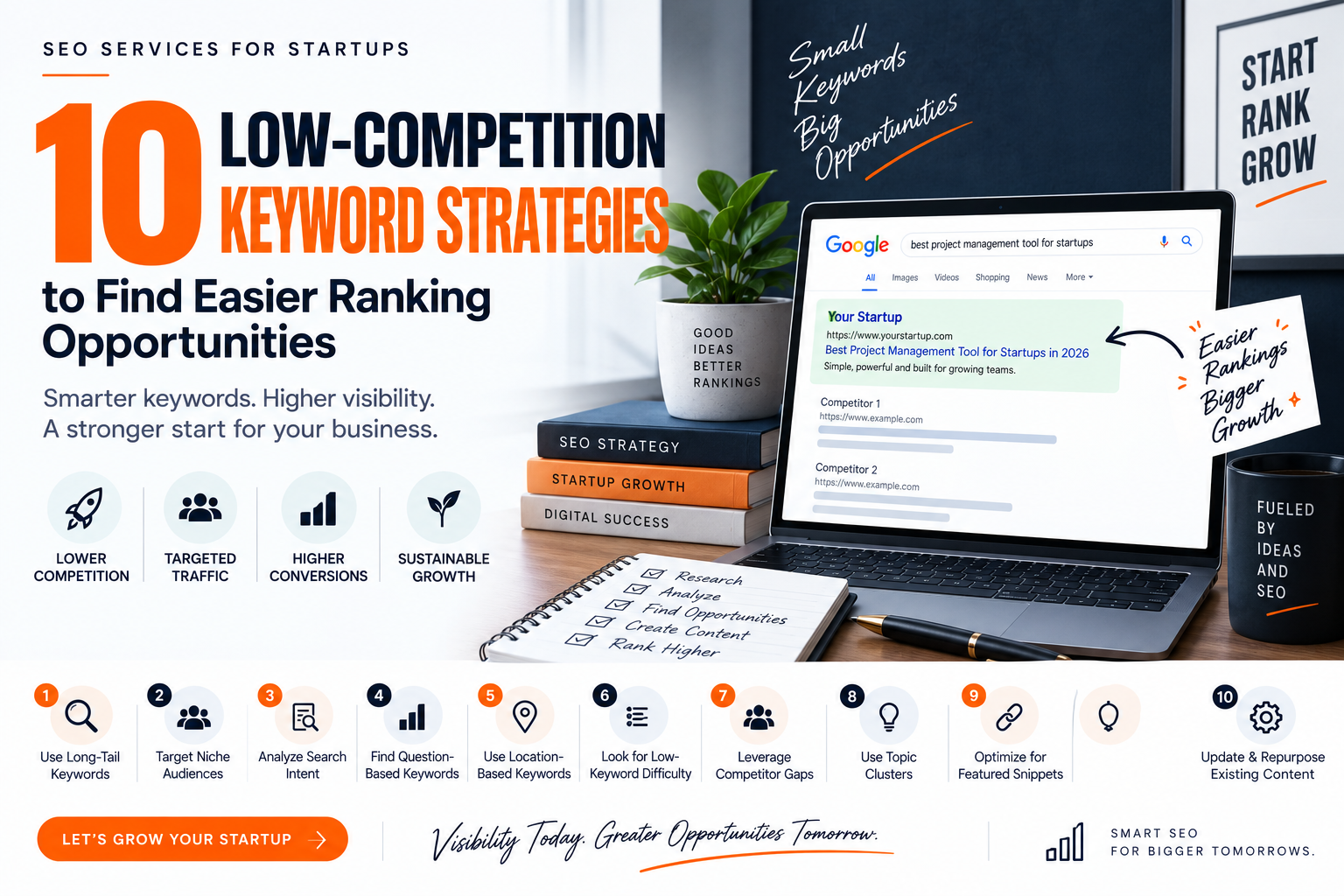
SEO Services for Startups: 10 Low-Competition Keyword Strategies to Find Easier Ranking Opportunities
Getting a new startup website to rank on Google can be difficult when you immediately target broad, highly competitive keywords. Established companies often have years of content, thousands of backlinks, strong brand recognition, and significant domain authority. A new business usually does not have those advantages.
That does not mean a startup cannot compete.
The smarter approach is to identify low-competition keywords that are closely connected to your products, services, audience, and location. These keywords may have lower search volume than broad industry terms, but they can provide more realistic ranking opportunities and often attract visitors with clearer intent.
This is one of the most important areas of SEO Services for Startups because startups typically need to make every SEO resource count. Instead of spending months trying to rank for one extremely competitive keyword, a startup can build visibility through multiple specific searches and gradually develop the authority needed to compete for larger terms.
Low-competition keyword research is not simply about finding keywords with low search volume. A keyword is valuable when it combines relevance, achievable competition, meaningful search intent, and business potential.
For example, a web development startup may struggle to rank for “web development company.” But a more specific phrase such as “web development company for SaaS startups” or “affordable website development for small businesses” may provide a more focused opportunity, depending on the actual search results and competition.
The goal is not to find keywords nobody searches for. The goal is to find valuable searches where your startup can realistically provide the best answer or solution.
This guide covers 10 practical keyword strategies, explains how to evaluate ranking opportunities, and shows how startups can turn low-competition searches into a scalable SEO strategy.
Table of Contents
What Are Low-Competition Keywords?
Low-competition keywords are search terms that may be easier to rank for compared with highly competitive keywords in the same industry.
However, “low competition” does not simply mean a keyword has a small search volume.
Consider these two examples:
Keyword A: digital marketing
Keyword B: digital marketing services for healthcare startups
The first keyword is broad and can attract a large number of searches. It is also likely to have substantial competition.
The second keyword is more specific. It has a narrower audience and potentially lower search demand, but the people searching it may have a much clearer need.
For a startup, the second type of keyword can be more useful because it allows the business to create a highly relevant page for a specific audience.
Four characteristics of a useful low-competition keyword
A good opportunity generally has:
Business relevance – The keyword relates directly to something your business offers.
Search intent – The searcher has a clear reason for using the query.
Reasonable competition – The current results are realistically beatable.
Business value – Ranking could potentially generate leads, sales, sign-ups, or meaningful awareness.
This distinction matters because targeting keywords that nobody searches for will not produce meaningful organic growth.
The purpose of SEO Services for Startups should not be to collect hundreds of low-volume keywords. It should be to identify search opportunities that connect your startup with potential customers.
Why Low-Competition Keywords Matter for Startups
Startups usually operate with fewer resources than established businesses.
You may have:
A new domain
Limited content
Few backlinks
Small marketing budgets
Limited brand awareness
A small SEO team
No established search authority
Trying to compete immediately with websites that have dominated search results for years can be inefficient.
Low-competition keywords provide a way to build visibility gradually.
They can provide more realistic early opportunities
A highly competitive keyword may require significant authority and a large content investment.
A specific keyword can sometimes be approached with one highly focused page.
For example, instead of creating a generic article targeting:
“SEO”
a startup could create:
“SEO checklist for early-stage SaaS startups.”
The second topic allows the company to address a specific audience and problem in greater detail.
They can attract highly relevant traffic
Traffic volume is not the only consideration.
Imagine:
Keyword A generates 10,000 searches but has weak relevance to your product.
Keyword B generates 500 searches and closely matches your service.
Keyword B could potentially produce more valuable visitors.
They help build topical authority
Ranking for related, specific searches can help a website establish depth around a subject.
Once your website has strong coverage of a topic, it may become better positioned to compete for broader terms.
This is why SEO Services for Startups should often begin with focused opportunities and expand toward more competitive keywords as the website develops.
10 Low-Competition Keyword Strategies
1. Target Specific Long-Tail Keywords
Long-tail keywords are longer and more specific search queries.
Examples include:
SEO services for SaaS startups
affordable SEO services for small businesses
website development company for startups
local SEO services for restaurants
Google Ads agency for ecommerce startups
Compared with broad keywords, long-tail searches usually describe a more specific need.
Why they work for startups
Specific searches can make it easier to create highly relevant content.
If someone searches for:
“SEO services for SaaS startups”
they are providing considerably more context than someone searching for:
“SEO.”
The first search tells you:
The person is interested in SEO.
They may be associated with a SaaS business.
They are potentially looking for a service.
They may have specific startup-related requirements.
That gives you an opportunity to create a page that directly addresses those needs.
How to find long-tail opportunities
Start with your primary service.
Then add relevant modifiers related to:
Audience
Industry
Location
Problem
Budget
Experience level
Use case
Product type
For example:
Base keyword: SEO services
Possible variations:
SEO services for startups
affordable SEO services for startups
technical SEO services for startups
local SEO services for startups
SEO services for SaaS startups
Do not create a separate page for every variation automatically. First determine whether the search intent is different enough to justify a separate page.
Long-tail keyword research is often one of the first activities included in effective SEO Services for Startups because it gives new websites a practical way to prioritize achievable opportunities.
2. Use Customer Problem-Based Keywords
People do not always search for products or services directly.
Sometimes they search for the problem they are trying to solve.
For example, someone may not search:
website optimization services
Instead, they may search:
why is my website slow
how to get more leads from my website
why is my website not ranking
how to improve website conversions
how to reduce website bounce rate
These problem-focused searches can reveal valuable content opportunities.
Create content around real problems
Suppose your startup sells SEO services.
Instead of only creating service pages, you can create useful resources such as:
Why Is My New Website Not Ranking on Google?
Within the article, you can explain:
Indexing issues
Weak keyword targeting
Poor search intent alignment
Lack of authority
Technical problems
Thin content
Competition
The article can then naturally direct interested readers toward your relevant service page.
Use customer conversations
Your best keyword ideas may already exist inside your business.
Review:
Sales calls
Customer emails
Support conversations
FAQs
Chat messages
Consultation questions
Product reviews
Look for repeated questions.
If multiple prospects ask the same question, there is a good chance that the question deserves a useful website resource.
This approach makes SEO Services for Startups more customer-focused because keyword research begins with actual problems rather than keyword tools alone.
3. Find Location-Based Keyword Opportunities
If your startup serves a specific geographic area, location-based keywords can provide strong opportunities.
Examples:
SEO agency in Hyderabad
digital marketing agency in Bangalore
website development company in Mumbai
branding agency in Delhi
local SEO services in Pune
The exact competition will depend on the location and industry.
Why local keywords can be valuable
Location-based searches narrow the audience.
A person searching:
SEO agency in Hyderabad
is likely looking for a provider in Hyderabad.
That is considerably more commercially focused than someone searching:
SEO agency
for a business that only serves one city.
Create useful local pages
A local landing page should provide actual information about serving that area.
Include:
Services available
Areas served
Local customer needs
Relevant examples
Testimonials
Business information
Contact options
Location-specific FAQs
Do not create dozens of pages where only the city name changes.
Google and users need a genuine reason for each page to exist.
Combine location and niche
One useful strategy is combining geographic and audience modifiers.
For example:
SEO services for startups in Hyderabad
can be more specific than:
SEO services
However, always verify actual search demand and search results before investing heavily in a keyword.
For startups serving local markets, SEO Services for Startups can work particularly well when combined with a focused local SEO strategy.
4. Target Industry-Specific Keywords
Another way to reduce competition is to focus on a particular industry.
Broad:
SEO services
Industry-specific:
SEO services for SaaS companies
Other examples include:
SEO for healthcare startups
SEO for law firms
SEO for ecommerce businesses
SEO for real estate companies
SEO for education startups
SEO for fintech companies
Why niche targeting works
Different industries have different:
Customer journeys
Search behavior
Regulations
Terminology
Content requirements
Conversion processes
A general SEO page may not address these differences.
An industry-specific page can.
For example, an SEO agency serving SaaS companies could explain:
Product-led growth
SaaS keyword funnels
Comparison pages
Feature-based searches
Integration pages
Free-trial conversion
Recurring revenue economics
That level of specificity can make the content more useful.
Don’t create artificial niches
Only target an industry if your business genuinely understands or serves it.
Creating pages for every industry simply because they contain keywords can produce weak content.
Your niche pages should demonstrate actual expertise.
5. Use Commercial Keyword Modifiers
Keyword modifiers can help you discover more specific commercial searches.
Common modifiers include:
Best
Affordable
Professional
Local
Expert
Agency
Company
Services
Consultant
For small business
For startups
For ecommerce
Near me
For example:
SEO
can become:
affordable SEO services for startups
or:
SEO consultant for small businesses
Why commercial modifiers matter
Someone searching for:
what is SEO
is looking for information.
Someone searching for:
SEO services for startups
may be comparing providers.
Someone searching for:
hire SEO consultant for startup
has even stronger commercial intent.
These searches should be handled with different types of pages.
Build commercial pages carefully
A commercial landing page should not simply contain a keyword repeated throughout the copy.
It should explain:
What you provide
Who you serve
Your process
What customers receive
Expected outcomes
Relevant experience
Frequently asked questions
How to get started
The keyword helps define the topic, but the page must convince a real customer.
This is an important distinction in SEO Services for Startups: ranking is valuable, but the page must also be capable of converting qualified visitors.
6. Find Question-Based Keywords
Question searches can provide excellent content opportunities.
Examples:
How long does SEO take for a startup?
How much does startup SEO cost?
How do I find low-competition keywords?
How can a new website rank on Google?
Does SEO work for startups?
How many keywords should a startup target?
Question-based searches are particularly useful for blog content and guides.
Start with customer questions
Create a list of questions your target customers ask before buying.
Then group them into categories:
Pricing questions
How much does SEO cost?
What does an SEO agency include?
Process questions
How does SEO work?
How long does SEO take?
Problem questions
Why is my website not ranking?
Why did my traffic decrease?
Comparison questions
SEO vs Google Ads
In-house SEO vs agency
Each category can support different content.
Avoid answering questions superficially
If you target a question, answer it properly.
Include:
Direct answer
Explanation
Examples
Practical steps
Relevant data where available
Related questions
A 500-word article that repeats the same generic answer five times is not automatically better than a concise, genuinely useful explanation.
The goal of SEO Services for Startups should always be to create content that solves a real searcher’s problem.
7. Analyze Competitor Keyword Gaps
Your competitors can reveal keyword opportunities that you may not have considered.
A competitor keyword gap occurs when another website ranks for relevant searches that your website does not target.
How to find gaps
Choose several direct competitors.
Look at:
Their service pages
Blog topics
Industry pages
Location pages
Comparison content
Resource guides
Frequently asked questions
Use an SEO keyword research platform to identify terms for which competitors rank.
Then filter the list.
Do not copy every keyword.
Ask:
Is this relevant to my business?
Can I create something better?
Does this keyword have business value?
Can my website realistically compete?
Look for weak search results
Sometimes the opportunity is not simply low keyword difficulty.
Look at the actual search results.
You may find pages that:
Do not fully answer the query
Are outdated
Have poor user experience
Lack specific examples
Are too general
Do not address the search intent well
That can create an opportunity to publish a better resource.
Competitor research is therefore an important part of SEO Services for Startups, but it should be used to identify opportunities rather than duplicate competitors.
8. Target Supporting and Related Keywords
Do not build your entire SEO strategy around one primary keyword.
Instead, identify related searches around the same subject.
Suppose your main topic is:
SEO Services for Startups
Supporting topics could include:
startup keyword research
technical SEO for startups
startup content strategy
local SEO for startups
startup link building
SEO analytics for startups
SEO mistakes startups make
startup SEO checklist
Each article can target its own search intent while connecting back to the main topic.
Build topic clusters
A topic cluster typically includes:
Pillar page
A comprehensive page covering the main subject.
Supporting pages
Detailed articles covering specific subtopics.
Internal links
Links connecting the related content.
This structure helps users navigate your resources and gives search engines clearer contextual relationships between pages.
Avoid cannibalization
If two pages target nearly identical search intent, they may compete against each other.
Before creating a new page, ask:
Do I need a new page, or should I improve an existing page?
Sometimes combining two weak articles into one comprehensive resource is the better SEO decision.
Building content clusters strategically is a major component of scalable SEO Services for Startups because it allows a website to expand topical coverage without creating unnecessary pages.
9. Look for Emerging and Trending Searches
New businesses sometimes have an advantage when they target emerging topics early.
New technologies, products, regulations, platforms, and consumer behaviors can create search demand before the competition becomes intense.
Examples could include:
New software categories
Emerging AI tools
New industry regulations
New technologies
New search features
New business models
Newly popular products
Why timing matters
Established websites often dominate older, highly competitive topics.
Emerging subjects may have fewer comprehensive resources.
A startup that identifies an emerging topic early can publish useful content before the search landscape becomes crowded.
Don’t chase every trend
A trend is only valuable if it relates to your business.
Ask:
Is this relevant to my audience?
Can my business provide useful information?
Does the topic have commercial potential?
Is the interest likely to last?
Can we add original insight?
Build evergreen value
If possible, connect a trend to a broader topic.
For example, instead of writing only:
“New SEO Tool Released in 2026”
you could create:
“How New SEO Tools Are Changing Keyword Research for Startups”
The second topic has a stronger chance of remaining useful after the initial news cycle.
Using emerging search opportunities as part of SEO Services for Startups can help a new website build visibility in areas where established competitors may not yet have comprehensive content.
10. Find Low-Competition Keywords With Strong Buying Intent
The best low-competition keyword is not always the one with the lowest difficulty.
Business intent matters.
Consider these searches:
“what is digital marketing”
and
“digital marketing agency for SaaS startups”
The first may have significantly more search volume.
The second may have fewer searches but stronger commercial relevance.
For a service business, the second keyword may be more valuable.
Look for purchase signals
Commercial intent often appears through terms such as:
Services
Agency
Company
Consultant
Pricing
Cost
Quote
Hire
Provider
Software
Platform
Best
Near me
These modifiers can help identify people who are evaluating solutions.
Connect keywords to revenue
Create a simple keyword scoring system.
For each keyword, rate:
| Factor | Score |
|---|---|
| Business relevance | 1–5 |
| Search intent | 1–5 |
| Ranking opportunity | 1–5 |
| Conversion potential | 1–5 |
| Content fit | 1–5 |
A keyword scoring 23/25 could deserve more attention than a keyword scoring 14/25 even if the second keyword has greater search volume.
This prevents startups from choosing keywords based only on traffic estimates.
The goal of SEO Services for Startups should be to attract people who are relevant to the business, not simply maximize visitor numbers.
How to Evaluate a Low-Competition Keyword
Before targeting any keyword, evaluate the actual search results.
Keyword difficulty tools can provide useful estimates, but they should not be your only source of information.
1. Check search intent
Search the keyword on Google.
Look at the results.
Are they:
Blog posts?
Service pages?
Product pages?
Videos?
Forums?
Guides?
Local businesses?
The results reveal what Google believes users want.
2. Evaluate competitors
Look at the top-ranking pages.
Ask:
How comprehensive are they?
Are they current?
Are they well structured?
Do they answer the query directly?
Do they have strong authority?
Do they demonstrate expertise?
3. Check business relevance
Would someone searching the keyword realistically become your customer?
If not, it may not deserve priority.
4. Estimate traffic potential
Search volume can help estimate demand, but it should not be treated as an exact traffic forecast.
A keyword with 200 monthly searches can still be valuable if it produces qualified leads.
5. Check conversion potential
Ask:
What happens if I rank?
If the answer is “we might get visitors,” that is incomplete.
A better answer is:
“We can attract qualified visitors who may request a consultation.”
That is a business outcome.
How to Map Keywords to Your Website
Once you have selected keywords, assign them to specific pages.
A basic keyword map could look like this:
| Keyword Type | Recommended Page |
|---|---|
| Main service keyword | Service page |
| Location keyword | Location landing page |
| Industry keyword | Industry service page |
| Informational question | Blog article |
| Comparison keyword | Comparison guide |
| Product keyword | Product page |
| High-intent commercial keyword | Service or landing page |
| Supporting topic | Blog/resource page |
Example
For a startup SEO agency:
Primary service page:
SEO Services for Startups
Supporting articles:
Low-competition keyword research
Startup technical SEO
Startup content strategy
SEO timeline
Local SEO for startups
Startup SEO mistakes
This creates a connected content ecosystem.
Do not force multiple unrelated keywords onto one page simply because they contain similar words.
One page should have a clear primary purpose.
A Practical Keyword Research Process for Startups
Here is a simple process you can repeat every month.
Step 1: List your services
Write down every major product or service your business offers.
Step 2: Define your audience
Identify:
Industry
Company size
Location
Job role
Customer problem
Buying stage
Step 3: Create seed keywords
Start with basic terms related to your services.
Step 4: Expand the list
Use keyword research tools, Google suggestions, related searches, competitor analysis, customer questions, and industry discussions.
Step 5: Add modifiers
Test modifiers such as:
For startups
For small businesses
Local
Affordable
Professional
Industry-specific
Location-specific
Step 6: Analyze the SERPs
Search each important keyword manually.
Study the pages already ranking.
Step 7: Group similar keywords
Put keywords with the same search intent together.
Step 8: Assign keywords to pages
Decide whether each group deserves:
Service page
Landing page
Blog post
Guide
Product page
Location page
Step 9: Prioritize
Rank opportunities according to:
Relevance + intent + competition + business value.
Step 10: Publish and measure
Monitor impressions, clicks, rankings, organic traffic, and conversions.
Then improve the pages based on actual data.
This process is more sustainable than selecting keywords randomly every time you publish an article.
Common Low-Competition Keyword Mistakes
Choosing keywords only because they have low difficulty
A low-difficulty keyword is useless if nobody searches for it or if it has no relevance to your business.
Ignoring search intent
You can create an excellent article and still fail to rank if Google expects a completely different type of content.
Creating separate pages for every variation
This can create duplicate or overlapping content.
Group keywords based on intent instead.
Targeting extremely low-volume keywords
Low competition does not automatically mean good opportunity.
Look for a balance between accessibility and business value.
Stuffing keywords into content
Repeating a phrase unnaturally does not make an article better.
Write for the reader first.
Copying competitors
Competitor research should identify opportunities, not encourage duplication.
Your content should provide additional value.
Ignoring conversion optimization
Ranking is only one part of SEO.
A page should also make it easy for qualified visitors to take the next step.
Publishing without measuring results
Without performance data, you cannot know which topics are working.
Track results and continuously improve.
Frequently Asked Questions
1. What are the best low-competition keywords for startups?
There is no universal list. The best keywords depend on your industry, audience, location, products, services, and competition. Long-tail, industry-specific, location-specific, problem-based, and commercial-intent keywords are often useful places to begin.
2. How do I find low-competition keywords?
Start with your products and services, then expand into long-tail variations, customer questions, location terms, industry terms, competitor gaps, and related searches. After creating a keyword list, manually review Google’s search results to assess the actual competition.
3. Should startups target high-volume keywords?
Eventually, yes, but they do not necessarily need to start there. A startup with a new domain may benefit from targeting more specific opportunities first and moving toward broader, more competitive terms as its authority and content depth grow.
4. Are long-tail keywords better for startups?
Long-tail keywords can be particularly useful because they are more specific and can have clearer search intent. However, they should still have sufficient relevance and potential value to justify creating content around them.
5. How many low-competition keywords should a startup target?
There is no fixed number. Start with a focused group of keywords connected to your highest-value services and customer problems. Expand the keyword set as your content and website authority grow.
6. Should every low-competition keyword have its own page?
No. Several keywords with the same search intent can often be targeted by one strong page. Create separate pages when the keywords represent substantially different needs or search intents.
7. Can low-competition keywords generate leads?
Yes. In many cases, highly specific keywords can attract visitors with clearer needs. The important factor is not only ranking difficulty but also the keyword’s commercial relevance and conversion potential.
8. How important is search volume?
Search volume is useful for estimating demand, but it should not be the only deciding factor. A lower-volume keyword with strong buying intent can be more valuable than a high-volume keyword with weak commercial relevance.
9. How long does it take to rank for low-competition keywords?
There is no guaranteed timeline. Results depend on competition, website authority, technical SEO, content quality, search intent, backlinks, and many other factors. Some easier keywords may gain visibility relatively quickly, while others can take much longer.
10. Can professional SEO Services for Startups help with keyword research?
Yes. A professional SEO team can help identify keyword opportunities, analyze competitors, map search intent, prioritize terms, create content plans, and monitor performance. The value comes from connecting keyword research with the startup’s actual business goals.
Final Takeaway
Startups do not need to win the most competitive Google searches immediately.
They need to find the right opportunities.
Low-competition keyword research gives new businesses a practical way to enter search results without competing head-on with the largest websites from day one. By focusing on long-tail searches, customer problems, locations, industries, commercial modifiers, questions, competitor gaps, related topics, emerging searches, and high-intent terms, startups can build a more focused organic search strategy.
But keyword difficulty should never be the only factor.
A keyword becomes valuable when it is relevant to your audience, matches search intent, has realistic competition, and can contribute to a meaningful business outcome.
That is why effective SEO Services for Startups should combine keyword research with content strategy, technical SEO, on-page optimization, internal linking, authority building, and conversion optimization.
The process should be continuous.
Find an opportunity.
Create the best page for that search.
Connect it to related content.
Promote it where appropriate.
Measure performance.
Improve the page.
Then move to the next opportunity.
Over time, dozens of focused ranking opportunities can build into a much larger organic search presence.
The objective is not to rank for every keyword in your industry.
It is to build visibility for the searches that matter most to your customers and your business.
For startups working with limited resources, that focused approach makes SEO Services for Startups more efficient, measurable, and capable of supporting sustainable organic growth.
Finding low-competition keywords is only one part of building a successful startup SEO strategy. Once you identify the right keywords, they should be connected to relevant service pages and supporting content through a clear internal linking structure. For example, a startup targeting low-competition search terms can strengthen its overall strategy by combining keyword research, technical SEO, content optimization, and local SEO. You can also explore our SEO Services for Startups to learn how a structured approach can help identify realistic ranking opportunities, optimize important pages, and build long-term organic visibility.
When researching low-competition keywords, it is important to look beyond keyword volume and consider how Google evaluates content, relevance, and search visibility. Google’s official SEO Starter Guide provides useful guidance on creating search-friendly websites, organizing content, and helping search engines understand your pages. Startups can use these fundamentals alongside a focused SEO Services for Startups strategy to identify realistic keyword opportunities and build content that genuinely helps their target audience. Google Search Central SEO Starter Guide
You can also use Google Search Console to monitor which search queries are generating impressions and clicks for your website. This data can help identify keywords where your pages are already gaining visibility but may need better optimization to capture more traffic. Google Search Console
For startups targeting local customers, Google’s Business Profile Help is another useful resource for understanding how businesses can manage their presence across Google Search and Maps. Combining local optimization with targeted keyword research can strengthen the overall approach to SEO Services for Startups. Google Business Profile Help