Brand Identity Design Services: 10 Ways Brand Strategy Shapes Visual Design
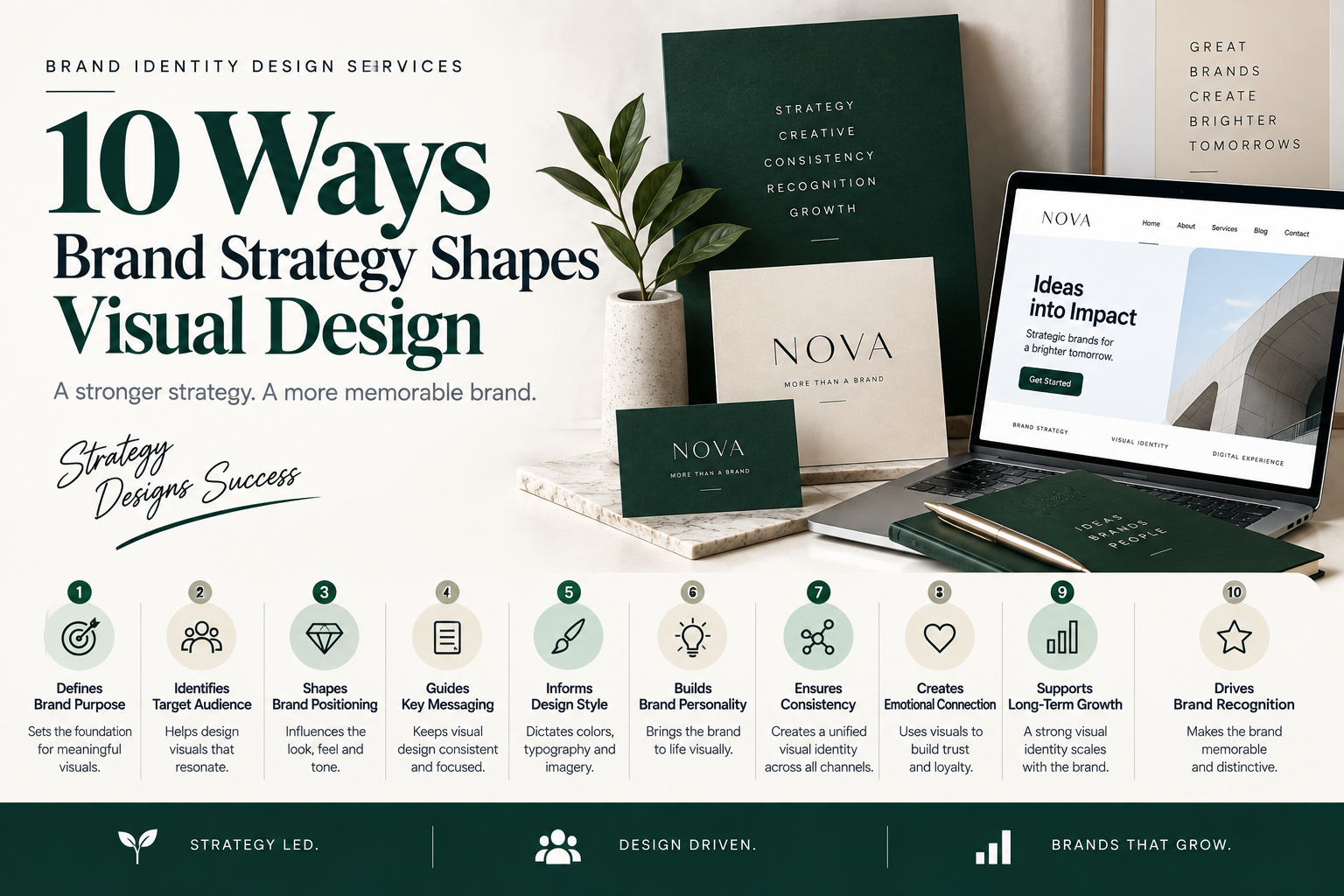
Brand Identity Design Services: 10 Ways Brand Strategy Shapes Visual Design
A strong visual identity does not begin with a colour palette, a font, or a logo sketch. It begins with a clear understanding of what a brand stands for.
Many businesses make the mistake of treating visual design as a separate creative exercise. They choose colours they like, select a modern font, ask for a professional-looking logo, and then try to build their branding around those decisions. The result may look attractive, but it often lacks direction.
Good branding works differently.
The strategy comes first, and visual design translates that strategy into something people can see, recognize, and remember. When the two are connected properly, every design decision has a purpose. The logo reflects the brand personality. The colours support the positioning. Typography communicates the right tone. Images speak to the intended audience. Even layouts and graphic elements contribute to the same message.
This is one of the main reasons businesses work with professional Brand Identity Design Services. The goal is not simply to make a company look polished. It is to turn its strategy, personality, values, and positioning into a visual system that can be used consistently.
A useful way to understand the relationship is simple:
Brand strategy defines what the brand should communicate. Visual design determines how people see that message.
In this article, we will look at 10 important ways brand strategy shapes visual design and why businesses should connect both before developing their identity.
Table of Contents
What Is Brand Strategy?
What Is Visual Design?
Why Should Brand Strategy and Visual Design Work Together?
10 Ways Brand Strategy Shapes Visual Design
Brand Positioning Determines the Visual Direction
Target Audience Influences Design Choices
Brand Personality Shapes the Look and Feel
Brand Values Influence Visual Elements
Brand Differentiation Guides Creative Decisions
Brand Voice Connects Visuals With Communication
Brand Purpose Gives Meaning to Design
Competitive Positioning Helps Create a Distinct Identity
Customer Experience Shapes the Complete Visual System
Long-Term Business Goals Influence Design Flexibility
The Role of Brand Identity Design Services
Common Disconnects Between Strategy and Design
How to Connect Brand Strategy With Visual Design
FAQs
Conclusion
What Is Brand Strategy?
Brand strategy is the foundation behind how a business wants to be understood in the market.
It answers important questions such as:
Who are we?
Who are our customers?
What problem do we solve?
What makes us different?
What do we stand for?
How do we want customers to perceive us?
What kind of experience should customers have?
Why should someone choose us instead of a competitor?
Brand strategy can include positioning, target audience, brand purpose, values, personality, messaging, differentiation, and long-term goals.
For example, imagine two businesses selling similar skincare products.
One wants to position itself as an affordable, simple skincare brand for young consumers. The other wants to position itself as a premium, science-focused skincare company.
The products may belong to the same industry, but their strategies are different.
Their visual identities should therefore be different too.
The first brand might use bright, approachable visuals and straightforward communication. The second might use restrained colours, sophisticated typography, detailed product photography, and a more technical communication style.
The design follows the strategy.
What Is Visual Design?
Visual design is the visible expression of a brand.
It includes elements such as:
Logo
Colour palette
Typography
Photography
Illustration
Icons
Patterns
Shapes
Layouts
Packaging
Website visuals
Social media graphics
Marketing materials
These elements work together to create a visual identity.
A visual identity should make a brand recognizable, but recognition is only one part of the job. It should also communicate the brand’s personality and positioning.
If a company claims to be innovative but its visual identity looks outdated, customers may notice the contradiction.
If a premium company uses poor-quality visuals, its design can weaken the perception it is trying to create.
Visual design is therefore not decoration added after strategy. It is one of the main ways strategy becomes visible.
Why Should Brand Strategy and Visual Design Work Together?
A business can have excellent strategy and poor design.
It can also have beautiful design and weak strategy.
Neither situation creates a strong brand.
When strategy and design work together, the business can communicate more clearly.
For example:
Strategy: We are a professional financial technology company focused on making complex financial services easier.
Visual direction: Clean layouts, confident typography, simple diagrams, clear information hierarchy, and a modern but trustworthy colour system.
The design reflects the strategic idea.
Without that connection, designers may make decisions based mostly on trends or personal preferences.
This is why professional Brand Identity Design Services usually involve strategic discovery before visual development.
10 Ways Brand Strategy Shapes Visual Design
1. Brand Positioning Determines the Visual Direction
Brand positioning describes the place a company wants to occupy in the minds of its customers.
It answers a basic question:
What should people think of when they think about this brand?
A company positioned as premium will usually need a visual identity that communicates quality, exclusivity, and attention to detail.
A company positioned as affordable and accessible may need a more approachable visual system.
A technology company positioned around innovation may require a modern visual language.
The design should reinforce the position rather than contradict it.
Positioning can influence:
Colour choices
Typography
Logo style
Photography
Layout
Packaging
Website design
Advertising style
Consider a luxury interior design company.
If its positioning focuses on sophisticated, high-end interiors, using loud colours, playful typography, and crowded layouts may create the wrong impression.
A restrained colour palette, elegant typography, strong photography, and generous spacing may better communicate the intended position.
This does not mean every premium brand needs black and gold. It means visual decisions should support the position rather than being selected randomly.
Effective Brand Identity Design Services translate positioning into a visual direction that customers can understand without needing the strategy document in front of them.
2. Target Audience Influences Design Choices
A brand is not designed for everyone.
The target audience has a major influence on how the identity should look and communicate.
A design that appeals to teenagers may not work for corporate executives. A visual identity created for children will have different requirements from one created for healthcare professionals.
Understanding the audience helps designers make practical decisions.
Important audience factors include:
Age
Lifestyle
Expectations
Industry
Income level
Cultural background
Buying behaviour
Digital habits
Preferences
Problems and needs
Suppose a company sells educational software to university students.
Its audience may respond better to a modern, approachable, digital-first identity than to a formal corporate visual system.
On the other hand, a company selling enterprise software to large financial institutions may need a more restrained and professional approach.
The purpose is not to follow stereotypes. It is to understand what visual language is likely to communicate effectively with the intended audience.
Good design begins with understanding the people who will see it.
3. Brand Personality Shapes the Look and Feel
If brand strategy defines the personality of a business, visual design gives that personality a visible form.
A brand can be:
Bold
Friendly
Serious
Playful
Premium
Minimal
Energetic
Traditional
Innovative
Trustworthy
These characteristics influence design choices.
For example, a playful brand may use:
Brighter colours
Rounded shapes
Friendly typography
Illustrations
Informal layouts
A professional consulting company may use:
Structured layouts
Neutral colours
Strong typography
Clean photography
Formal visual hierarchy
The important point is that the visual personality should be intentional.
Without a defined personality, designers may create something that looks attractive but does not feel connected to the business.
This is where Brand Identity Design Services provide value by connecting strategic personality traits with practical design decisions.
4. Brand Values Influence Visual Elements
Brand values explain what matters to a business.
Common examples include:
Sustainability
Innovation
Transparency
Quality
Simplicity
Accessibility
Reliability
Creativity
Community
These values can influence visual design.
Imagine a company whose strategy is strongly based on sustainability. Its identity should not rely only on green colours and leaf icons. Instead, sustainability can influence the overall visual system through natural imagery, thoughtful materials, restrained design, responsible packaging, and authentic communication.
Similarly, a brand that values simplicity may use a clean interface, limited visual elements, straightforward typography, and concise messaging.
The connection needs to go deeper than symbolism.
If the company says simplicity is a core value but its website is confusing and overloaded with information, the visual experience does not support the stated value.
A strong identity makes strategic values visible through repeated design choices.
5. Brand Differentiation Guides Creative Decisions
Every competitive market has visual patterns.
Restaurants may use certain colour combinations. Technology companies may favour particular styles of typography. Financial companies often use conservative visual systems.
Following the category too closely can make a brand difficult to distinguish.
Brand strategy should identify what makes the business different.
That difference can then influence visual design.
For example, if most competitors in an industry use dark corporate colours, a business may find an opportunity to develop a more distinctive but still credible colour system.
If competitors rely heavily on generic stock photography, a company may build recognition through original photography or a unique illustration style.
Differentiation does not mean being unusual for the sake of being unusual.
The design must still make sense for the audience and category.
The goal is to answer:
“How can we look like we belong in this market without looking exactly like everyone else?”
Professional Brand Identity Design Services can help identify this visual opportunity by combining brand strategy with competitive research.
6. Brand Voice Connects Visuals With Communication
Brand voice is usually discussed as a writing issue, but it also has an important connection with visual design.
Imagine a brand that communicates in a warm, friendly, conversational tone but uses extremely formal and rigid visual design.
The experience may feel inconsistent.
The same applies in reverse.
A bold brand voice needs visual confidence. A sophisticated brand voice may need a more refined visual system.
Brand voice can influence:
Typography
Headlines
Layout
Photography
Illustrations
Graphic style
Social media design
For example, a playful brand might combine conversational copy with expressive illustrations and flexible layouts.
A professional B2B brand might use concise copy with structured layouts, clear data visualizations, and restrained imagery.
The customer should feel that the words and visuals belong to the same company.
That consistency makes the brand easier to understand and remember.
7. Brand Purpose Gives Meaning to Design
Brand purpose explains why a business exists beyond simply selling products or services.
A purpose can provide creative direction.
For example, a company may exist to make education more accessible. Its visual identity could emphasize clarity, openness, inclusivity, and accessibility.
A healthcare organization focused on improving patient confidence may use visual choices that communicate calmness, clarity, and reassurance.
The purpose does not need to appear literally in every graphic.
Instead, it can influence the overall design approach.
This prevents visual identity from becoming a collection of disconnected aesthetic choices.
A meaningful identity should answer more than:
“Does this look good?”
It should also answer:
“Does this look like us?”
and
“Does this communicate what we stand for?”
That distinction separates strategic design from decoration.
8. Competitive Positioning Helps Create a Distinct Identity
Competitor research is an important part of brand strategy.
Before creating an identity, businesses should understand how competitors present themselves.
Look at:
Logos
Colours
Typography
Websites
Packaging
Social media
Advertising
Messaging
Photography
The purpose is not to copy competitors.
It is to identify patterns.
Suppose most businesses in a particular market use blue logos, corporate photography, and conservative typography.
That information tells the design team something useful.
The brand could either follow those conventions because they communicate an important category expectation or deliberately introduce distinctive elements to stand apart.
Both choices can be valid.
The decision should come from strategy.
A strong visual identity balances category relevance and differentiation.
If a brand looks completely disconnected from its industry, customers may not immediately understand what it does. If it looks exactly like its competitors, customers may not remember it.
Strategic visual design finds the middle ground.
9. Customer Experience Shapes the Complete Visual System
Brand identity is experienced at many points, not just through advertising.
Customers may interact with a business through:
Website
Mobile application
Social media
Packaging
Emails
Presentations
Sales materials
Customer support
Physical stores
Digital advertisements
Each interaction contributes to the overall brand experience.
This means brand strategy should consider how the identity behaves across different touchpoints.
For example, a logo that works well on a website may need an icon version for mobile applications.
A colour palette that looks good in print may need accessible digital alternatives.
A photography style that works for advertisements may need adaptation for social media.
A strong identity is therefore designed as a system rather than as a single finished graphic.
This is another area where Brand Identity Design Services can help. The identity can be developed with real-world applications in mind instead of being designed only for presentation.
10. Long-Term Business Goals Influence Design Flexibility
A brand identity should not only solve today’s problem.
It should have enough flexibility to support the business as it grows.
Imagine a company that currently sells one product but plans to launch several product categories over the next five years.
Its identity needs room for expansion.
Similarly, a startup may begin in one market but eventually expand into other regions or industries.
Strategic planning helps designers anticipate these possibilities.
Long-term considerations can include:
New products
New services
New markets
Digital platforms
Physical locations
Product packaging
Sub-brands
Partnerships
International expansion
A rigid identity can become difficult to manage when a business grows.
A flexible design system can adapt without losing recognition.
This is why professional Brand Identity Design Services should consider where the business is going, not only where it is today.
The Role of Brand Identity Design Services
The connection between strategy and design is one of the biggest reasons businesses choose professional Brand Identity Design Services.
The process usually starts before the actual design work.
1. Research
The design team learns about the company, industry, audience, competitors, and existing brand perception.
2. Strategy Review
The team identifies important strategic characteristics such as positioning, personality, values, audience, and differentiation.
3. Creative Direction
These strategic findings are translated into possible visual directions.
Moodboards, typography options, colour concepts, photography styles, and design references may be explored.
4. Identity Development
The selected direction is developed into a complete visual system.
This may include:
Logo
Colour palette
Typography
Icons
Graphics
Photography
Layout principles
5. Brand Guidelines
Rules are documented so the identity can remain consistent across different platforms and teams.
6. Real-World Applications
The identity is tested across relevant touchpoints such as websites, social media, packaging, presentations, advertisements, and other marketing materials.
This process helps ensure that the final identity is not only attractive but strategically useful.
Common Disconnects Between Strategy and Design
Even businesses with a documented strategy can experience problems when strategy and design are not properly connected.
Designing Around Trends
Trends can make a brand look modern temporarily, but they should not replace strategic thinking.
A design should remain relevant even after the trend disappears.
Choosing Colours Based Only on Preference
A founder may love a particular colour, but personal preference should not be the only deciding factor.
Colour should support positioning, personality, audience, and usability.
Copying Competitors
A competitor’s successful design is not automatically right for another business.
Every company has different positioning and customers.
Creating a Logo Before Defining the Brand
Starting with the logo can limit strategic thinking.
The identity should be developed from a clear understanding of the brand.
Ignoring Brand Voice
Visuals and words should feel like they belong together.
A disconnect can make the brand feel inconsistent.
Designing for One Platform
An identity should work across the business’s major customer touchpoints.
A design that works only on Instagram is not a complete brand identity.
How to Connect Brand Strategy With Visual Design
Businesses can use a straightforward process to connect strategy and design.
Step 1: Define the Brand Clearly
Write down:
Mission
Vision
Values
Audience
Positioning
Personality
Differentiators
Keep these statements practical rather than filling them with generic business language.
Step 2: Research the Market
Study competitors and identify common visual patterns.
Ask:
What does everyone else look like?
Then ask:
Where can our brand be different while remaining relevant?
Step 3: Create a Personality Framework
Choose a few characteristics that define how the brand should feel.
For example:
Confident + Modern + Helpful + Clear
Use these traits to evaluate design decisions.
Step 4: Translate Strategy Into Design
Now connect each strategic characteristic with visual choices.
For example:
| Brand Strategy | Possible Visual Expression |
|---|---|
| Premium | Refined typography, controlled layouts, high-quality imagery |
| Playful | Expressive graphics, brighter colours, rounded shapes |
| Professional | Structured layouts, strong hierarchy, restrained typography |
| Innovative | Contemporary graphics, flexible layouts, modern typography |
| Approachable | Friendly photography, softer shapes, accessible language |
| Minimal | Limited colours, generous spacing, simple graphics |
These are starting points, not fixed formulas. The right solution depends on the business and its audience.
Step 5: Build a Complete System
Do not stop after creating the logo.
Develop the supporting elements that make the identity recognizable.
Step 6: Test the Identity
Apply the design to real situations.
Ask:
Does it work on mobile?
Is the logo recognizable at small sizes?
Is the typography readable?
Do the colours work digitally and in print?
Does the imagery feel consistent?
Does the identity look different from competitors?
Does it communicate the intended personality?
Step 7: Document Everything
Create brand guidelines that explain how the identity should be used.
This makes consistency easier as the business grows.
FAQs
1. What is the relationship between brand strategy and visual design?
Brand strategy defines what a business stands for, who it serves, how it is positioned, and how it wants to be perceived. Visual design translates those strategic decisions into visible elements such as colours, typography, logos, imagery, and layouts.
2. Why is brand strategy important before designing a logo?
Without strategy, logo design can become based mainly on personal preferences or current trends. Strategy gives the designer a clear reason for making creative decisions.
3. Can visual design change a brand’s perception?
Yes. Visual elements can influence how customers interpret a company. However, design is only one part of perception. The actual product, service, communication, and customer experience also matter.
4. What does Brand Identity Design Services include?
Depending on the project, Brand Identity Design Services can include brand discovery, visual strategy, logo design, colour systems, typography, imagery, graphic elements, brand guidelines, and applications across digital and print platforms.
5. Should a brand follow industry design trends?
A brand should understand trends but should not depend on them. Strategic relevance and differentiation are generally more important than simply looking current.
6. How does the target audience influence visual identity?
Audience expectations can influence colour, typography, imagery, layouts, messaging, and overall visual personality. The goal is to create an identity that communicates effectively with the people the business wants to reach.
7. Can a small business use the same strategic branding process as a large company?
Yes. The scale of the project may be different, but the fundamental principles remain useful: understand the audience, define positioning, identify differentiation, establish personality, and create a consistent visual system.
8. How often should a brand strategy and visual identity be reviewed?
Businesses should review their identity when their market, audience, offerings, positioning, or long-term direction changes significantly. Regular review is useful, but constant redesign can weaken recognition.
9. What is more important: brand strategy or visual design?
Neither works effectively in isolation. Strategy provides direction, while visual design communicates that direction. A strong brand needs both.
10. Can brand identity improve marketing performance?
A clear and consistent identity can make marketing communications easier to recognize and maintain. However, marketing performance also depends on factors such as the offer, audience targeting, messaging, channel selection, and customer experience.
Conclusion
Brand strategy and visual design should never operate as two completely separate processes.
Strategy establishes the foundation. It explains who the brand is, who it wants to reach, what makes it different, what it values, and how it wants to be perceived.
Visual design turns those decisions into something customers can see.
The connection can be seen in every major part of an identity. Positioning influences the visual direction. The target audience influences design choices. Personality shapes the look and feel. Values influence visual elements. Differentiation creates opportunities to stand apart. Brand voice connects words with visuals. Purpose gives design meaning. Competitive positioning helps establish distinction. Customer experience determines how the identity works across touchpoints. Long-term business goals ensure the system can grow.
That is why Brand Identity Design Services should not be viewed as simply hiring someone to create a logo.
The real objective is to build a visual system that represents the business accurately and consistently.
When strategy and design are connected, a brand does not simply look professional. It becomes easier to understand, easier to recognize, and more consistent across every interaction.
A successful identity ultimately answers three questions:
Who are we?
What do we stand for?
Why should customers remember us?
When the strategy provides clear answers and the visual identity communicates those answers effectively, design becomes more than decoration. It becomes a practical tool for building recognition, differentiation, and long-term brand value.
Explore More Gowenza Services
A strong brand strategy becomes even more effective when it is supported by a consistent digital presence. Businesses can strengthen their online identity through Brand Identity Design Services, while Website Development Services ensure the visual strategy is reflected across the website. SEO Services can help improve search visibility, while Graphic Design Services maintain consistent visuals across marketing materials. For broader online growth, Digital Marketing Services and Google Ads Services can help connect the brand with the right audience across relevant digital channels. Together, these services create a more consistent experience from the first brand impression to customer interaction.
Gowenza — Create. Innovate. Elevate.
Understanding how brand strategy influences visual design becomes easier with reliable design and branding resources. Adobe Color can help you explore colour combinations and create effective brand palettes, while Google Fonts offers a wide selection of typefaces for different brand personalities. For research-based insights into usability, visual communication, and user experience, Nielsen Norman Group is another useful resource. Exploring these resources alongside professional Brand Identity Design Services can help businesses make more informed decisions about colour, typography, consistency, and visual communication.