
Brand Identity Design Services: 10 Powerful Differences Between Brand Identity and Brand Image
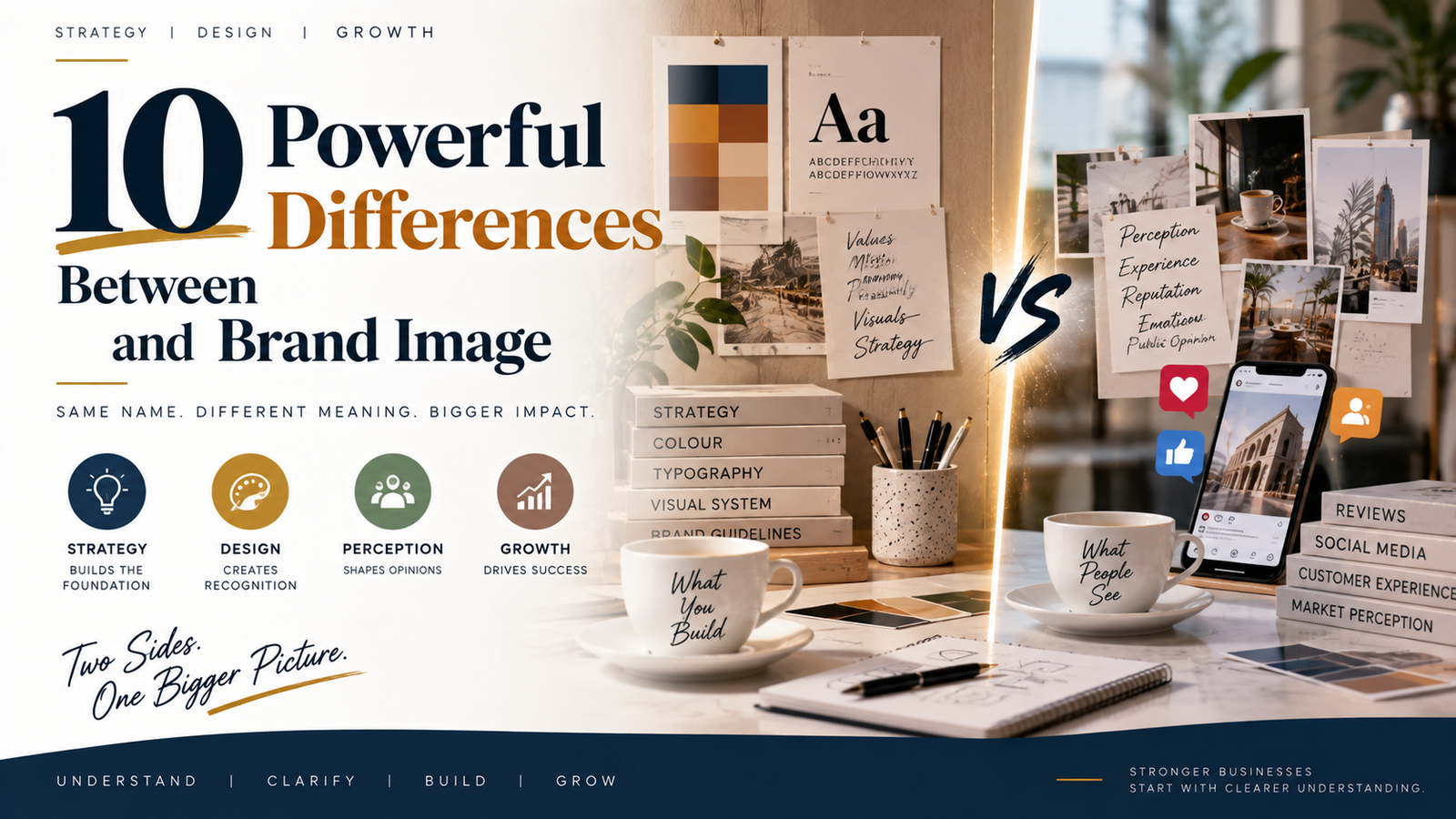
Brand Identity Design Services: 10 Powerful Differences Between Brand Identity and Brand Image
Brand identity and brand image are often used as if they mean the same thing. They are closely connected, but they describe two different sides of branding.
Brand identity is what a business intentionally creates and communicates. It includes the visual and verbal elements that represent the company, such as its logo, colours, typography, messaging, personality, and overall design system.
Brand image, on the other hand, is how customers actually perceive the business.
This difference matters because a company can carefully design an identity and still develop a completely different image in the minds of its customers. A business may want to be seen as premium, but customers may consider it expensive without enough value. A company may position itself as friendly, but poor customer service may create an image of being difficult to deal with.
In other words:
Brand identity is what you build and communicate. Brand image is what people understand and remember.
Professional Brand Identity Design Services help businesses build a clear identity that communicates their positioning consistently. However, the final brand image depends on much more than design. Customer experience, product quality, advertising, reviews, communication, reputation, and every interaction with the business can influence it.
Understanding the difference between these two concepts helps businesses make better branding decisions and avoid one of the most common mistakes in brand strategy: assuming that the identity a company creates is automatically the image customers will have.
This guide explains 10 powerful differences between brand identity and brand image, with practical examples of how they work together.
Table of Contents
What Is Brand Identity?
What Is Brand Image?
Why the Difference Matters
10 Powerful Differences Between Brand Identity and Brand Image
Creation vs Perception
Internal Control vs External Interpretation
Planned vs Experienced
Visual Elements vs Overall Impression
Brand Intent vs Customer Reality
Consistency vs Accumulated Experience
Active Communication vs Passive Perception
Strategic Direction vs Public Reputation
Brand Management vs Customer Response
Designed Identity vs Evolving Image
How Brand Identity Influences Brand Image
How Brand Identity Design Services Help
Common Mistakes Businesses Make
How to Align Brand Identity With Brand Image
FAQs
Conclusion
What Is Brand Identity?
Brand identity is the collection of elements a business intentionally creates to represent itself.
It answers questions such as:
Who are we?
What do we stand for?
How do we want to be recognized?
What personality should our brand communicate?
What should customers see and hear when they interact with us?
Brand identity can include both visual and verbal components.
Visual identity may include:
Logo
Colour palette
Typography
Photography
Illustrations
Icons
Patterns
Graphic elements
Website design
Packaging
Social media designs
Verbal identity may include:
Brand name
Tagline
Brand voice
Messaging
Value proposition
Brand story
Communication style
For example, a company may decide that it wants to be positioned as a modern, trustworthy, and approachable technology brand.
Its identity might therefore use:
Clean typography
A simple logo
A modern colour palette
Clear language
Friendly photography
Minimal layouts
These choices are intentional.
They are part of the company’s identity because the business is actively creating and controlling them.
This is where Brand Identity Design Services can provide strategic value. Instead of designing individual elements separately, professionals can create a complete identity system where the logo, colours, typography, imagery, and other elements communicate a consistent message.
What Is Brand Image?
Brand image is the perception people have of a business.
It exists in the minds of customers, potential customers, employees, partners, and sometimes the wider public.
A company can influence its brand image, but it cannot completely control it.
People develop impressions based on their experiences and the information they receive.
For example, customers may form an opinion based on:
Product quality
Customer service
Website experience
Advertising
Social media
Reviews
Word of mouth
Pricing
Packaging
Company communication
News coverage
Employee interactions
Previous experiences
Suppose a company presents itself as affordable and customer-friendly.
If customers consistently receive helpful support and good value, that identity may contribute to an image of being accessible and reliable.
But if customers regularly experience poor support, their perception may be very different from the identity the company intended to create.
That is why brand image is not simply another design element.
It is the result of how people experience the brand.
Why Does the Difference Matter?
The distinction becomes especially important when businesses evaluate their branding.
A company might say:
“Our brand is premium.”
That statement describes the intended identity.
But customers may say:
“Their products are expensive.”
That describes part of the brand image.
The two statements are not necessarily the same.
A successful brand needs a reasonable level of alignment between what the business communicates and what customers actually perceive.
When there is a large gap, the business may need to examine its:
Positioning
Visual identity
Messaging
Product experience
Customer service
Marketing
Pricing
Website
Overall customer journey
Understanding this distinction allows businesses to diagnose branding problems more accurately.
10 Powerful Differences Between Brand Identity and Brand Image
1. Brand Identity Is Created; Brand Image Is Perceived
The first and most fundamental difference is who creates each one.
Brand identity is created by the business.
Brand image is formed by the audience.
A company chooses its logo, colours, fonts, messaging, tone, packaging, and other brand elements.
Customers then interpret those elements along with their experiences.
For example, a company may select dark blue because it wants to communicate professionalism and reliability.
That is part of its identity.
A customer might instead interpret the same visual identity as conservative or corporate.
That interpretation contributes to the brand image.
This does not mean the business has no influence over its image. It means perception involves the audience and cannot be completely controlled.
Professional Brand Identity Design Services focus heavily on the first side of this relationship: creating an intentional identity that gives customers a clear foundation for understanding the brand.
2. Brand Identity Is Internally Controlled; Brand Image Is Externally Influenced
Businesses have considerable control over their identity.
They can decide:
Which logo to use
Which colours represent the brand
What typography to use
How the website should look
How employees communicate
What messaging appears in advertisements
Brand image is different.
External factors can influence it.
These include:
Customer reviews
Social media conversations
Recommendations
Online discussions
Customer experiences
Competitor comparisons
Public interactions
Imagine a restaurant that creates a sophisticated visual identity and positions itself as a premium dining experience.
The business controls its menu design, interior branding, website, and advertising.
But customers ultimately decide whether the experience actually feels premium.
If service is slow or inconsistent, the resulting image may not match the intended identity.
This is why design cannot replace business quality.
3. Brand Identity Is Planned; Brand Image Develops Through Experience
Brand identity is normally developed through a deliberate process.
Businesses may conduct research, define positioning, develop brand personality, create visual systems, and establish guidelines.
Brand image develops gradually.
Every customer interaction contributes to it.
A person might see an advertisement today, visit the website next week, read reviews a month later, and eventually purchase a product.
Each interaction adds another piece to their perception.
This means brand image is cumulative.
A single advertisement cannot completely define it.
Likewise, a beautiful logo cannot compensate for a consistently poor customer experience.
The identity provides the intended direction, while experience determines how closely reality follows that direction.
4. Brand Identity Includes Specific Elements; Brand Image Is a Broader Impression
Brand identity can be broken into identifiable components.
For example:
Logo + Colour + Typography + Photography + Messaging + Brand Voice + Design System
These elements can be documented in a brand guideline.
Brand image is broader.
A customer’s perception may be described using words such as:
Reliable
Expensive
Friendly
Innovative
Complicated
Trustworthy
Outdated
Convenient
Premium
Accessible
These impressions are not individual design elements.
They are the overall meaning customers attach to the business.
This difference is important when evaluating branding.
If a business wants to improve its image, simply changing the logo may not solve the underlying problem.
The business needs to understand why customers perceive it the way they do.
5. Brand Identity Represents Brand Intent; Brand Image Reflects Customer Reality
Brand identity communicates what the company wants to say about itself.
Brand image reflects what customers believe about the company.
These can be aligned, partially aligned, or completely different.
Consider a hypothetical clothing brand.
Intended identity:
Sustainable
Ethical
Modern
Transparent
The company may use natural colours, minimalist packaging, and messaging focused on sustainability.
But if customers discover that the company’s sustainability claims are unclear or unsupported, their perception may change.
The visual identity still communicates sustainability, but the brand image may become less positive because customers evaluate the business through more than visual design.
This demonstrates an important principle:
Brand identity can create expectations, but brand experience helps determine whether those expectations are fulfilled.
6. Brand Identity Requires Consistency; Brand Image Develops Through Repeated Experiences
Consistency is one of the most important characteristics of a strong identity.
If a company constantly changes its colours, typography, messaging, and visual style, customers may struggle to recognize it.
A consistent identity creates repeated signals.
For example, customers may repeatedly encounter:
The same logo
Similar colour combinations
Consistent typography
Familiar photography
Similar messaging
A recognizable tone
Over time, these repeated signals can strengthen recognition.
However, brand image develops from more than repeated visuals.
The customer may also repeatedly experience:
Product quality
Customer service
Delivery
Pricing
Communication
Support
The visual identity and actual experience should therefore reinforce each other.
This is one reason Brand Identity Design Services often include brand guidelines. Guidelines help businesses maintain visual consistency as different teams and marketing channels become involved.
7. Brand Identity Communicates Actively; Brand Image Forms Passively
Businesses actively communicate their identity.
They create campaigns, publish content, design websites, produce packaging, and communicate with customers.
Brand image is formed by people as they process those communications and experiences.
For example, a company might publish a campaign describing itself as innovative.
That is active communication.
A potential customer then sees the campaign, visits the website, reads reviews, compares competitors, and forms an opinion.
That opinion contributes to brand image.
The customer does not simply accept every message exactly as the business intended.
They interpret it through their own experiences, expectations, and previous knowledge.
This is why clear branding matters.
The more clearly a business communicates its intended identity, the easier it can be for customers to understand what the company represents.
8. Brand Identity Provides Strategic Direction; Brand Image Reflects Reputation
Brand identity is closely connected with brand strategy.
It gives the company a direction for how it should present itself.
For example:
Positioning: Premium skincare for customers seeking science-based products.
The identity might support that positioning through:
Refined typography
Clean packaging
Detailed product information
Controlled colour palettes
Professional photography
Consistent messaging
Brand image develops after customers interact with the company.
They may eventually describe the business as:
High quality
Expensive
Scientific
Trustworthy
Difficult to understand
Some of those perceptions may be intended, while others may not be.
This is where businesses should compare the identity they planned with the image customers actually have.
The gap can reveal opportunities for improvement.
9. Brand Identity Can Be Managed; Brand Image Must Be Monitored
Businesses can directly manage many parts of their identity.
They can update:
Logo guidelines
Colours
Typography
Website design
Brand voice
Marketing templates
Photography style
Brand image requires monitoring.
Businesses can learn about customer perception through:
Reviews
Surveys
Customer interviews
Social media feedback
Website behaviour
Support conversations
Brand research
Market research
The objective is not to react to every individual opinion.
Instead, businesses should look for meaningful patterns.
If many customers consistently describe a company differently from how it positions itself, that information may be useful.
For example, if a brand wants to be perceived as simple but customers repeatedly describe its website as confusing, the business may need to examine the customer experience.
Design changes may be part of the solution, but they should address the actual issue.
10. Brand Identity Can Be Redesigned; Brand Image Takes Time to Change
A business can redesign its identity relatively quickly.
It can introduce a new:
Logo
Colour system
Typography
Website
Packaging
Brand guidelines
But customer perception does not automatically change on launch day.
If a company has spent years developing a particular reputation, a new identity may take time to influence that perception.
Customers need repeated experiences with the new brand.
This is why rebranding should not be treated as a shortcut for fixing every branding problem.
A new identity can signal a new direction, but the business must support that direction through its products, services, communication, and customer experience.
In other words:
Changing the identity is an action. Changing the image is a process.
How Brand Identity Influences Brand Image
Although identity and image are different, they are strongly connected.
A useful model is:
Brand Strategy → Brand Identity → Brand Experience → Brand Perception
Brand strategy defines the direction.
Brand identity communicates that direction.
Brand experience gives customers evidence.
Brand perception develops from those experiences.
For example:
Brand Strategy
“We want to be the most approachable accounting platform for small businesses.”
Brand Identity
The company uses:
Friendly typography
Clear language
Accessible colours
Simple illustrations
Approachable photography
Brand Experience
Customers receive:
Easy onboarding
Helpful support
Simple explanations
Straightforward pricing
Brand Image
Customers may eventually perceive the company as:
Simple, friendly, and helpful.
The identity supports the experience, while the experience reinforces the intended image.
This is the alignment businesses should aim for.
How Brand Identity Design Services Help
Professional Brand Identity Design Services can help businesses establish a stronger foundation for the identity side of this relationship.
A typical process may involve several stages.
Brand Discovery
The design team learns about the business, audience, industry, competitors, goals, and current perception.
Brand Positioning
The business defines how it wants to differentiate itself.
Brand Personality
The team identifies characteristics that should influence the visual and verbal identity.
Visual Identity Development
Designers develop:
Logo
Colours
Typography
Imagery
Graphic elements
Layout systems
Brand Guidelines
The final identity is documented so that employees, designers, marketers, and partners can apply it consistently.
Brand Applications
The identity can then be applied across:
Website
Social media
Advertisements
Packaging
Presentations
Business cards
Marketing materials
The purpose is to make the identity consistent enough that customers repeatedly encounter recognizable signals.
However, businesses should remember that Brand Identity Design Services influence the foundation of perception; they do not independently determine what every customer will think.
The actual product and customer experience remain essential.
Common Mistakes Businesses Make
Mistake 1: Treating Brand Identity and Brand Image as the Same Thing
This makes it difficult to understand customer perception.
A business should distinguish between what it communicates and what customers actually perceive.
Mistake 2: Thinking a Logo Defines the Entire Brand
A logo is only one component of identity.
The complete system includes visual and verbal elements.
Mistake 3: Changing the Design Without Understanding the Problem
A rebrand should have a reason.
Changing colours and fonts will not automatically fix poor customer service, unclear positioning, or an inconsistent product experience.
Mistake 4: Ignoring Customer Feedback
Customers provide valuable information about how a brand is actually being perceived.
Businesses should look for recurring patterns rather than focusing on isolated comments.
Mistake 5: Inconsistent Brand Application
Even a strong identity can become confusing when different teams use different logos, colours, fonts, and messaging.
Mistake 6: Promising an Image Instead of Delivering an Experience
A business can communicate that it is reliable, premium, affordable, or customer-focused.
But customers ultimately evaluate those claims through real interactions.
How to Align Brand Identity With Brand Image
Businesses can take several practical steps to reduce the gap between identity and image.
1. Define the Intended Perception
Write down three to five words describing how you want customers to perceive the business.
For example:
Reliable + Modern + Simple + Professional
These become strategic reference points.
2. Audit Your Existing Identity
Review your:
Website
Logo
Social media
Packaging
Advertisements
Emails
Presentations
Ask whether they communicate the intended personality.
3. Research Customer Perception
Ask customers what words they associate with the brand.
Compare their responses with the words the business wants to own.
4. Identify the Gaps
If the intended identity is “simple” but customers describe the business as “confusing,” investigate why.
The problem may involve design, communication, product complexity, or customer service.
5. Improve the Complete Experience
Do not focus only on visuals.
Look at:
Product
Service
Support
Website
Communication
Marketing
Customer journey
6. Create Consistent Guidelines
Make sure everyone representing the business understands how the identity should be used.
7. Monitor Over Time
Brand perception changes gradually.
Continue collecting feedback and watching for meaningful patterns.
Brand Identity vs Brand Image: Quick Comparison
| Factor | Brand Identity | Brand Image |
|---|---|---|
| Definition | How a business presents itself | How people perceive the business |
| Main source | Business | Audience |
| Control | More directly controlled | Cannot be completely controlled |
| Nature | Planned | Perceived |
| Focus | Identity and communication | Reputation and perception |
| Components | Logo, colour, typography, voice, messaging | Opinions, associations, experiences |
| Development | Created intentionally | Develops over time |
| Measurement | Brand guidelines and identity audits | Research, reviews, surveys, feedback |
| Change | Can be redesigned | Changes through repeated experiences |
| Goal | Communicate intended positioning | Build a desired and credible perception |
FAQs
1. What is the main difference between brand identity and brand image?
Brand identity is how a company intentionally presents itself, while brand image is how customers and other audiences actually perceive it.
2. Is a logo part of brand identity or brand image?
A logo is primarily part of brand identity. However, repeated exposure to the logo can contribute to the associations people develop with the brand, which become part of brand image.
3. Can a business completely control its brand image?
No. Businesses can influence perception through their identity, communication, products, and customer experience, but audiences ultimately form their own perceptions.
4. Why are Brand Identity Design Services important?
Brand Identity Design Services help businesses create a structured and consistent visual and verbal identity that communicates their positioning, personality, and values.
5. Can a strong identity create a positive brand image?
A strong identity can provide a clear foundation for perception, but the final image also depends on customer experience, product quality, communication, reputation, and other factors.
6. Can brand image exist without brand identity?
Even businesses without formal branding will develop some kind of image. Customers form impressions from the company’s name, behaviour, products, communication, and experiences.
7. Can rebranding change brand image?
It can contribute to changing perception, particularly when the new identity reflects a genuine change in positioning or experience. However, customer perception generally changes through repeated exposure and experience rather than immediately after a redesign.
8. How can businesses measure brand image?
Businesses can use customer surveys, interviews, reviews, social listening, market research, and other feedback methods to understand how people perceive the brand.
9. Is brand identity only visual?
No. Brand identity can include both visual and verbal elements, including messaging, tone of voice, brand personality, and other communication principles.
10. What happens when brand identity and brand image do not match?
A gap between the two can create confusion or disappointment. Businesses should investigate whether the issue comes from positioning, communication, design, product experience, customer service, or another part of the customer journey.
Conclusion
Brand identity and brand image are connected, but they are not interchangeable.
Brand identity is what a business intentionally creates. Brand image is what people ultimately perceive.
Identity includes the things a company can actively develop and manage: its logo, colours, typography, messaging, personality, visual language, and communication system.
Image develops through the broader experience customers have with the business.
That experience includes advertising, website interactions, products, services, customer support, reviews, communication, and word of mouth.
The distinction is important because a business cannot simply design its way into a particular reputation.
A carefully developed identity can communicate a clear promise, but the business needs to support that promise through real experiences.
This is where Brand Identity Design Services become particularly useful. They can help establish a strategic, consistent, and recognizable identity that gives the business a strong foundation for communication across different platforms.
But the work does not end with the logo.
A successful brand connects its identity with its actions.
When the visual identity, messaging, customer experience, and business values reinforce one another, the gap between what a brand intends to communicate and what customers actually perceive can become much smaller.
Ultimately, strong branding is not about controlling every opinion people have.
It is about communicating clearly, delivering consistently, and giving customers eno
ugh meaningful experiences to form a recognizable and credible perception of the brand.
Explore Gowenza Digital
A strong brand identity becomes more effective when it is supported by a consistent digital presence. Brand Identity Design Services help businesses establish a recognizable visual and strategic foundation, while Website Development Services bring that identity to life through a professional website. SEO Services can improve the brand’s visibility in search results, while Graphic Design Services help maintain visual consistency across marketing materials. Businesses can also use Digital Marketing Services to build awareness and Google Ads Services to reach relevant audiences through targeted campaigns. Together, these services help create a consistent brand experience across multiple digital touchpoints.
Gowenza — Create. Innovate. Elevate.
Helpful External Resources
Understanding the difference between brand identity and brand image becomes easier when you explore reliable branding and design resources. Adobe offers useful tools and resources for developing visual branding, while Google Fonts provides a wide range of typefaces that can support different brand personalities. For research-based insights into user perception, design, and customer experience, Nielsen Norman Group is also a valuable resource. These resources can complement professional Brand Identity Design Services by helping businesses better understand how visual identity, communication, and customer experience contribute to overall brand perception.


One Response