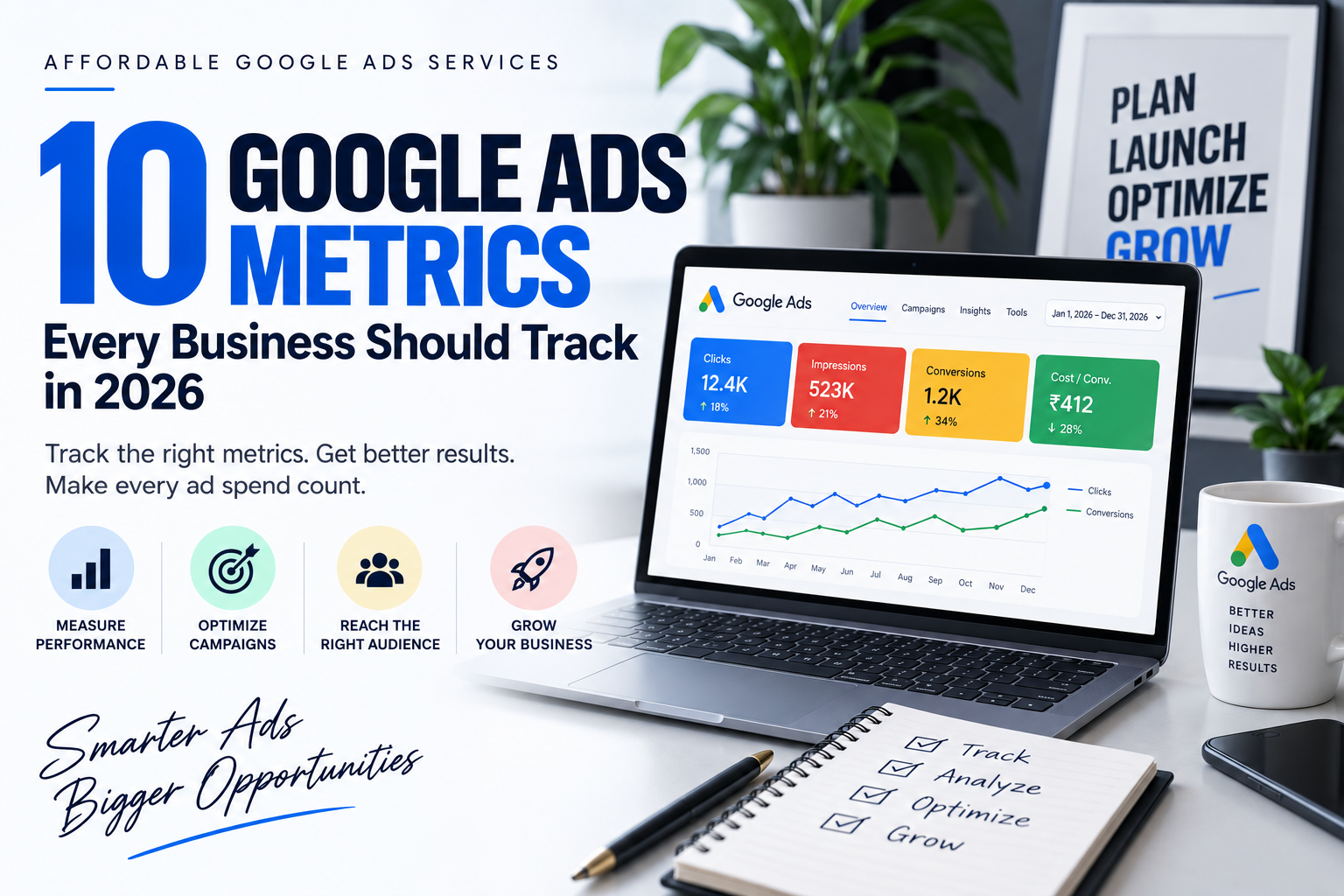
Google Ads can generate leads, sales, website traffic, and brand visibility, but simply running campaigns does not guarantee good results. A campaign can receive hundreds of clicks and still lose money if the wrong metrics are being monitored.
The key is knowing which Google Ads metrics actually matter and what they tell you about campaign performance.
For businesses using Affordable Google Ads Services, tracking the right numbers is especially important. A limited advertising budget leaves less room for wasted clicks, poorly targeted keywords, weak landing pages, or campaigns that generate traffic without conversions.
This guide covers 10 essential Google Ads metrics every business should track in 2026, including what each metric means, why it matters, and what you should do when the numbers are too high or too low.
Why Google Ads Metrics Matter
Google Ads gives businesses access to a large amount of performance data. However, looking at every available number can make campaign management unnecessarily complicated.
Instead, focus on metrics that answer important business questions:
Are people seeing my ads?
Are they clicking?
Are the right people clicking?
How much am I paying for each click?
Are clicks turning into leads or sales?
How much does each conversion cost?
Is my advertising profitable?
Which campaigns deserve more budget?
Which campaigns need improvement?
Tracking these metrics allows businesses to make decisions based on data rather than assumptions.
With Affordable Google Ads Services, regular performance monitoring can also help identify wasted spending early and move budget toward campaigns, keywords, locations, and ads that produce better results.
10 Google Ads Metrics Every Business Should Track
1. Impressions
Impressions represent how many times your ad was shown to users.
For example, if your ad appears 5,000 times during a month, your campaign has received 5,000 impressions.
Why impressions matter
Impressions tell you whether your ads are getting visibility.
A campaign with very few impressions may have a targeting or budget problem. Possible causes include:
Very low search volume
Highly restrictive keyword targeting
Small geographic targeting
Low bids
Limited budget
Ad or campaign restrictions
Highly competitive keywords
However, a high number of impressions does not automatically mean your campaign is successful.
You could receive thousands of impressions without generating meaningful traffic or conversions.
What to look for
Don’t evaluate impressions alone. Compare them with:
Clicks
CTR
Conversions
Conversion rate
Cost per conversion
For example:
Campaign A: 10,000 impressions → 500 clicks → 30 leads
Campaign B: 20,000 impressions → 300 clicks → 5 leads
Campaign B has more visibility but produces a much weaker business outcome.
Action to take
If impressions are low, review your:
Keyword targeting
Match types
Location targeting
Budget
Bidding strategy
Search demand
The goal isn’t necessarily to maximize impressions. The goal is to get relevant impressions from potential customers.
2. Clicks
A click occurs when someone interacts with your ad and visits the destination associated with it.
Clicks are important because they show that your advertisement generated enough interest for someone to take action.
Why clicks matter
Clicks help you understand whether your ads are bringing visitors to your website or landing page.
For example:
If your campaign receives:
10,000 impressions
400 clicks
you know that 400 users interacted with the advertisement.
But clicks alone don’t tell you whether those visitors became customers.
That’s why clicks should always be analyzed alongside CTR, conversions, conversion rate, and cost.
What low clicks can indicate
If impressions are healthy but clicks are low, investigate:
Ad messaging
Keyword relevance
Search intent
Headlines
Offers
Calls to action
Competitor positioning
Your ad may be appearing but failing to convince users to click.
Action to take
Review your ads and ask:
“Why should someone choose my ad instead of another result?”
Your copy should communicate a clear benefit and match the user’s search intent.
Businesses using Affordable Google Ads Services can also test different ad messages to determine which positioning generates stronger engagement.
3. Click-Through Rate (CTR)
Click-through rate (CTR) measures the percentage of impressions that resulted in clicks.
The basic formula is:
CTR = (Clicks ÷ Impressions) × 100
For example:
10,000 impressions and 500 clicks:
500 ÷ 10,000 × 100 = 5% CTR
Why CTR matters
CTR provides insight into how relevant and compelling your ad is to the people seeing it.
A low CTR may indicate that:
Your ad doesn’t match search intent
Your keywords are too broad
Your messaging is weak
Your offer isn’t competitive
Your audience isn’t the right audience
Your ad doesn’t clearly communicate value
A higher CTR can indicate stronger alignment between the search, keyword, and advertisement.
However, don’t chase CTR blindly.
An ad can have a high CTR but generate poor-quality leads.
Example
Ad A
CTR: 8%
Conversions: 2%
Ad B
CTR: 4%
Conversions: 8%
Ad B may be more valuable to the business despite having a lower CTR.
Action to take
Use CTR as a diagnostic metric, not your final success metric.
If CTR is weak, test:
Different headlines
Stronger benefits
More relevant keywords
Better calls to action
More specific offers
4. Average Cost Per Click (CPC)
Average CPC tells you approximately how much you pay, on average, for each click on your advertisement.
The basic calculation is:
Average CPC = Total Cost ÷ Total Clicks
For example:
If you spend ₹20,000 and receive 1,000 clicks:
₹20,000 ÷ 1,000 = ₹20 average CPC
Why CPC matters
CPC helps you understand how efficiently your advertising budget is purchasing traffic.
A high CPC isn’t necessarily bad.
Suppose:
Campaign A: ₹50 CPC → 1 customer from 20 clicks
Campaign B: ₹20 CPC → 1 customer from 100 clicks
Campaign A has a higher CPC but could still be considerably more profitable.
Therefore, CPC should always be evaluated in relation to conversions and revenue.
What can influence CPC?
Your CPC can be affected by factors such as:
Competition
Keyword demand
Ad relevance
Quality-related factors
Bidding strategy
Geographic targeting
Industry
Search intent
Action to take
Don’t simply try to reduce CPC.
Instead, ask:
“Is the traffic I’m buying worth what I’m paying for it?”
A slightly higher CPC can be acceptable if it produces significantly better customers.
5. Conversions
Conversions are the actions you define as valuable to your business.
Depending on your business model, a conversion could be:
Contact form submission
Phone call
Online purchase
Appointment booking
Quote request
Demo request
WhatsApp enquiry
Newsletter signup
Product registration
Why conversions are one of the most important metrics
Clicks represent interest.
Conversions represent action.
A campaign receiving 1,000 clicks but zero qualified leads is not performing well, regardless of how impressive its traffic numbers look.
This is why conversion tracking should be correctly configured before making major campaign decisions.
Example
Imagine two campaigns:
| Metric | Campaign A | Campaign B |
|---|
| Clicks | 1,000 | 500 |
| Conversions | 10 | 30 |
| Spend | ₹30,000 | ₹25,000 |
Campaign B generates fewer clicks but three times as many conversions while spending less.
That’s a much more useful result for a lead-generation business.
Action to take
Make sure you define what actually matters to your business.
Don’t count every website interaction as a valuable conversion.
A business should distinguish between:
Primary conversions: Leads, sales, bookings, purchases
Secondary actions: Page views, downloads, time spent, etc.
6. Conversion Rate
Conversion rate shows the percentage of users who clicked your ad and then completed a tracked conversion.
The basic formula is:
Conversion Rate = (Conversions ÷ Clicks) × 100
For example:
500 clicks
25 conversions
25 ÷ 500 × 100 = 5% conversion rate
Why conversion rate matters
Conversion rate helps you determine whether your traffic is actually producing results.
A low conversion rate can indicate problems beyond the advertisement itself.
Possible causes include:
Example
Suppose your Google Ads campaign generates 1,000 clicks.
If your conversion rate is 1%, you get:
10 conversions
If you improve the conversion rate to 3%, you get:
30 conversions
That’s three times the conversions from the same number of clicks.
This is one reason Affordable Google Ads Services should focus on the entire conversion journey—not just increasing ad traffic.
Action to take
If traffic is good but conversions are poor, don’t immediately increase your advertising budget.
First examine the landing page and offer.
7. Cost Per Conversion / Cost Per Lead
Cost per conversion measures how much you spend to generate one conversion.
The basic formula is:
Cost Per Conversion = Total Ad Spend ÷ Number of Conversions
For example:
₹30,000 ad spend
30 conversions
₹30,000 ÷ 30 = ₹1,000 per conversion
For lead-generation businesses, this is often referred to as Cost Per Lead (CPL) when the conversion is a lead.
Why it matters
This metric connects advertising expenditure with an actual business outcome.
If your average customer is worth ₹20,000 in profit and your average cost per qualified lead is ₹500, the economics may work well.
If you’re paying ₹5,000 for a lead that rarely becomes a customer, the campaign may need significant improvement.
Don’t judge CPL without considering lead quality
This is critical.
Suppose:
Campaign A: ₹300 per lead → 50 leads
Campaign B: ₹700 per lead → 20 leads
If Campaign A produces mostly irrelevant enquiries while Campaign B produces customers, Campaign B could be the better campaign.
Track:
Cost per lead → Lead quality → Customer acquisition cost → Revenue
That gives you a much more accurate picture.
8. Conversion Value
Conversion value represents the value assigned to conversions.
For ecommerce businesses, this could be the revenue generated from purchases.
For lead-generation businesses, you may assign values to different lead actions based on their estimated business value.
Why conversion value matters
Conversion volume tells you how many conversions you generated.
Conversion value tells you how valuable those conversions were.
For example:
| Campaign | Conversions | Conversion Value |
|---|
| A | 50 | ₹75,000 |
| B | 20 | ₹1,50,000 |
Campaign A generates more conversions.
Campaign B generates twice the conversion value.
If you only look at conversion volume, you could make the wrong budget decision.
Action to take
Where appropriate, assign meaningful values to conversions and regularly review whether those values reflect actual business outcomes.
For ecommerce, accurate transaction values are especially important.
For lead generation, businesses should consider connecting advertising data with CRM or sales data where possible.
9. Return on Ad Spend (ROAS)
ROAS measures the revenue generated compared with advertising expenditure.
The formula is:
ROAS = Conversion Value ÷ Ad Spend
For example:
₹2,00,000 conversion value
₹50,000 ad spend
₹2,00,000 ÷ ₹50,000 = 4 ROAS
That means the campaign generated ₹4 in tracked conversion value for every ₹1 spent on advertising.
Why ROAS matters
ROAS helps businesses evaluate advertising efficiency from a revenue perspective.
It is particularly useful for ecommerce businesses where purchase revenue can be directly tracked.
But ROAS should not be treated as universal proof of profitability.
Why?
Because revenue isn’t the same as profit.
Consider:
Product costs
Shipping
Staff
Discounts
Payment processing
Returns
Operational expenses
A campaign with a 3x ROAS isn’t automatically profitable.
For lead-generation businesses
ROAS can be harder to calculate accurately because the sale often happens offline.
In that case, businesses should also track:
Action to take
Use ROAS alongside actual profit margins and customer acquisition data whenever possible.
10. Impression Share
Impression share measures the percentage of eligible impressions your ads received compared with the estimated number of impressions you could have received.
In simple terms, it helps answer:
“How often am I showing when I’m eligible to show?”
Why impression share matters
This metric can help identify missed opportunities.
For example, your campaign might have strong:
CTR
Conversion rate
Cost per lead
ROAS
but still receive limited exposure because of budget or other campaign constraints.
In that situation, increasing visibility may provide an opportunity to generate more profitable conversions.
Important distinction
Low impression share isn’t automatically a problem.
If your keywords are low-value or your campaign is already generating enough profitable conversions, maximizing impression share may not be the right objective.
Focus on profitable opportunities rather than visibility for its own sake.
Action to take
When impression share is low, investigate why.
Consider:
Budget limitations
Bidding limitations
Keyword targeting
Competition
Search volume
Then determine whether gaining additional exposure is financially worthwhile.
Google Ads Metrics: Quick Comparison
| Metric | What It Tells You | Why It Matters |
|---|
| Impressions | How often ads appeared | Measures visibility |
| Clicks | Number of ad interactions | Measures traffic generation |
| CTR | Percentage of impressions producing clicks | Indicates ad relevance/appeal |
| Average CPC | Average cost per click | Measures traffic cost |
| Conversions | Number of valuable actions | Measures results |
| Conversion Rate | Percentage of clicks producing conversions | Measures landing-page/traffic effectiveness |
| Cost Per Conversion | Cost to generate a conversion | Measures acquisition efficiency |
| Conversion Value | Value generated by conversions | Measures business value |
| ROAS | Revenue/value relative to ad spend | Helps evaluate return |
| Impression Share | Share of eligible impressions received | Identifies visibility opportunities |
Which Google Ads Metrics Should You Prioritize?
Not every business should prioritize all 10 metrics equally.
Your priorities should depend on your business model.
Ecommerce businesses
Focus heavily on:
Conversions
Conversion value
ROAS
Conversion rate
Cost per conversion
CPC
Lead-generation businesses
Focus heavily on:
Qualified conversions
Cost per lead
Conversion rate
Lead quality
Customer acquisition cost
Revenue generated from leads
Local businesses
Focus on:
Leads
Phone calls
Location-based performance
Cost per lead
Conversion rate
Search terms
New businesses
Start by establishing baseline data.
Don’t worry about finding a perfect benchmark immediately.
First understand:
How much you’re spending
How many clicks you’re receiving
How many conversions you’re generating
What each conversion costs
Which keywords generate results
Then optimize based on your own data.
How Often Should You Check Google Ads Metrics?
You don’t need to make major campaign changes every few hours.
Constantly reacting to small fluctuations can lead to poor decisions.
A better approach is to establish a regular review process.
Daily
Check for major issues:
Weekly
Review:
CTR
CPC
Search terms
Conversions
Cost per conversion
Campaign performance
Monthly
Analyze:
Conversion trends
ROAS
Conversion value
Budget allocation
Keyword performance
Geographic performance
Ad performance
Landing page performance
The longer-term trend is generally more useful than reacting to one unusual day.
Common Google Ads Metric Mistakes
Focusing only on clicks
Traffic is useful, but traffic without results can become expensive.
Always connect clicks to conversions and business outcomes.
Chasing the lowest CPC
Cheap clicks aren’t necessarily good clicks.
A higher CPC can be worthwhile when it produces more valuable customers.
Ignoring conversion tracking
Without reliable conversion tracking, it’s difficult to know which campaigns are actually producing results.
Measuring quantity instead of quality
100 poor leads aren’t necessarily better than 20 qualified leads.
Looking at metrics individually
Google Ads metrics work together.
For example:
Impressions → CTR → Clicks → Conversion Rate → Conversions → Cost Per Conversion → Revenue/Value
Understanding this chain gives you a much clearer view of campaign performance.
How Affordable Google Ads Services Can Improve Metric Performance
Professional campaign management isn’t simply about launching advertisements.
The real value comes from continuously analyzing performance and making informed adjustments.
Affordable Google Ads Services can help businesses with:
The goal isn’t to make every metric look good.
The goal is to improve the metrics that directly contribute to profitable business growth.
For example, reducing CPC might look positive, but if conversion volume falls at the same time, the campaign may actually become less effective.
Likewise, increasing CTR is useful only when the additional clicks are relevant and contribute to meaningful business outcomes.
Google Ads Metrics Checklist for 2026
Use this checklist during your regular campaign review:
FAQs About Google Ads Metrics
What is the most important Google Ads metric?
There isn’t one metric that is most important for every business. For many businesses, conversions, cost per conversion, conversion rate, and revenue or conversion value are more useful for decision-making than clicks or impressions alone.
What is a good CTR for Google Ads?
There is no universal CTR that every campaign should achieve. CTR varies by industry, keyword intent, campaign type, competition, and audience. Compare your performance against your own historical data and relevant campaign segments.
Should I focus on CPC or conversions?
Conversions should generally receive more attention than CPC when the goal is generating leads or sales. A low CPC doesn’t help much if the resulting traffic doesn’t convert.
How can I reduce my Google Ads cost per lead?
Start by improving targeting, removing irrelevant search terms, using appropriate negative keywords, improving ad relevance, optimizing landing pages, and shifting budget toward campaigns that generate qualified leads.
How often should Google Ads campaigns be optimized?
Google Ads should be monitored regularly, but major changes should be based on sufficient performance data rather than random short-term fluctuations. Weekly and monthly reviews are useful for most businesses.
Do small businesses need to track all 10 metrics?
Not necessarily. Small businesses should focus on the metrics that connect advertising activity to business results. For lead generation, conversions, conversion rate, cost per lead, lead quality, and customer value are especially important.
Final Thoughts
Google Ads performance isn’t determined by one number.
Impressions show visibility. Clicks show engagement. CTR indicates how effectively ads attract attention. CPC shows traffic cost. Conversions show results, while conversion rate and cost per conversion reveal how efficiently your advertising turns traffic into business opportunities.
For ecommerce businesses, conversion value and ROAS are particularly important. For lead-generation businesses, cost per qualified lead and customer acquisition cost can provide a more realistic picture of performance.
The most effective approach is to look at these metrics together and connect them to actual business outcomes.
If you’re investing in Affordable Google Ads Services, make sure your campaigns are being measured against meaningful goals—not vanity metrics. The right tracking system can reveal where your budget is working, where money is being wasted, and where your next opportunity for growth lies.
Gowenza Digital helps businesses build, manage, and optimize Google Ads campaigns with a focus on measurable results, smarter targeting, conversion tracking, and better use of advertising budgets. If your current campaigns aren’t delivering the leads or sales you expect, professional campaign optimization can help turn your existing ad spend into a more effective growth channel.
If you want to improve your Google Ads performance without wasting your advertising budget, explore Gowenza Digital’s Affordable Google Ads Services for campaign setup, keyword research, conversion tracking, ad optimization, and ongoing management. You can also explore Gowenza Digital’s SEO Services to strengthen your organic visibility and Website Development Services to create faster, conversion-focused websites and landing pages that support better advertising results.
For accurate information on Google Ads performance, campaign optimization, and measurement, businesses can refer to Google’s official resources. The Google Ads Help Center provides detailed guidance on managing campaigns, while Google Ads Keyword Planner can help with keyword research and planning. For website and user behaviour analysis, Google Analytics provides useful measurement tools. Businesses can also explore Think with Google for research and insights into consumer behaviour and digital advertising trends. Using these resources alongside Affordable Google Ads Services can help businesses make better-informed decisions and improve campaign performance.