
Website Development Company Guide 10 Powerful Differences Between Business Websites and eCommerce Websites
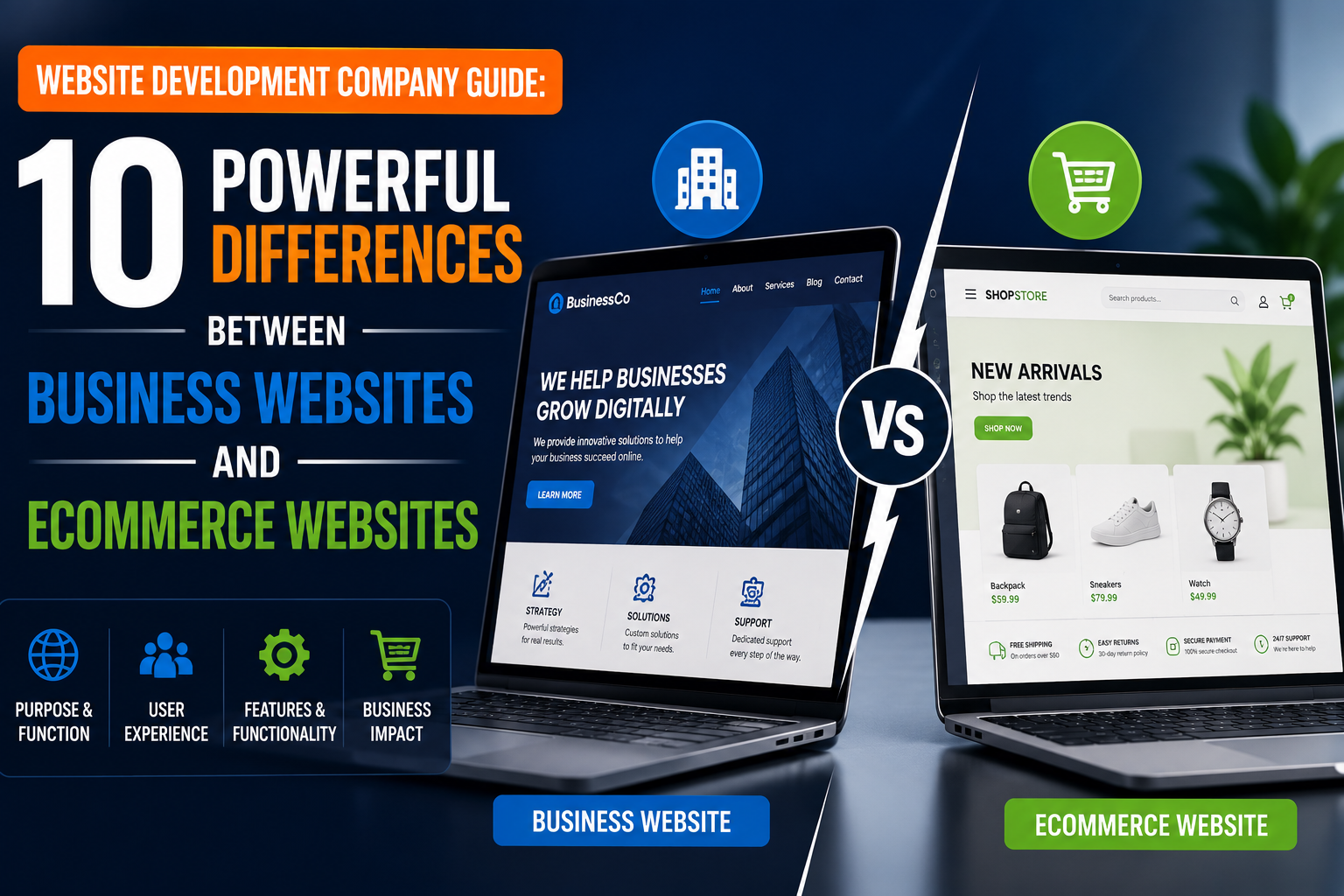
Website Development Company Guide 10 Powerful Differences Between Business Websites and eCommerce Websites
Table of Contents
Introduction
What Is a Business Website?
What Is an eCommerce Website?
Difference #1: Primary Purpose
Difference #2: Website Structure and Navigation
Difference #3: Features and Functionality
Difference #4: Product and Service Presentation
Difference #5: Payments and Transactions
Difference #6: Security Requirements
Difference #7: SEO Strategy
Difference #8: Maintenance and Management
Difference #9: Cost and Development Requirements
Difference #10: Scalability and Business Growth
Business Website vs eCommerce Website: Quick Comparison
Which Website Is Right for Your Business?
When Should You Choose a Business Website?
When Should You Choose an eCommerce Website?
Can a Business Website Become an eCommerce Website?
Common Mistakes Businesses Should Avoid
Conclusion
Frequently Asked Questions
Introduction
A website is no longer optional for businesses that want to establish credibility, attract customers, and compete in the digital marketplace. However, not every business needs the same type of website.
A company that provides professional services may only need a website that explains its services, showcases its work, builds trust, and generates enquiries. An online retailer, on the other hand, needs a website that allows customers to browse products, add items to a cart, make payments, and track orders.
This is where the difference between a business website and an eCommerce website becomes important.
Both types of websites can look professional and use similar technologies, but their purposes, features, development requirements, security needs, and ongoing maintenance can be very different.
Choosing the wrong website structure can create unnecessary costs and make it harder for your business to achieve its goals. A service-based company doesn’t necessarily need a complex online store, while an online retailer cannot rely on a simple brochure-style website to manage hundreds of products and customer transactions.
A professional Website Development Company can help businesses identify which type of website is appropriate based on their products, services, customers, sales process, budget, and future plans.
This guide explains 10 powerful differences between business websites and eCommerce websites, helping you understand what each type offers and which option may be better for your business.
What Is a Business Website?
A business website is primarily designed to introduce a company, explain its services or products, establish credibility, and encourage visitors to contact the business.
It acts as a digital representation of the company.
A typical business website may include:
Home page
About Us page
Services page
Product or solution pages
Portfolio
Case studies
Testimonials
Blog
FAQ section
Contact page
For example, a digital marketing agency may use its website to explain SEO, social media marketing, web development, branding, and advertising services. Visitors can learn about the company and submit an enquiry through a contact form.
The primary action isn’t necessarily an online purchase. Instead, the website may encourage visitors to:
Call the business
Submit an enquiry
Request a quote
Book a consultation
Send an email
Visit a physical location
A professional Website Development Company can design a business website around these conversion goals while ensuring it is responsive, fast, secure, and SEO-friendly.
What Is an eCommerce Website?
An eCommerce website is designed specifically for selling products or services online.
Unlike a standard business website, an eCommerce website needs to manage transactions from beginning to end.
Typical eCommerce features include:
Product catalogues
Product categories
Shopping carts
Checkout pages
Payment gateways
Customer accounts
Order management
Inventory management
Shipping options
Discount codes
Product reviews
Order tracking
An eCommerce website essentially operates as an online store.
Customers can discover a product, evaluate it, add it to their cart, complete payment, and receive order confirmation without needing to speak directly with an employee.
Because it handles financial transactions and customer information, an eCommerce website requires more complex development and security measures than many standard business websites.
A professional Website Development Company can integrate payment gateways, inventory systems, shipping platforms, analytics, and other tools required to operate an online store effectively.
Difference #1: Primary Purpose
The biggest difference between the two website types is their purpose.
A business website is generally focused on information, credibility, lead generation, and communication.
An eCommerce website is focused on online sales and transactions.
For example, a law firm may use its website to explain its areas of practice and encourage potential clients to contact the firm.
An online clothing store needs customers to browse products, select sizes, add products to a cart, enter shipping information, and make payments.
Business Website Goals
Common goals include:
Generate leads
Build brand awareness
Explain services
Establish credibility
Attract enquiries
Showcase previous work
eCommerce Website Goals
Common goals include:
Sell products
Increase order volume
Improve conversion rates
Reduce cart abandonment
Increase average order value
Encourage repeat purchases
A Website Development Company should define these goals before deciding the website structure because the development strategy depends heavily on what the website needs to accomplish.
Difference #2: Website Structure and Navigation
Business websites usually have relatively simple navigation.
A visitor may move through:
Home → Services → About → Portfolio → Contact
The number of pages can vary, but the overall structure is usually straightforward.
eCommerce websites require more complex navigation because they may contain hundreds or thousands of products.
Visitors need to filter products by:
Category
Price
Size
Colour
Brand
Rating
Availability
Product type
An online store may have a structure such as:
Home → Category → Subcategory → Product → Cart → Checkout
Search and filtering become especially important when a store has a large inventory.
A professional Website Development Company designs navigation based on the number of pages, products, categories, and user journeys involved.
Poor navigation can cause visitors to abandon a website before finding what they need.
Difference #3: Features and Functionality
Business websites typically require fewer complex features.
They may need:
Contact forms
Newsletter subscriptions
Booking forms
Google Maps
Social media integration
Blog functionality
Testimonials
Portfolio galleries
eCommerce websites require significantly more functionality.
These can include:
Product management
Shopping cart
Checkout
Payment processing
Inventory tracking
Customer accounts
Shipping calculations
Order management
Coupons
Product reviews
For example, if a customer purchases a product, several processes must happen automatically:
Product selected → Cart updated → Checkout → Payment processed → Order created → Inventory updated → Confirmation sent
Each stage needs to work correctly.
A professional Website Development Company tests these workflows carefully because a small technical issue during checkout can directly result in lost revenue.
Difference #4: Product and Service Presentation
Business websites usually focus on presenting services and building confidence.
A service page may explain:
What the service includes
Who it’s for
Benefits
Pricing information
Process
Frequently asked questions
Previous results
eCommerce websites need much more detailed product information.
Product pages may include:
Product name
Images
Videos
Specifications
Variations
Price
Availability
Reviews
Shipping information
Return policy
Related products
High-quality product presentation is particularly important because customers cannot physically examine an online product.
Images, descriptions, specifications, and reviews help customers make purchasing decisions.
A Website Development Company can structure product pages so important information is easy to find while keeping the purchasing process simple.
Difference #5: Payments and Transactions
This is one of the most important technical differences.
A standard business website may not process payments at all.
A visitor might simply submit a form or contact the company.
An eCommerce website must securely process financial transactions.
Payment options may include:
Credit cards
Debit cards
UPI
Net banking
Digital wallets
Payment links
Other online payment methods
The website also needs to handle:
Successful payments
Failed payments
Refunds
Order confirmations
Transaction records
Payment notifications
Payment functionality must be tested carefully.
A professional Website Development Company integrates reliable payment gateways and ensures that sensitive transaction information is handled securely.
A broken checkout system can directly affect revenue, making payment functionality one of the highest-priority areas of eCommerce development.
Difference #6: Security Requirements
All websites require security, but eCommerce websites generally face additional security responsibilities because they handle transactions, customer accounts, and order information.
Business websites still need protection against:
Malware
Hacking
Spam
Brute-force attacks
Unauthorized access
eCommerce websites may additionally need to protect:
Customer account information
Order data
Payment-related information
Transaction records
Personal details
Essential security measures include:
HTTPS
Secure authentication
Strong passwords
Regular backups
Software updates
Security monitoring
Access control
Secure payment integrations
A professional Website Development Company should treat security as part of the development process rather than adding it after the website is completed.
Security also requires ongoing maintenance because vulnerabilities can emerge after launch.
Difference #7: SEO Strategy
Both business websites and eCommerce websites can benefit from SEO, but their strategies are different.
A business website may focus on keywords related to:
Services
Industries
Locations
Problems customers need solved
For example, a web development agency may target keywords related to website development services in specific cities or markets.
eCommerce SEO focuses heavily on:
Product keywords
Category keywords
Brand searches
Product variations
Buying-intent keywords
Long-tail product searches
An online store may have hundreds of product pages that need individual optimisation.
This creates additional SEO challenges.
A Website Development Company should ensure the website architecture supports SEO from the beginning.
Important technical elements include:
SEO-friendly URLs
Proper heading structures
Internal linking
XML sitemap
Mobile responsiveness
Fast loading speeds
Structured data
Canonical URLs
For eCommerce websites, structured data can also help search engines understand product information such as price, availability, and ratings.
Difference #8: Maintenance and Management
Business websites are generally easier to maintain because they have fewer moving parts.
Maintenance may involve:
Updating content
Updating plugins
Security checks
Backups
Performance optimisation
Broken link checks
eCommerce websites require more frequent management.
Businesses need to maintain:
Product information
Prices
Inventory
Product images
Orders
Payment systems
Shipping settings
Promotions
Customer accounts
An eCommerce website can become difficult to manage if the product catalogue grows significantly.
Regular maintenance is therefore essential.
A Website Development Company can provide ongoing technical support while helping businesses manage updates, security, performance, integrations, and new features.
Difference #9: Cost and Development Requirements
A business website is generally less expensive to develop than a fully functional eCommerce website because it requires fewer complex systems.
The final cost depends on factors such as:
Number of pages
Design complexity
Custom functionality
CMS
Integrations
Content requirements
SEO requirements
eCommerce websites usually require a larger investment because of their additional functionality.
Development may involve:
Product catalogue setup
Payment gateway integration
Shopping cart development
Checkout optimisation
Inventory management
Shipping integration
Customer accounts
Order management
Security testing
This doesn’t mean every eCommerce website needs to be expensive. A small store with a limited product range can be relatively simple, while a large marketplace can require highly complex custom development.
A professional Website Development Company can recommend a technology and development approach based on the actual requirements instead of adding unnecessary features.
Difference #10: Scalability and Business Growth
Both website types should be built with future growth in mind, but eCommerce websites often require more planning because the number of products, customers, and transactions can increase significantly.
A business website may eventually need:
New service pages
New locations
Booking systems
Customer portals
Additional integrations
Multiple languages
An eCommerce website may need:
Thousands of products
Multiple warehouses
Advanced inventory management
Multiple payment methods
International shipping
Multiple currencies
Customer loyalty programs
Subscription products
Marketplace functionality
Choosing the right technology from the beginning can prevent expensive redevelopment later.
A professional Website Development Company considers future requirements before building the website so the platform can grow alongside the business.
Business Website vs eCommerce Website: Quick Comparison
| Feature | Business Website | eCommerce Website |
|---|---|---|
| Primary Goal | Leads and information | Online sales |
| Product Catalogue | Usually limited or informational | Core feature |
| Shopping Cart | Not required | Essential |
| Online Payments | Optional | Essential |
| Customer Accounts | Optional | Common |
| Inventory Management | Usually unnecessary | Essential |
| Checkout | Not required | Essential |
| Product Reviews | Optional | Common |
| SEO | Service-focused | Product and category-focused |
| Maintenance | Moderate | More frequent |
| Development Complexity | Low to moderate | Moderate to high |
| Security Requirements | Important | Very high |
| Scalability | Services and content | Products, orders, customers |
Which Website Is Right for Your Business?
The right choice depends on how your business operates.
Don’t choose eCommerce simply because it sounds more advanced. If customers don’t need to purchase products online, an eCommerce system may add unnecessary complexity.
Likewise, don’t choose a basic business website if your primary goal is selling products online.
Start by asking:
What do I want visitors to do on my website?
If the answer is:
“Contact us”
“Request a quote”
“Book an appointment”
“Learn about our services”
a business website may be sufficient.
If the answer is:
“Browse products”
“Add products to a cart”
“Pay online”
“Track orders”
you need an eCommerce website.
When Should You Choose a Business Website?
A business website is usually suitable for:
Agencies
Consultants
Law firms
Schools
Clinics
Restaurants
Construction companies
Manufacturers
Service providers
Professional firms
The primary purpose is to establish an online presence and generate enquiries.
A business website is particularly useful when the sales process requires communication between the customer and business before a purchase.
For example, a construction company may need to discuss project requirements before providing a quote. An online shopping cart wouldn’t necessarily improve that process.
A well-designed business website can instead guide visitors toward an enquiry form or phone call.
When Should You Choose an eCommerce Website?
An eCommerce website is appropriate when customers can purchase products or services online.
Common examples include:
Fashion stores
Electronics stores
Beauty brands
Furniture businesses
Grocery stores
Digital product sellers
Bookstores
Subscription businesses
If customers need to select products, make payments, and receive order confirmations without direct assistance, eCommerce functionality is usually necessary.
A professional Website Development Company can build the store around your product catalogue, target customers, payment requirements, shipping model, and future growth plans.
Can a Business Website Become an eCommerce Website?
Yes.
A business may initially launch a simple website and later add eCommerce functionality.
For example, a clothing brand may start with a website showcasing its collections and physical store location. As online demand grows, the business may add product pages, shopping carts, payments, and shipping.
However, the original website should ideally be built with future expansion in mind.
This is why discussing long-term plans with a Website Development Company before development begins can be valuable.
If you know that online selling may become important in the future, developers can choose a flexible structure that makes the transition easier.
Common Mistakes Businesses Should Avoid
Choosing a Website Based Only on Price
The cheapest option isn’t always the best value.
Consider performance, security, scalability, maintenance, and future development costs.
Adding Unnecessary eCommerce Features
If your business doesn’t sell products online, don’t add complex shopping functionality simply because competitors have it.
Ignoring Mobile Users
Both business and eCommerce websites must work properly on smartphones.
Using Poor Product Images
For online stores, product images strongly influence purchasing decisions.
Making Checkout Complicated
Every unnecessary step can increase cart abandonment.
Keep the checkout process simple.
Ignoring Website Security
Security should be considered from the beginning, particularly when customer accounts and transactions are involved.
Forgetting SEO During Development
SEO shouldn’t be added after the website is finished. Website architecture, speed, mobile usability, URLs, and internal linking should be considered during development.
Conclusion
Business websites and eCommerce websites serve different purposes, even though they may share similar design principles and technologies.
A business website focuses primarily on building credibility, presenting services, generating leads, and helping customers understand the company. An eCommerce website goes further by providing a complete online purchasing system that handles products, carts, payments, orders, inventory, and customer accounts.
The right choice depends on your business model and what you expect visitors to do.
If your primary goal is to generate enquiries, showcase services, and build trust, a professional business website may be the most practical solution.
If your business depends on selling products online, an eCommerce website is a better fit because it provides the functionality required to manage the entire purchasing process.
A professional Website Development Company can help you evaluate your requirements before development begins. Instead of selecting a website type based purely on trends, businesses should consider their customers, sales process, budget, current needs, and future growth.
The most important thing is to build a website around your business—not force your business into a website structure that doesn’t fit.
Whether you choose a business website or an eCommerce platform, the website should be fast, secure, mobile-friendly, easy to navigate, SEO-friendly, and scalable.
When the technology supports the business strategy, your website becomes more than an online presence. It becomes a practical tool for attracting customers, generating revenue, building trust, and supporting long-term growth.
Frequently Asked Questions
1. What is the main difference between a business website and an eCommerce website?
A business website primarily provides information and generates leads, while an eCommerce website is designed to sell products or services online through features such as shopping carts, checkout, and payment gateways.
2. Is an eCommerce website better than a business website?
Neither is universally better. The right option depends on your business model. Businesses that sell products online generally need eCommerce functionality, while service-based businesses may only need a professional business website.
3. Can a Website Development Company build both types of websites?
Yes. A professional Website Development Company can develop business websites, eCommerce stores, and custom platforms based on the specific requirements of a business.
4. Is an eCommerce website more expensive than a business website?
Usually, yes. eCommerce websites often require additional functionality such as payment gateways, product management, inventory systems, checkout processes, customer accounts, and order management.
5. Does an eCommerce website need SEO?
Yes. SEO is important for eCommerce websites because it can help products and categories appear in relevant search results and attract customers with purchase intent.
6. Can I add eCommerce features to my existing business website?
In many cases, yes. However, the existing website’s technology, structure, hosting, and scalability should be evaluated before adding an online store.
7. Which website is easier to maintain?
A standard business website is generally easier to maintain because it usually has fewer complex systems. eCommerce websites require ongoing management of products, inventory, orders, payments, shipping, and customer accounts.
8. What should I consider before choosing a website type?
Consider your business model, target audience, sales process, website goals, budget, required features, security needs, and future growth plans. A professional Website Development Company can help you choose the most suitable approach based on these factors.
Explore Gowenza
Choosing the right website type is only the first step toward building a strong online presence. At Gowenza, our Web Development services help businesses create responsive, secure, SEO-friendly, and high-performing websites tailored to their goals. Whether you need a professional business website or a fully functional eCommerce store, our team focuses on user experience, performance, scalability, and modern development practices to create websites built for long-term growth.
Anchor Text: Web Development
When choosing between a business website and an eCommerce website, businesses should also consider factors such as SEO, website performance, and security. Google Search Central provides guidance on building search-friendly websites, while PageSpeed Insights can be used to evaluate website performance. For security best practices, businesses can refer to OWASP, a trusted resource for web application security. Using these resources alongside professional development practices can help businesses build websites that are faster, more secure, and better prepared for long-term growth.