Table of Content
Google Ads has become one of the most effective digital marketing platforms for businesses looking to generate leads, increase website traffic, and drive online sales. Over the past few years, Google has introduced automation features that reduce manual work and help advertisers optimize campaigns using machine learning.
Today, businesses can automate bidding strategies, audience targeting, ad creation, budget allocation, and campaign optimization. These tools promise improved efficiency and better performance, making automation attractive for companies with limited time and resources.
However, automation is not a guaranteed solution. While it can improve campaign performance in many situations, it can also lead to wasted advertising spend when used without proper planning or oversight.
This is where Affordable Google Ads Services become valuable. Instead of relying entirely on automation, experienced professionals combine Google’s automated tools with human expertise to ensure campaigns remain aligned with business goals. This balanced approach helps businesses reduce unnecessary spending while maximizing conversions and return on investment.
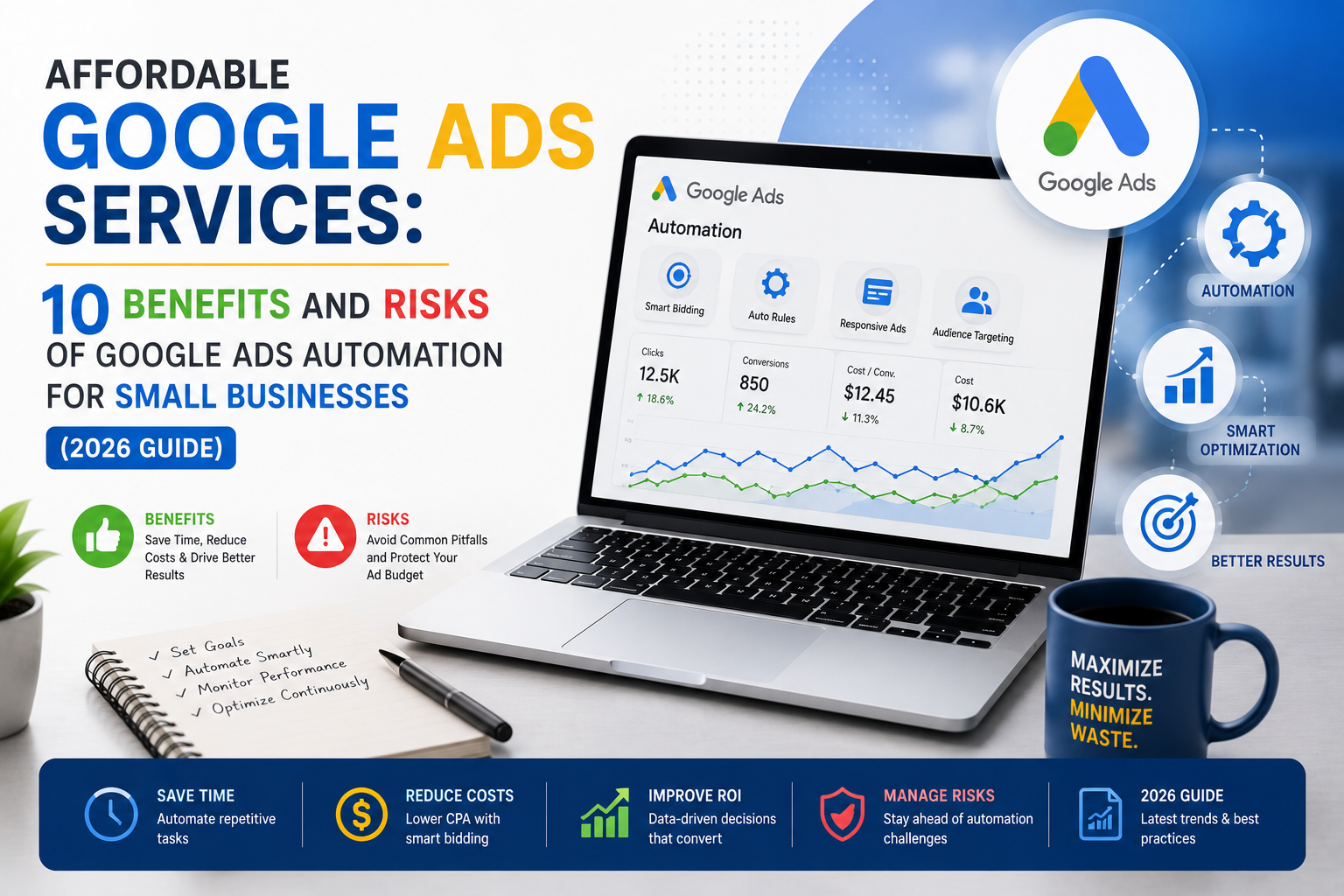
In this guide, you’ll learn the 10 biggest benefits and risks of Google Ads automation, helping you decide when automation is useful and when manual control is the better option.
What Is Google Ads Automation?
Google Ads automation refers to features that allow Google’s machine learning systems to make decisions that advertisers previously handled manually.
Instead of adjusting bids, selecting audiences, or optimizing campaigns every day, Google’s algorithms analyse large amounts of data and automatically make changes designed to improve campaign performance.
Some common automation features include:
- Smart Bidding
- Performance Max campaigns
- Responsive Search Ads
- Dynamic Search Ads
- Automated bidding adjustments
- Audience expansion
- Budget recommendations
- Automated rules
The primary objective is simple: improve campaign efficiency while reducing the amount of manual work required.
For small businesses that don’t have dedicated marketing teams, automation can save considerable time. However, these systems still require monitoring because Google’s recommendations are based on available data—not your specific business priorities.
Businesses using Affordable Google Ads Services often achieve better results because automation is guided by strategic human decision-making rather than left to operate independently.
Why Small Businesses Are Using Google Ads Automation
Small business owners often manage multiple responsibilities, including sales, customer support, operations, and marketing.
Monitoring Google Ads every day may not always be practical.
Automation helps simplify campaign management by handling repetitive tasks such as:
- Adjusting keyword bids
- Optimizing campaign budgets
- Displaying ads to relevant audiences
- Testing multiple ad combinations
- Identifying conversion opportunities
Instead of spending hours reviewing campaign reports, advertisers can focus on business growth while automation handles routine optimizations.
However, automation should support your strategy—not replace it.
Even the most advanced automation system depends on quality inputs such as:
- Accurate conversion tracking
- Relevant keywords
- High-quality landing pages
- Well-written advertisements
- Correct campaign objectives
Without these foundations, automation may optimise the wrong actions and produce disappointing results.
Benefit #1: Saves Time on Campaign Management
Managing Google Ads manually requires constant attention.
Advertisers often need to:
- Adjust bids
- Pause underperforming keywords
- Review search terms
- Optimise advertisements
- Monitor campaign budgets
- Analyse conversion reports
For busy small business owners, these tasks quickly become time-consuming.
Google Ads automation reduces much of this manual work by automatically responding to changes in campaign performance.
For example, Smart Bidding can increase or decrease bids based on factors such as:
- Device type
- User location
- Time of day
- Search intent
- Previous user behaviour
- Likelihood of conversion
Instead of reviewing every keyword individually, advertisers can spend more time improving products, serving customers, or growing their business.
When combined with Affordable Google Ads Services, automation saves time without sacrificing campaign quality because experienced specialists continue monitoring performance and making strategic improvements where automation cannot.
Benefit #2: Smarter Bid Optimization
Setting bids manually often involves guesswork.
Many advertisers either bid too aggressively and overspend or bid too conservatively and lose valuable traffic.
Google’s automated bidding strategies use historical performance data and real-time signals to adjust bids for every search.
Popular automated bidding strategies include:
| Bidding Strategy | Best Used For |
|---|
| Maximize Clicks | Increasing website traffic |
| Maximize Conversions | Lead generation |
| Target CPA | Controlling acquisition costs |
| Target ROAS | E-commerce sales |
| Maximize Conversion Value | Higher-value purchases |
Rather than applying one fixed bid to every user, automation evaluates each search individually.
For example, if Google’s system predicts that one user has a higher chance of completing a purchase, it may automatically increase the bid for that auction while lowering bids for less valuable traffic.
This often leads to:
- Better use of advertising budgets
- More qualified clicks
- Improved conversion rates
- Lower cost per acquisition over time
Professional providers of Affordable Google Ads Services regularly evaluate automated bidding performance to ensure the selected strategy matches business objectives and campaign goals.
Benefit #3: Better Audience Targeting
Reaching the right audience is essential for campaign success.
Google Ads automation uses machine learning to analyse user behaviour and identify potential customers based on hundreds of signals.
Instead of relying only on basic demographics, automation considers factors such as:
- Search history
- Device usage
- Browsing behaviour
- Geographic location
- Time of search
- Purchase intent
This allows Google to deliver advertisements to users who are more likely to convert.
For example, a small accounting firm advertising tax services can automatically reach people actively searching for financial assistance during tax season rather than showing ads to general audiences.
Automation also supports:
- Remarketing campaigns
- Similar audience targeting
- Customer Match
- Performance Max audience signals
These features help businesses reach users who already show interest in their products or services.
Businesses investing in Affordable Google Ads Services often benefit from better audience segmentation because automation is combined with detailed market research and ongoing campaign analysis.
Benefit #4: Improves Campaign Performance Through Data Analysis
One of Google’s greatest strengths is its ability to process enormous amounts of data within seconds.
Manual campaign management cannot analyse millions of search signals in real time.
Automation can.
Google continuously evaluates:
- Click behaviour
- Conversion history
- Device performance
- Search queries
- Audience engagement
- Geographic performance
- Time-of-day trends
Using this information, Google’s system adjusts campaigns to improve overall performance.
For example, automation may identify that users searching during weekday mornings convert at a much higher rate than those searching late at night.
The system can automatically prioritise those higher-performing opportunities.
Over time, these small improvements often produce better campaign efficiency.
However, automation performs best when businesses have accurate conversion tracking and sufficient campaign data.
This is another reason many companies choose Affordable Google Ads Services. Professional management ensures that Google’s automation receives reliable data, allowing machine learning to make more informed optimisation decisions.
Benefit #5: Automatically Tests Multiple Ad Variations
Creating a single ad and expecting it to perform well over time is rarely an effective strategy. Different users respond to different headlines, descriptions, and calls to action.
Google Ads automation helps solve this by testing multiple ad combinations automatically.
For example, when using Responsive Search Ads (RSA), you can provide several headlines and descriptions. Google’s machine learning system combines these assets in different ways and identifies which combinations perform best for different search queries.
Instead of manually creating dozens of ad versions, advertisers can let Google continuously test and optimise combinations.
Advantages of Responsive Search Ads
- Higher ad relevance
- Better Click-Through Rate (CTR)
- Reduced manual testing
- Faster optimisation
- Improved campaign performance over time
For example, one user may respond better to a headline highlighting affordable pricing, while another may prefer a headline focused on generating more leads. Google automatically displays the most relevant variation based on the available data.
Businesses using Affordable Google Ads Services often combine Responsive Search Ads with manual copy improvements to ensure every headline aligns with their brand message while still benefiting from Google’s automated testing.
Benefit #6: Easier Campaign Scaling
As businesses grow, managing multiple campaigns manually becomes increasingly difficult.
Imagine managing campaigns for:
- Multiple cities
- Different products
- Several services
- Seasonal promotions
- Brand awareness campaigns
- Remarketing campaigns
Updating bids, keywords, budgets, and advertisements for every campaign can consume hours every week.
Automation makes scaling much easier by handling repetitive optimisation tasks while maintaining consistent campaign performance.
For example, a growing business expanding into new cities can use automated bidding and audience targeting to launch campaigns more efficiently without manually adjusting every keyword.
Automation also supports businesses during seasonal demand.
For example:
- Holiday sales
- Festival promotions
- End-of-year offers
- Product launches
Google’s machine learning can respond faster to changing search behaviour than manual campaign adjustments alone.
Many companies offering Affordable Google Ads Services use automation to manage large campaigns while still reviewing overall strategy, performance, and budget allocation regularly.
Risk #1: Losing Control Over Campaign Decisions
Automation is helpful, but it also means allowing Google’s algorithms to make decisions that were previously handled by advertisers.
This includes:
- Bid adjustments
- Audience expansion
- Budget recommendations
- Keyword prioritisation
- Ad delivery
While these decisions are often beneficial, they don’t always reflect your specific business priorities.
For example, Google’s goal is generally to maximise campaign performance based on selected objectives. It doesn’t understand factors such as:
- Your profit margins
- Sales team capacity
- Seasonal stock shortages
- Premium product priorities
- Business-specific objectives
As a result, automation may increase spending in areas that don’t align with your overall marketing strategy.
Businesses relying entirely on automation without regular reviews may discover unnecessary budget increases or reduced campaign efficiency.
Professional Affordable Google Ads Services help maintain the right balance by combining automation with strategic human oversight.
Risk #2: Poor Data Leads to Poor Decisions
Google’s machine learning depends entirely on the quality of the information it receives.
If your campaign data is inaccurate, automation will optimise for the wrong outcomes.
Common data problems include:
- Missing conversion tracking
- Incorrect conversion setup
- Duplicate conversions
- Low conversion volume
- Poorly structured campaigns
Imagine that every phone call is accidentally counted as two conversions.
Google may assume your campaign is performing exceptionally well and automatically increase bids.
In reality, your advertising costs rise while actual business results remain unchanged.
This demonstrates one of the most important principles of Google Ads automation:
Better data produces better decisions.
Before enabling advanced automation features, businesses should ensure:
- Conversion tracking is accurate.
- Google Analytics 4 is properly connected.
- Campaign objectives are correctly configured.
- Landing pages are functioning properly.
Companies providing Affordable Google Ads Services usually audit tracking systems before implementing automation to ensure Google’s algorithms work with reliable information.
Risk #3: Automation Can Increase Spending Faster Than Expected
Automation is designed to improve performance, but improving performance often requires spending more budget when Google identifies additional opportunities.
This can surprise advertisers who aren’t monitoring campaigns regularly.
For example:
You set a modest daily budget for lead generation.
Google notices that increasing bids during peak hours generates more conversions.
The system begins spending more of the available daily budget earlier in the day.
Although this may improve lead volume, businesses with limited budgets may prefer a more controlled approach.
How to Prevent Overspending
Follow these best practices:
- Set realistic daily budgets.
- Monitor campaign performance weekly.
- Review automated recommendations before accepting them.
- Adjust bidding strategies when business priorities change.
- Keep track of Cost Per Acquisition (CPA).
Automation should support your financial goals—not determine them.
Businesses using Affordable Google Ads Services benefit from regular budget reviews that help control costs while maintaining campaign performance.
Risk #4: Automation Doesn’t Replace Strategic Thinking
One of the biggest misconceptions about Google Ads automation is that it eliminates the need for human expertise.
In reality, automation cannot:
- Understand your brand voice.
- Write persuasive marketing messages.
- Create compelling offers.
- Develop long-term advertising strategies.
- Analyse competitor positioning.
- Understand customer relationships.
These decisions still require human experience.
Automation is excellent at processing data and making rapid adjustments, but it cannot replace creative thinking or business strategy.
The most successful campaigns combine both.
Automation handles repetitive optimisation.
Marketing professionals provide strategy, creativity, and business insight.
This balanced approach is why many growing companies invest in Affordable Google Ads Services instead of relying entirely on automated recommendations.
Risk #5: Automation Isn’t Suitable for Every Campaign
Although Google Ads automation has become increasingly sophisticated, it doesn’t always produce the best results.
Automation performs best when campaigns have:
- A consistent flow of conversions
- Accurate conversion tracking
- Sufficient historical data
- Clearly defined campaign objectives
New businesses or campaigns with limited data often don’t provide Google’s machine learning with enough information to optimise effectively.
For example, a newly launched campaign generating only a few conversions each month may struggle with automated bidding because the algorithm has very little data to learn from.
In these situations, manual bidding and close monitoring may deliver better results until enough conversion data has been collected.
This is why experienced providers of Affordable Google Ads Services don’t rely on a one-size-fits-all approach. They evaluate each campaign individually and recommend automation only when it supports the client’s goals.
Automated vs Manual Google Ads Management
Automation and manual management each have advantages. The right choice depends on your campaign size, business goals, and available data.
| Feature | Automated Management | Manual Management |
|---|
| Time Required | Low | High |
| Campaign Control | Moderate | Full |
| Learning Curve | Easy | Steeper |
| Best for Large Campaigns | Yes | Sometimes |
| Best for New Campaigns | Depends on data | Often Yes |
| Strategy Decisions | Limited | Complete |
| Flexibility | Moderate | High |
For many small businesses, the most effective approach is a combination of both.
Automation handles repetitive optimisation tasks, while experienced marketers make strategic decisions based on business goals and market conditions.
Best Practices for Using Google Ads Automation
Automation should improve your campaigns—not replace good marketing.
Follow these best practices to get the best results.
1. Set Up Accurate Conversion Tracking
Before enabling Smart Bidding or Performance Max campaigns, make sure all important conversions are tracked correctly.
These may include:
- Contact forms
- Phone calls
- Online purchases
- Quote requests
- Appointment bookings
Accurate data allows Google’s algorithms to optimise for meaningful business outcomes.
2. Give Automation Time to Learn
Google’s machine learning requires time to collect and analyse performance data.
Avoid making major changes every day.
Instead:
- Allow campaigns to complete the learning phase.
- Monitor performance patiently.
- Evaluate results over several weeks instead of a few days.
Frequent changes interrupt the learning process and may reduce campaign performance.
3. Review Campaign Performance Regularly
Automation doesn’t eliminate the need for monitoring.
Review key metrics such as:
- Cost Per Click (CPC)
- Click-Through Rate (CTR)
- Conversion Rate
- Cost Per Lead
- Quality Score
- Return on Ad Spend (ROAS)
Regular reviews help identify opportunities that automation may overlook.
4. Continue Testing Landing Pages
Even the best automation cannot compensate for a poor landing page.
Test different:
- Headlines
- Images
- Calls to action
- Contact forms
- Layouts
- Page speed improvements
Better landing pages often produce higher conversion rates without increasing advertising costs.
5. Combine Automation with Human Expertise
Automation excels at analysing large volumes of data, but experienced marketers understand business objectives, customer behaviour, and competitive positioning.
Combining Google’s automation with professional campaign management often produces stronger long-term results.
Businesses using Affordable Google Ads Services benefit from this balanced approach, where automation improves efficiency while experts continue refining strategy, messaging, targeting, and campaign performance.
Is Google Ads Automation Right for Your Business?
Automation isn’t about replacing marketers—it’s about improving efficiency.
It can be an excellent choice if your business:
- Generates consistent conversions.
- Has reliable conversion tracking.
- Runs multiple campaigns.
- Wants to save management time.
- Has enough historical campaign data.
You may benefit from a more manual approach if you:
- Have just launched Google Ads.
- Receive very few monthly conversions.
- Frequently change campaign goals.
- Want complete control over bidding decisions.
The best solution for many small businesses is a hybrid strategy that combines automation with regular expert oversight.
This allows you to benefit from machine learning without losing control over important business decisions.
Frequently Asked Questions
1. Is Google Ads automation good for small businesses?
Yes. Google Ads automation can save time, improve efficiency, and optimise campaigns. However, it works best when supported by accurate conversion tracking and regular performance reviews.
2. Can automation reduce advertising costs?
Automation may reduce costs by improving bidding decisions, audience targeting, and campaign efficiency. Results depend on campaign quality, available data, and business objectives.
3. Should I use Smart Bidding?
Smart Bidding is a good option for many businesses with reliable conversion data. New campaigns with limited data may perform better using manual bidding until enough historical information has been collected.
4. Does automation replace Google Ads experts?
No. Automation handles repetitive optimisation tasks, but strategic planning, compelling ad copy, landing page optimisation, and business decision-making still require human expertise.
5. What is the biggest risk of Google Ads automation?
One of the biggest risks is relying entirely on automation without reviewing campaign performance. Poor tracking, incorrect settings, or changing business priorities can reduce campaign effectiveness if left unchecked.
Final Thoughts
Google Ads automation has transformed the way businesses manage online advertising. Features such as Smart Bidding, Responsive Search Ads, and Performance Max campaigns help advertisers save time, analyse large amounts of data, and improve campaign efficiency.
However, automation is not a substitute for strategy. It performs best when campaigns have accurate tracking, high-quality data, relevant landing pages, and clearly defined objectives. Without these foundations, even the most advanced automation can make decisions that increase costs without delivering better results.
The most successful advertisers use automation as a powerful tool rather than a complete replacement for human expertise. By combining machine learning with thoughtful planning, regular monitoring, and continuous optimisation, businesses can achieve stronger performance while maintaining control over their advertising budget.
Grow Your Business with Gowenza
At Gowenza, we provide Affordable Google Ads Services that combine the power of Google Ads automation with expert campaign management. We help businesses create high-performing campaigns through strategic keyword research, audience targeting, conversion tracking, landing page recommendations, and ongoing optimisation.
Whether you’re launching your first campaign or looking to improve existing results, our team ensures automation works for your business—not against it. Contact Gowenza today to build smarter Google Ads campaigns that generate more qualified leads, improve return on investment, and support long-term business growth.
.