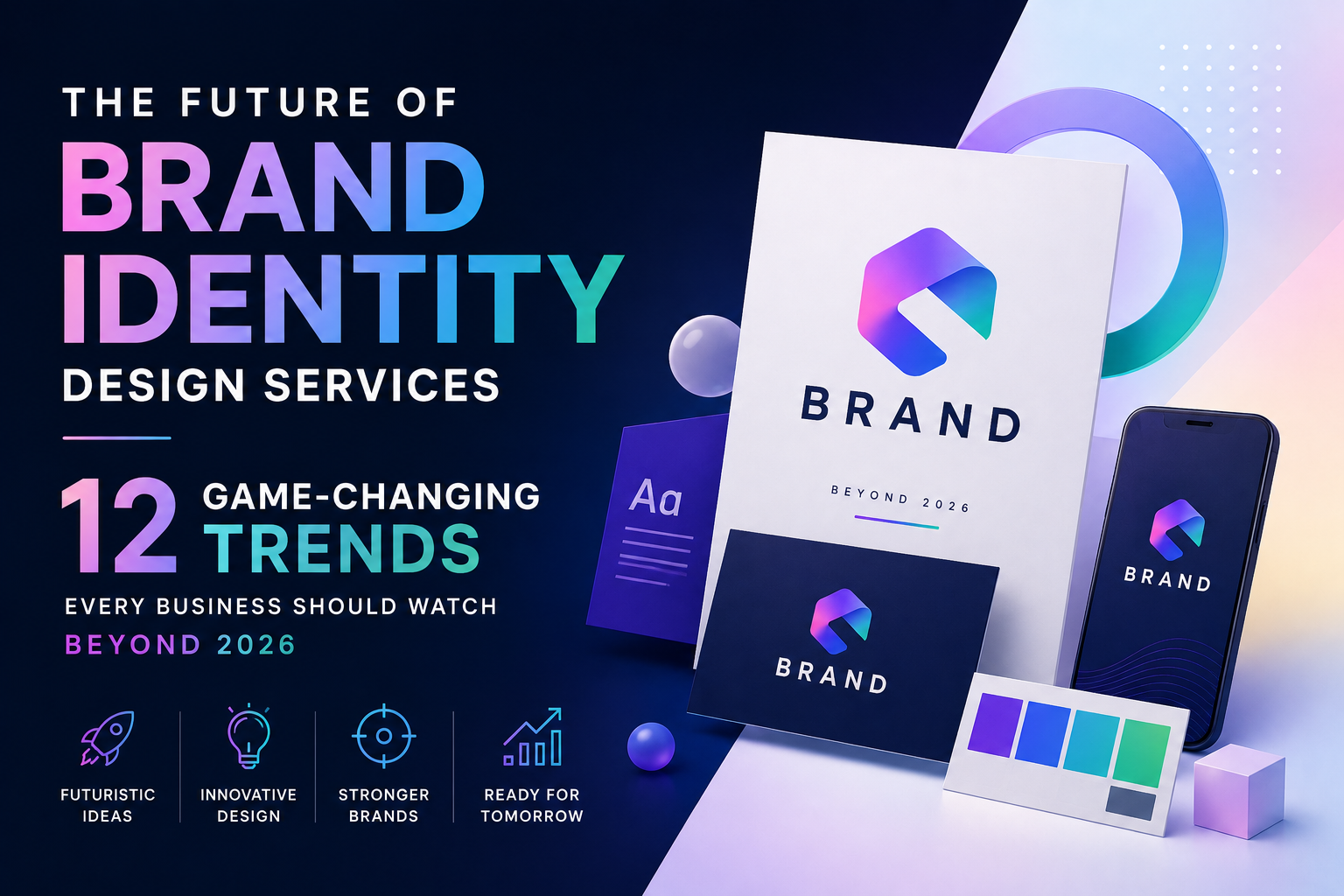
The Future of Brand Identity Design Services: 12 Game-Changing Trends Every Business Should Watch Beyond 2026
Digital Marketing Strategies to Grow Your Business
Branding has never been static. From hand-painted shop signs to digital-first experiences, the way businesses present themselves has evolved alongside technology and customer expectations. Today, a strong logo alone is no longer enough. Customers expect brands to deliver consistent experiences across websites, mobile apps, social media, email, packaging, videos, and even AI-powered interactions.
This shift has transformed the role of Brand Identity Design Services. Modern branding is no longer limited to choosing colors and designing a logo. It now involves creating flexible identity systems that can adapt to multiple platforms, communicate brand values, and build meaningful relationships with customers.
As we move beyond 2026, businesses will face new challenges and opportunities. Artificial intelligence, immersive technologies, sustainability, personalization, and changing consumer behavior are reshaping how brands are created and experienced. Companies that adapt to these changes will be better positioned to earn trust, strengthen recognition, and remain competitive.
Whether you’re launching a startup, rebranding an established company, or expanding into new markets, understanding where branding is headed can help you make smarter business decisions.
In this guide, we’ll explore 12 game-changing trends that are shaping the future of Brand Identity Design Services and explain how businesses can prepare for the next generation of branding.
Table of Contents
- Why Brand Identity Is Changing Faster Than Ever
- Trend #1: AI Becomes a Creative Partner, Not a Replacement
- Trend #2: Flexible Brand Identity Systems
- Trend #3: Hyper-Personalized Brand Experiences
- Trend #4: Motion-First Branding
- Trend #5: Sustainable and Ethical Brand Design
- Trend #6: Accessibility-Driven Identity Systems
- Trend #7: Community-Centered Branding
- Trend #8: Branding for Voice and AI Assistants
- Trend #9: Immersive Digital Experiences
- Trend #10: Data-Informed Brand Evolution
- Trend #11: Human-Centered Storytelling
- Trend #12: Future-Proof Brand Guidelines
- How Businesses Can Prepare for the Future
- Frequently Asked Questions
- Conclusion
Why Brand Identity Is Changing Faster Than Ever
Businesses today interact with customers in more places than ever before.
A potential customer may discover your brand through:
- A Google search
- An Instagram Reel
- A LinkedIn article
- A YouTube video
- A chatbot
- A podcast
- An email newsletter
- A mobile application
Each interaction contributes to how people perceive your business.
This means branding can no longer be designed for just one platform. It must work consistently across dozens of digital and physical touchpoints.
At the same time, customer expectations are changing. People expect businesses to be authentic, transparent, accessible, and responsive. They also expect personalized experiences without sacrificing privacy or trust.
Professional Brand Identity Design Services are evolving to meet these demands by creating adaptable identity systems instead of static visual assets.
The future belongs to brands that can remain recognizable while adapting to new technologies and changing customer behaviors.
Trend #1: Artificial Intelligence Becomes a Creative Partner—Not a Replacement
Artificial intelligence has already changed how businesses create content, analyze customer behavior, and automate repetitive tasks.
However, one of the biggest misconceptions is that AI will replace branding professionals.
The reality is quite different.
AI is becoming a creative assistant rather than a creative director.
Modern branding agencies are using AI to:
- Generate early design concepts
- Analyze market trends
- Explore color combinations
- Speed up research
- Test multiple layout variations
- Organize brand assets
- Improve workflow efficiency
These tools reduce production time, allowing designers to spend more time on strategic thinking and creative problem-solving.
What AI cannot replace is human understanding.
Successful branding requires empathy, storytelling, cultural awareness, emotional intelligence, and business strategy—qualities that still depend on experienced designers.
As technology advances, Brand Identity Design Services will increasingly combine AI-powered efficiency with human creativity to produce stronger, more meaningful brand identities.
Businesses that embrace this collaboration rather than viewing AI as a threat will gain a competitive advantage.
Trend #2: Flexible Brand Identity Systems Replace Static Branding
Traditional branding often relied on strict rules.
A fixed logo.
A fixed color palette.
A limited number of approved applications.
That approach worked when businesses primarily operated through print media.
Today’s brands live across hundreds of digital environments.
Your branding needs to appear consistently on:
- Websites
- Mobile apps
- Smart watches
- Digital advertisements
- Social media platforms
- Interactive displays
- Video content
- Online communities
Because of this, rigid branding systems are giving way to flexible identity systems.
Instead of relying on a single logo variation, businesses are creating adaptable visual elements that respond to different screen sizes, user experiences, and communication channels while maintaining a recognizable identity.
Professional Brand Identity Design Services are increasingly focused on developing branding systems rather than isolated design assets.
This flexibility helps businesses remain consistent even as new technologies emerge.
Trend #3: Hyper-Personalized Brand Experiences Become the New Standard
Customers no longer expect identical experiences.
They expect brands to understand their interests, preferences, and behaviors.
Personalization is rapidly becoming one of the defining characteristics of modern branding.
Future brand experiences may adapt based on factors such as:
- Customer interests
- Geographic location
- Purchase history
- Preferred language
- Device type
- Browsing behavior
- Customer loyalty
Imagine visiting a company’s website and seeing visuals, messaging, and recommendations tailored specifically to your needs.
The overall identity remains consistent, but the experience feels more relevant.
This doesn’t mean changing your logo every time someone visits your website.
Instead, it means creating an adaptable identity that delivers personalized experiences while preserving brand consistency.
Professional Brand Identity Design Services increasingly consider personalization during the branding process by developing systems that support dynamic digital experiences without compromising recognition.
Businesses that personalize responsibly while respecting customer privacy will build stronger relationships and improve long-term loyalty.
Why Human Emotion Will Always Matter
Technology is changing branding faster than ever, but one thing remains constant.
People connect with people.
Customers remember how a brand makes them feel far more than they remember individual design elements.
That’s why successful brands don’t simply look attractive.
They communicate:
- Trust
- Confidence
- Innovation
- Reliability
- Authenticity
- Purpose
The role of Brand Identity Design Services is evolving from creating beautiful visuals to designing meaningful experiences that evoke these emotions across every customer interaction.
No matter how advanced technology becomes, businesses that prioritize genuine human connections will continue to stand out.
Key Takeaways from These Emerging Trends
The first three trends reveal an important shift in the branding industry:
- AI is improving creative workflows rather than replacing designers.
- Flexible identity systems are replacing rigid branding rules.
- Personalized customer experiences are becoming a competitive necessity.
Businesses that begin adapting now will be better prepared for the next generation of branding, while those that rely on outdated identity systems may struggle to remain relevant.
Trend #4: Motion-First Branding Becomes the New Standard
Brand identities were once designed primarily for print. Today, they live on screens, where movement naturally attracts attention.
Think about how you interact with brands online. You see animated logos, scrolling websites, short-form videos, app transitions, and social media stories every day. Static visuals still matter, but motion has become an essential part of how brands communicate.
This doesn’t mean every logo needs to spin or every website should be filled with animations. Effective motion branding uses movement with purpose. It guides users, highlights important information, and creates memorable experiences without distracting from the message.
Examples of motion branding include:
- Animated logo reveals
- Interactive website transitions
- Micro-animations on buttons and icons
- Product demonstration videos
- Animated social media graphics
- Loading animations in mobile apps
- Motion graphics in presentations
Professional Brand Identity Design Services are increasingly including motion guidelines alongside traditional brand guidelines. These define how animations should behave, their speed, style, and consistency across platforms.
As digital experiences continue to dominate, businesses that incorporate thoughtful motion into their branding will appear more modern, engaging, and memorable.
Trend #5: Sustainable and Ethical Branding Will Influence Customer Decisions
Consumers today are paying closer attention to the values behind the brands they support.
People want to know:
- Where products come from.
- How companies treat employees.
- Whether packaging is environmentally responsible.
- If businesses genuinely support social causes.
- How transparent companies are about their practices.
This shift means branding is no longer just about appearance—it’s also about authenticity.
Future-focused businesses will communicate sustainability through both their actions and their visual identity.
Examples include:
- Eco-friendly packaging design
- Minimalist printing to reduce waste
- Environmentally conscious color palettes
- Transparent messaging
- Responsible material choices
- Honest storytelling
However, businesses must avoid “greenwashing”—making environmental claims without meaningful action.
Customers are becoming better at identifying exaggerated or misleading marketing.
Professional Brand Identity Design Services help businesses communicate genuine values in a way that aligns with their mission and operations.
Authenticity will become one of the strongest competitive advantages beyond 2026.
Trend #6: Accessibility Will Become a Core Part of Brand Identity
Inclusive design is no longer optional.
A brand should be accessible to everyone, including people with visual, hearing, cognitive, or motor impairments.
An inaccessible website, poor color contrast, or unreadable typography can prevent potential customers from engaging with your business.
Future-ready branding considers accessibility from the beginning rather than treating it as an afterthought.
Important accessibility practices include:
- High color contrast for readability
- Legible typography
- Clear visual hierarchy
- Descriptive icons
- Captioned videos
- Keyboard-friendly interfaces
- Readable document layouts
- Accessible digital assets
Accessibility doesn’t limit creativity.
Instead, it encourages designers to create experiences that work for a wider audience.
Professional Brand Identity Design Services increasingly include accessibility standards within brand guidelines so every future marketing asset remains inclusive.
Beyond meeting regulations, accessible branding demonstrates respect for customers and strengthens trust.
Trend #7: Community-Centered Branding Will Outperform Corporate Messaging
Years ago, branding was largely one-way communication.
Businesses created advertisements.
Customers watched them.
Today, branding is a conversation.
Customers comment on social media, write reviews, create user-generated content, and interact directly with businesses.
The strongest brands don’t simply speak to their audience—they build communities around shared interests and values.
Community-centered branding focuses on:
- Encouraging customer participation
- Highlighting real customer stories
- Responding to feedback
- Supporting meaningful conversations
- Creating educational content
- Rewarding loyal customers
- Building long-term relationships
Instead of asking, “How can we sell more products?” successful brands increasingly ask, “How can we create value for our community?”
This shift changes how businesses approach branding.
Professional Brand Identity Design Services now consider how a brand should communicate across forums, social platforms, online communities, events, and customer support channels.
A strong identity supports interaction, not just recognition.
The Growing Role of Brand Consistency Across Digital Channels
As businesses expand across multiple platforms, maintaining consistency becomes more challenging.
A customer may interact with your business through:
- Your website
- YouTube
- Email newsletters
- Mobile apps
- Digital advertisements
- Customer support chat
If each platform uses different visuals, messaging, or tone of voice, the overall brand experience becomes fragmented.
Consistency doesn’t mean every piece of content should look identical.
Instead, every interaction should feel like it belongs to the same brand.
Professional Brand Identity Design Services establish systems that help businesses maintain this consistency while adapting content for different audiences and platforms.
These systems often include:
- Visual identity guidelines
- Tone of voice documentation
- Social media templates
- Photography style guides
- Icon libraries
- Motion principles
- Content formatting standards
With clear guidelines in place, teams can create new marketing materials more efficiently without sacrificing quality or recognition.
Why Adaptability Matters More Than Perfection
One mistake many businesses make is trying to create a “perfect” brand identity that never changes.
The reality is that markets evolve.
Technology changes.
Customer expectations shift.
A successful brand is one that can adapt while remaining recognizable.
Think about companies that have refreshed their logos, modernized their websites, or updated their messaging over time. The strongest examples don’t abandon their identity—they refine it.
Future-focused Brand Identity Design Services prioritize flexibility.
Rather than creating rigid systems that quickly become outdated, designers build adaptable frameworks that allow businesses to evolve confidently.
This approach ensures that branding remains relevant for years rather than requiring complete redesigns every few years.
Preparing for the Next Wave of Branding Innovation
The trends discussed so far point toward one clear direction.
Branding is becoming more:
- Interactive
- Inclusive
- Personalized
- Community-driven
- Technology-enabled
- Purpose-focused
Businesses that continue viewing branding as a one-time design project may struggle to keep pace.
Those that invest in adaptable identity systems will be better prepared for whatever technologies and customer expectations emerge next.
Trend #8: Branding for Voice Search and AI Assistants
Search behavior is changing rapidly. More people are using voice assistants, AI-powered search tools, and conversational interfaces to find information instead of typing traditional search queries.
Customers now ask questions like:
- “Which branding agency is best for startups?”
- “Who offers professional brand identity services near me?”
- “How can I improve my business branding?”
Instead of browsing multiple pages, users increasingly expect direct, conversational answers.
This means branding is expanding beyond visuals.
Businesses now need a recognizable verbal identity as well.
Professional Brand Identity Design Services are beginning to include:
- Brand voice guidelines
- Conversational messaging
- AI chatbot personality
- Voice assistant responses
- FAQ strategies
- Consistent communication across digital platforms
A customer should experience the same personality whether they visit your website, interact with a chatbot, or ask an AI assistant about your business.
Companies that invest in consistent verbal branding will build stronger recognition in an AI-first digital environment.
Trend #9: Immersive Digital Experiences Will Redefine Customer Engagement
Digital experiences are becoming increasingly interactive.
Instead of simply reading information, customers want to explore, interact, and participate.
Brands are already experimenting with technologies such as:
- Augmented Reality (AR)
- Virtual Reality (VR)
- 3D product visualization
- Interactive websites
- Virtual showrooms
- Digital exhibitions
- Product configurators
Imagine a furniture company allowing customers to place products virtually inside their homes before purchasing.
Or a fashion brand offering virtual fitting rooms.
These experiences go beyond marketing—they become part of the brand itself.
Professional Brand Identity Design Services will increasingly define how a brand behaves inside immersive environments, ensuring consistency across traditional and emerging digital platforms.
While not every business needs AR or VR today, designing a flexible identity that can adapt to future technologies is becoming a smart long-term investment.
Trend #10: Data-Informed Brand Evolution
Branding has traditionally relied on creative intuition and market research.
In the future, businesses will combine creativity with data-driven insights.
Instead of making branding decisions based solely on assumptions, companies will analyze information such as:
- Customer engagement
- Website behavior
- Social media interactions
- Content performance
- User feedback
- Search trends
- Purchase patterns
For example, if customers consistently respond better to educational content than promotional messaging, the brand’s communication strategy can evolve accordingly.
Data doesn’t replace creativity.
It provides valuable context that helps businesses refine their identity over time.
Professional Brand Identity Design Services increasingly incorporate performance analysis to ensure branding continues supporting business objectives rather than remaining static.
The most successful brands won’t simply launch an identity and leave it unchanged for years.
They’ll continuously improve it using meaningful customer insights.
Trend #11: Human-Centered Storytelling Will Outperform Corporate Messaging
Technology will continue advancing, but people will always connect with authentic stories.
Customers don’t form emotional connections with logos.
They connect with:
- Purpose
- Values
- Experiences
- Challenges
- Success stories
- Real people
Future branding will focus less on selling and more on meaningful communication.
Businesses that openly share their journey, mission, and customer impact often create stronger relationships than those relying solely on polished advertising.
Examples include:
- Founder stories
- Behind-the-scenes content
- Employee spotlights
- Customer success stories
- Community initiatives
- Educational resources
- Honest discussions about challenges and growth
Professional Brand Identity Design Services now extend beyond visual design to help businesses define how these stories should be communicated consistently across every platform.
Authenticity builds credibility.
Credibility builds trust.
Trust builds long-term customer relationships.
Trend #12: Future-Proof Brand Guidelines Will Replace Traditional Brand Manuals
Traditional brand guidelines were often simple PDF documents covering:
- Logo usage
- Colors
- Typography
- Spacing
- Basic design rules
Today’s businesses require much more comprehensive systems.
Modern brand guidelines increasingly include:
- Motion design standards
- Accessibility requirements
- Photography direction
- Video style guides
- Social media templates
- Content tone of voice
- AI content guidelines
- Illustration systems
- Icon libraries
- UX principles
- Digital interaction standards
These living design systems evolve alongside the business instead of remaining fixed documents.
Professional Brand Identity Design Services are shifting toward creating scalable brand systems that support long-term growth across new technologies and communication channels.
How Businesses Can Prepare for the Future of Branding
Knowing the trends is valuable.
Preparing for them is even more important.
Here are practical steps businesses can take today.
1. Build a Flexible Brand Identity
Avoid designing only for today’s platforms.
Your branding should work equally well on websites, mobile apps, social media, digital advertising, presentations, and future technologies.
2. Prioritize Consistency
Customers should recognize your business immediately regardless of where they encounter it.
Maintain consistent:
- Colors
- Typography
- Photography
- Messaging
- Visual style
- Tone of voice
3. Invest in Brand Guidelines
Comprehensive guidelines help internal teams, agencies, and freelancers maintain consistency as your business grows.
Strong guidelines reduce confusion and improve efficiency.
4. Embrace New Technology Carefully
Not every trend needs immediate adoption.
Evaluate technologies based on customer needs rather than novelty.
Choose tools that genuinely improve customer experiences.
5. Design for Accessibility
An accessible brand reaches more people.
Review your website, marketing materials, and digital assets regularly to ensure they remain inclusive.
6. Stay Customer-Focused
Branding isn’t about what a business wants to say.
It’s about what customers need to understand and experience.
Regularly gather feedback through surveys, analytics, reviews, and customer conversations.
7. Think Beyond Visual Design
Successful brands communicate consistently through:
- Design
- Writing
- Customer service
- Social media
- Sales presentations
- Email marketing
- Video content
Every interaction shapes customer perception.
Looking Beyond 2026
Predicting the exact future of branding is impossible.
New technologies will emerge.
Customer expectations will continue evolving.
Communication channels will expand.
However, one principle is unlikely to change:
Businesses that build authentic, adaptable, and customer-focused identities will continue outperforming those relying solely on attractive visuals.
Professional Brand Identity Design Services will play an increasingly strategic role by helping businesses connect creativity with technology, consistency with flexibility, and design with long-term business goals.
The future of branding isn’t about following every trend.
It’s about building an identity that can confidently adapt as those trends evolve.
Frequently Asked Questions (FAQs)
1. What are Brand Identity Design Services?
Brand Identity Design Services help businesses create a complete and consistent visual identity that reflects their values, personality, and goals. These services typically include logo design, color palette selection, typography, brand guidelines, messaging direction, marketing assets, and digital branding to ensure consistency across every customer touchpoint.
2. Why are Brand Identity Design Services becoming more important after 2026?
Businesses now interact with customers across websites, mobile apps, social media, AI assistants, and immersive digital platforms. As these touchpoints increase, companies need adaptable branding systems rather than static designs. Professional branding helps maintain consistency while meeting changing customer expectations and technological advancements.
3. Will artificial intelligence replace brand designers?
No. AI is becoming a valuable creative assistant that speeds up research, concept generation, and repetitive tasks. However, successful branding still depends on human creativity, strategy, storytelling, and emotional understanding. The future lies in collaboration between AI tools and experienced designers.
4. How often should a business update its brand identity?
There is no universal timeline. Most businesses review their branding every few years or whenever they experience significant growth, enter new markets, launch new products, or need to modernize their image. Regular reviews help ensure the brand remains relevant without losing recognition.
5. What makes a future-ready brand identity?
A future-ready brand identity is flexible, scalable, accessible, and consistent. It works across digital and physical platforms while adapting to new technologies such as AI, voice search, and immersive experiences without compromising recognition.
6. Can small businesses benefit from Brand Identity Design Services?
Absolutely. Small businesses often compete against larger companies with bigger marketing budgets. A professional brand identity helps build trust, improve recognition, and create a polished image that attracts customers and supports long-term growth.
7. Why is accessibility important in branding?
Accessible branding ensures that people of all abilities can interact with your business. Readable typography, sufficient color contrast, captioned videos, and inclusive design improve the customer experience while expanding your potential audience.
8. How can businesses prepare for the future of branding?
Businesses should invest in flexible brand systems, maintain consistency across platforms, embrace new technologies thoughtfully, focus on authentic storytelling, and regularly review their branding to ensure it aligns with changing customer expectations and industry trends.
Conclusion
The future of branding extends far beyond designing attractive logos or selecting modern color palettes. As businesses continue to operate in increasingly digital, connected, and customer-driven environments, branding is becoming a strategic business asset rather than a purely creative exercise.
Throughout this guide, we’ve explored 12 game-changing trends that are shaping the future of Brand Identity Design Services beyond 2026. From AI-assisted creativity and motion-first branding to accessibility, personalization, immersive experiences, and community-driven communication, one theme remains consistent: successful brands are built on adaptability.
Customers expect more than products or services—they expect meaningful experiences. They want brands that communicate clearly, act authentically, and remain consistent across every interaction. Whether they discover your business through a search engine, a social media post, an AI assistant, or a mobile application, every touchpoint should reinforce the same identity and values.
Businesses that treat branding as an ongoing investment rather than a one-time design project will be better equipped to respond to changing technologies and evolving customer expectations. A future-ready brand identity isn’t rigid; it’s designed to grow with the business while remaining recognizable and trustworthy.
Investing in professional Brand Identity Design Services also creates long-term value. A well-structured identity system improves marketing efficiency, strengthens customer recognition, supports business expansion, and reduces the need for costly redesigns as your company evolves. Instead of constantly reinventing your image, you build on a solid foundation that adapts to new opportunities.
Looking beyond 2026, the brands that stand out won’t necessarily be those with the boldest visuals or the biggest advertising budgets. They’ll be the ones that combine creativity with strategy, embrace innovation without losing authenticity, and consistently deliver experiences that customers remember and trust.
No one can predict every technological shift that lies ahead, but businesses can prepare by building flexible, customer-focused brand identities today. Those that do will be ready not only for the future of branding but for the future of business itself.
Build a Future-Ready Brand with Gowenza
As branding continues to evolve, businesses need more than attractive visuals—they need a strategic identity that grows with changing technologies and customer expectations. At Gowenza, our Brand Identity Design Services are designed to help startups, small businesses, and established companies build memorable, consistent, and scalable brands. From brand strategy and logo design to visual identity systems, brand guidelines, digital assets, and marketing collateral, we create identities that perform across every platform. To strengthen your online presence even further, explore our Website Development Services, SEO Services, Graphic Design Services, Google Ads Services, and Digital Marketing Services. Together, these solutions help your business build credibility, attract the right audience, and stay competitive in the years ahead.
Gowenza – Create. Innovate. Elevate.
Trusted External Resources
Expand your knowledge with these trusted industry resources:
- Google Search Central – Learn SEO best practices and how Google evaluates high-quality websites and content.
- Adobe Creative Cloud – Explore professional tools and inspiration for branding, graphic design, and creative workflows.
- Nielsen Norman Group – Read research-backed articles on user experience, usability, and digital design.
- Interaction Design Foundation – Access educational resources on UX, branding, accessibility, and design strategy.
- HubSpot Marketing Blog – Discover practical guides on branding, content marketing, customer engagement, and business growth.
- Canva Design School – Improve your understanding of visual communication, branding principles, and marketing design.