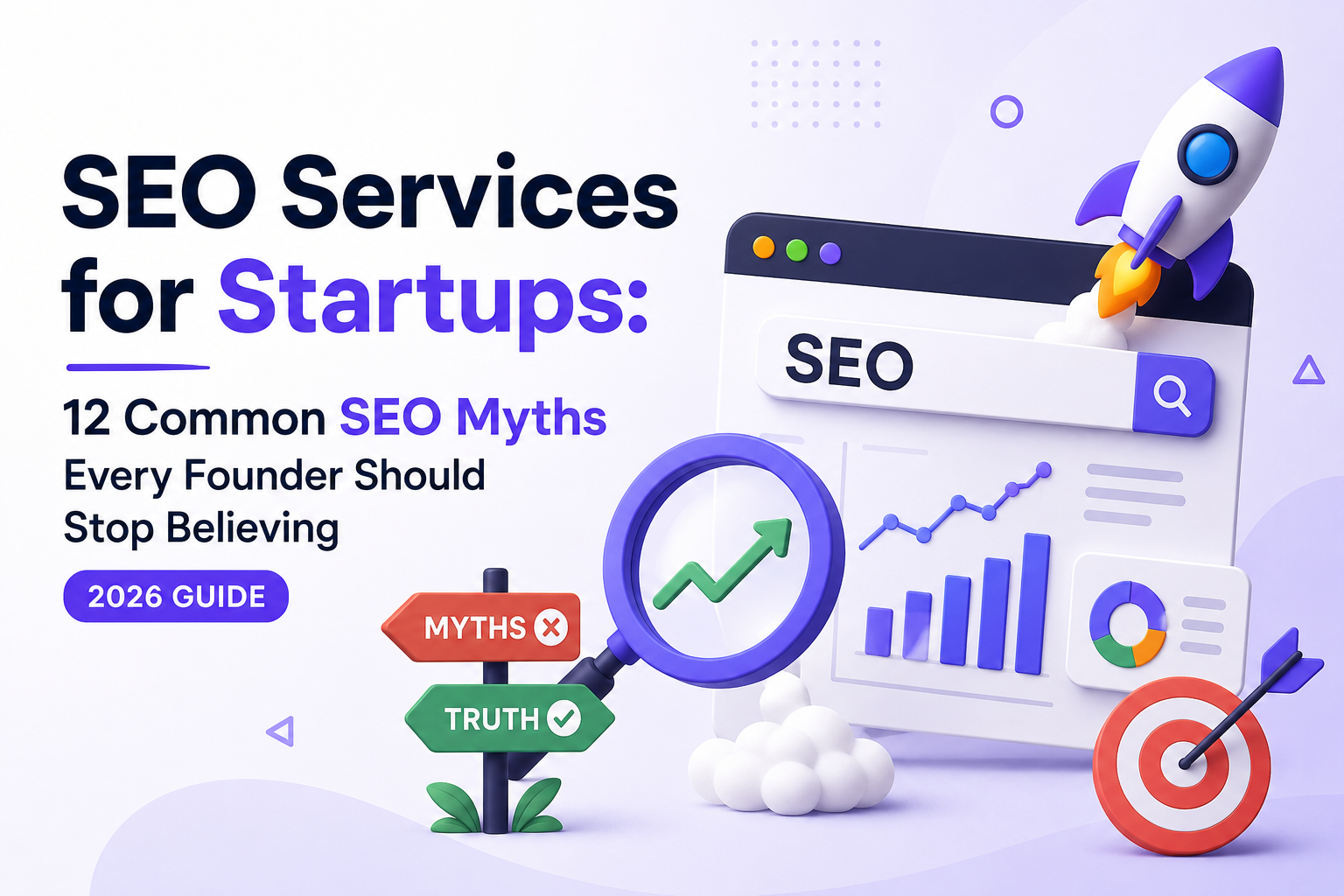
SEO Services for Startups: 12 Common SEO Myths Every Founder Should Stop Believing (2026 Guide)

SEO Services for Startups

SEO Services for Startups: 12 Common SEO Myths Every Founder Should Stop Believing (2026 Guide)

Starting a business is challenging enough without having to navigate conflicting advice about SEO. Search online, and you’ll find countless opinions claiming that SEO is dead, backlinks no longer matter, AI can do everything, or that simply publishing a few blog posts will bring thousands of visitors. Unfortunately, many of these claims are myths that mislead founders and waste valuable time and marketing budgets.

The reality is that SEO remains one of the most cost-effective ways for startups to attract qualified customers. Unlike paid advertising, which stops generating traffic the moment your budget runs out, SEO builds long-term visibility that continues to bring visitors, leads, and sales over time. However, success depends on following proven strategies instead of believing outdated misconceptions.

Many startup founders make critical decisions based on these myths. Some abandon SEO too early because they expect overnight results. Others invest in shortcuts that violate Google’s guidelines and end up hurting their rankings instead of improving them. There are also businesses that ignore SEO entirely, believing social media or paid ads are enough to sustain long-term growth.

Professional SEO Services for Startups help businesses separate facts from fiction. By focusing on technical optimization, high-quality content, keyword research, user experience, and ethical link building, startups can build sustainable organic growth instead of chasing quick fixes.

In this guide, we’ll debunk the 12 most common SEO myths that continue to confuse founders in 2026. Understanding the truth behind these misconceptions will help you make smarter marketing decisions, avoid costly mistakes, and build an SEO strategy that supports long-term business growth.

Table of Contents

  1. Why SEO Myths Hurt Startup Growth
  2. Myth #1: SEO Delivers Instant Results
  3. Myth #2: SEO Is Dead
  4. Myth #3: Ranking #1 Is the Only Goal
  5. Myth #4: More Keywords Mean Better Rankings
  6. Myth #5: You Only Need SEO Once
  7. Myth #6: AI Can Replace SEO Experts
  8. Myth #7: Backlinks No Longer Matter
  9. Myth #8: More Content Always Wins
  10. Myth #9: Technical SEO Isn’t Important
  11. Myth #10: Paid Ads Improve Organic Rankings
  12. Myth #11: Local SEO Is Only for Local Shops
  13. Myth #12: SEO Is Too Expensive for Startups
  14. Key Takeaways
  15. Frequently Asked Questions
  16. Final Thoughts

Why SEO Myths Hurt Startup Growth

Startups usually operate with limited budgets, small teams, and ambitious growth targets. Every marketing decision matters, and believing inaccurate SEO advice can lead to months of wasted effort.

For example, if a founder believes SEO should produce first-page rankings within a week, they may stop investing just before their strategy begins delivering results. Similarly, stuffing pages with keywords or buying cheap backlinks may produce short-term gains but can ultimately damage search visibility.

Professional SEO Services for Startups are built around data, search intent, and Google’s best practices—not internet myths. Understanding what actually influences rankings helps founders invest their time and budget where it matters most.

Myth #1: SEO Delivers Instant Results

This is one of the biggest misconceptions among new business owners.

Many founders assume that once they publish a few optimized pages, Google will immediately rank their website above established competitors.

Unfortunately, SEO doesn’t work that way.

Google evaluates hundreds of ranking signals, including:

  • Website quality
  • Content relevance
  • User experience
  • Technical performance
  • Backlink profile
  • Domain authority
  • Search intent satisfaction

Building trust with search engines takes time.

For most startups, noticeable improvements begin appearing within three to six months, while competitive keywords often require six to twelve months or longer.

Why SEO Takes Time

Search engines first need to:

  • Discover your pages
  • Crawl your website
  • Index your content
  • Evaluate quality
  • Compare your website against competitors
  • Measure user engagement

Only then do rankings begin improving.

Expecting instant success often leads founders to abandon effective strategies prematurely.

What You Should Expect Instead

During the early months, focus on:

  • Better indexing
  • Increased search impressions
  • Improved keyword rankings
  • Higher organic traffic
  • Stronger website authority

These indicators show that your SEO strategy is moving in the right direction, even if you haven’t reached the top positions yet.

Professional SEO Services for Startups prioritize sustainable growth rather than unrealistic promises of overnight rankings.

Myth #2: SEO Is Dead

Every year, someone claims that SEO is finished.

The rise of AI, voice search, social media, and changing Google algorithms has fueled this misconception for over a decade.

Yet businesses continue receiving millions of visitors through organic search every day.

The truth is simple:

SEO isn’t dead—it has evolved.

Google’s algorithms now reward websites that provide genuine value, helpful content, and excellent user experiences instead of relying on outdated tricks.

Today’s SEO focuses on:

  • Solving user problems
  • Creating authoritative content
  • Optimizing website performance
  • Understanding search intent
  • Building trust
  • Demonstrating expertise

Businesses that adapt continue growing, while those relying on outdated tactics struggle.

Professional SEO Services for Startups evolve alongside search engines, ensuring your website follows current best practices instead of obsolete techniques.

Myth #3: Ranking #1 Is the Only Goal

Many founders become obsessed with reaching the first position for a single keyword.

While high rankings are valuable, they aren’t the ultimate objective.

The real goal is generating business results.

A startup ranking third for several high-converting keywords often earns more leads than a business ranking first for a broad keyword that attracts irrelevant visitors.

For example:

A company selling accounting software may receive better results from ranking for:

  • “best accounting software for freelancers”
  • “cloud accounting software for startups”

than simply targeting:

  • “accounting software”

The first two searches have stronger purchase intent and lower competition.

Focus on Business Metrics

Instead of tracking rankings alone, monitor:

  • Organic traffic
  • Qualified leads
  • Conversion rates
  • Contact form submissions
  • Revenue generated
  • Customer acquisition costs

These metrics reveal whether your SEO efforts are actually helping your business grow.

Professional SEO Services for Startups focus on attracting the right audience—not just increasing ranking numbers.

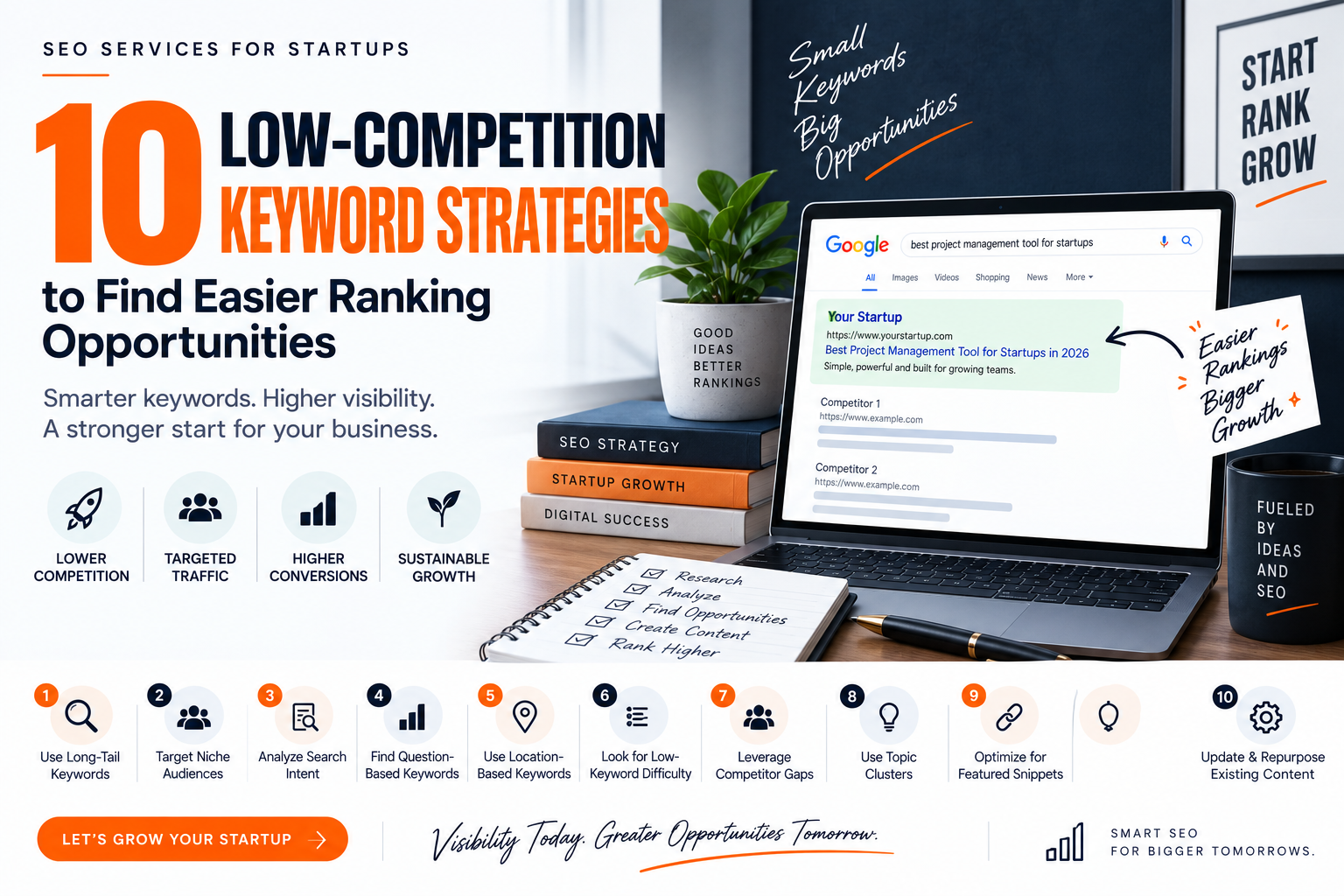
 

Myth #4: More Keywords Mean Better Rankings

One of the oldest SEO myths is that repeating the same keyword as many times as possible will help a page rank higher.

Years ago, this tactic—known as keyword stuffing—sometimes worked. Today, it does the opposite.

Google’s algorithms are sophisticated enough to understand context, synonyms, and search intent. A page overloaded with the same keyword looks unnatural, provides a poor reading experience, and may even be viewed as spam.

For example, writing a sentence like:

“Our SEO Services for Startups provide the best SEO Services for Startups because our SEO Services for Startups help startups…”

doesn’t improve rankings. It only reduces readability.

What Google Wants Instead

Google rewards content that answers users’ questions naturally.

Instead of repeating one keyword dozens of times, include related terms such as:

  • Startup SEO
  • Organic search
  • Technical SEO
  • Keyword research
  • Website optimization
  • Search rankings
  • Content marketing

This creates topical relevance without sacrificing readability.

Best Practices

When writing content:

  • Use one primary keyword naturally.
  • Include related keywords where relevant.
  • Write for people first, search engines second.
  • Focus on solving the reader’s problem.

Professional SEO Services for Startups balance keyword optimization with high-quality writing, ensuring every page is both search-engine friendly and enjoyable to read.

Myth #5: You Only Need SEO Once

Many founders believe SEO is something you complete once and never revisit.

Unfortunately, that’s not how search engines work.

SEO is an ongoing process because:

  • Google updates its algorithm regularly.
  • Competitors publish new content.
  • Customer search behavior changes.
  • Industry trends evolve.
  • New keywords emerge.
  • Existing pages become outdated.

A website optimized in 2024 may lose rankings in 2026 if it’s never updated.

SEO Requires Continuous Improvement

Successful startups regularly:

  • Update blog articles.
  • Refresh statistics.
  • Improve page speed.
  • Add new internal links.
  • Expand existing content.
  • Monitor keyword performance.
  • Fix technical issues.

These updates help maintain relevance and improve rankings over time.

Think of SEO Like Fitness

Building a healthy website is similar to maintaining physical fitness.

One workout won’t keep you healthy forever.

Likewise, one SEO campaign won’t guarantee long-term rankings.

Professional SEO Services for Startups include continuous monitoring, optimization, and reporting to ensure your website remains competitive as search engines and markets evolve.


Myth #6: AI Can Replace SEO Experts

Artificial intelligence has transformed content creation, keyword research, and data analysis. As a result, many founders believe AI tools can completely replace SEO professionals.

The truth is more nuanced.

AI is an excellent assistant—but it’s not a complete SEO strategy.

What AI Does Well

Modern AI tools can help with:

  • Brainstorming blog topics
  • Generating content outlines
  • Keyword clustering
  • Drafting metadata
  • Summarizing information
  • Identifying content gaps

These tasks save time and improve productivity.

Where AI Falls Short

AI cannot fully understand:

  • Your business goals
  • Customer psychology
  • Brand positioning
  • Competitive strategy
  • Local market nuances
  • Long-term SEO planning

It also cannot build relationships for backlinks, interpret business priorities, or make strategic decisions with the same judgment as an experienced SEO professional.

The Best Approach

The most successful startups combine AI with human expertise.

AI handles repetitive tasks, while SEO specialists focus on:

  • Strategy
  • Technical optimization
  • Content quality
  • User experience
  • Performance analysis
  • Conversion optimization

This combination produces stronger results than relying on either one alone.

Professional SEO Services for Startups increasingly use AI to improve efficiency, but every recommendation is reviewed and refined by experts who understand search behavior, business objectives, and Google’s quality guidelines.

Myth vs Reality

MythReality
More keywords improve rankings.Natural, high-quality content performs better than keyword stuffing.
SEO only needs to be done once.SEO requires continuous optimization and updates.
AI can completely replace SEO professionals.AI is a valuable tool, but human strategy and expertise remain essential.

Signs You’re Following SEO Myths

Ask yourself these questions:

  • Are you expecting first-page rankings within a few weeks?
  • Have you stopped updating your website after launch?
  • Are you writing content mainly for search engines instead of users?
  • Are you relying entirely on AI-generated content without review?
  • Are you focusing on keyword density instead of solving customer problems?

If you answered “yes” to any of these, it’s time to rethink your SEO strategy.

Professional SEO Services for Startups help founders move away from outdated practices and build sustainable, long-term organic growth.

Myth #7: Backlinks No Longer Matter

Some founders believe backlinks have lost their importance because Google has become smarter at understanding content.

While Google’s algorithms have evolved significantly, high-quality backlinks remain one of the strongest ranking signals.

A backlink is simply a link from another website pointing to yours. When a trusted website links to your content, it signals to search engines that your page is valuable and credible.

However, not all backlinks are equal.

One backlink from a respected industry publication is often worth far more than dozens of links from low-quality websites.

Quality Beats Quantity

Many startups make the mistake of purchasing cheap backlink packages promising thousands of links.

These links usually come from spam websites that offer little or no value.

Instead of improving rankings, they can damage your website’s reputation and even lead to manual penalties.

Professional SEO Services for Startups focus on earning backlinks naturally through:

  • Publishing in-depth guides
  • Guest posting on reputable websites
  • Creating original research
  • Building useful free tools or templates
  • Digital PR campaigns
  • Industry partnerships
  • Local business citations

The goal isn’t to collect the most backlinks—it’s to earn links that genuinely improve your website’s authority.

Signs of a High-Quality Backlink

A valuable backlink usually comes from a website that:

  • Has strong authority
  • Covers a relevant topic
  • Receives real traffic
  • Uses natural anchor text
  • Links editorially rather than through paid schemes

Backlinks remain an essential part of long-term SEO success, but only when acquired ethically.

Myth #8: More Content Always Wins

Many founders assume that publishing more articles automatically leads to better rankings.

This isn’t true.

Google rewards helpful, relevant, and comprehensive content—not simply a higher number of blog posts.

Imagine two startup websites:

Website A

  • Publishes 50 short articles.
  • Each article is around 300 words.
  • Content is repetitive.
  • Provides little practical value.

Website B

  • Publishes 10 detailed guides.
  • Each guide answers real customer questions.
  • Includes examples, tables, visuals, and practical advice.
  • Regularly updates older content.

In most cases, Website B will outperform Website A because its content better satisfies user intent.

Focus on Content Quality

Before publishing an article, ask:

  • Does it solve a real problem?
  • Is the information accurate?
  • Does it answer the reader’s question completely?
  • Is it easy to understand?
  • Would someone bookmark or share it?

If the answer is yes, you’re creating content Google is more likely to reward.

Professional SEO Services for Startups prioritize quality over quantity, building a content library that continues generating traffic long after publication.

Myth #9: Technical SEO Isn’t Important

Some founders believe SEO is only about keywords and blog posts.

While content is essential, even the best article can struggle to rank if the website has technical issues.

Technical SEO ensures search engines can crawl, understand, and index your website efficiently.

Without a strong technical foundation, your content may never reach its full potential.

Key Technical SEO Elements

Important technical factors include:

  • Fast page loading speed
  • Mobile-friendly design
  • Secure HTTPS connection
  • XML sitemap
  • Robots.txt configuration
  • Clean URL structure
  • Schema markup
  • Internal linking
  • Fixing broken links
  • Proper redirects

Ignoring these areas can reduce visibility, even if your content is excellent.

Example

Imagine publishing an outstanding guide that’s not indexed because your robots.txt file blocks search engines.

No matter how helpful the content is, it won’t rank because Google can’t access it.

That’s why technical SEO is critical.

Professional SEO Services for Startups regularly audit websites to identify and resolve technical issues before they impact rankings.


Technical SEO Checklist for Startups

Use this checklist to ensure your website is technically sound:

TaskStatus
HTTPS enabled✅
Mobile responsive design✅
XML sitemap submitted✅
Robots.txt configured correctly✅
Broken links fixed✅
Images optimized✅
Core Web Vitals improved✅
Schema markup implemented✅
Clean URL structure✅
Internal links added✅

Completing these tasks improves both search engine crawling and the overall user experience.

Myth vs Reality

MythReality
Backlinks no longer matter.High-quality backlinks remain one of Google’s strongest ranking signals.
Publishing more articles guarantees better rankings.Helpful, comprehensive content consistently outperforms large volumes of low-quality content.
Technical SEO isn’t important.Technical optimization is essential for crawling, indexing, and ranking.

What Successful Startups Do Differently

Founders who achieve sustainable organic growth don’t chase shortcuts.

Instead, they:

  • Create content that solves customer problems.
  • Invest in technical website improvements.
  • Earn backlinks from reputable websites.
  • Update older content regularly.
  • Measure performance using data instead of assumptions.

This disciplined approach produces stronger rankings and long-term results.

Professional SEO Services for Startups combine technical expertise, content strategy, and authority building to help startups compete effectively—even in competitive industries.

Myth #10: Paid Ads Improve Organic Rankings

One of the most common misconceptions among startup founders is that running Google Ads automatically improves organic search rankings.

The truth is simple:

Google Ads and Google Search rankings are completely separate systems.

Paying for advertisements does not increase your website’s organic position in search results. Google has repeatedly confirmed that advertising spend has no direct influence on organic rankings.

Why This Myth Exists

Businesses often notice increased website traffic after launching paid campaigns and assume their SEO has improved as well.

In reality:

  • Paid ads bring immediate visitors.
  • SEO builds long-term organic visibility.
  • They complement each other but don’t directly affect one another.

A startup using both strategies can achieve excellent results, but success comes from using each channel for its intended purpose.

When Paid Ads Can Indirectly Support SEO

Although ads don’t improve rankings directly, they can help by:

  • Increasing brand awareness
  • Driving more visitors to new content
  • Testing high-converting keywords
  • Generating customer insights
  • Supporting product launches

These insights can strengthen your overall marketing strategy, including your SEO efforts.

Professional SEO Services for Startups often work alongside paid advertising campaigns, but they treat SEO and PPC as separate strategies with different objectives.

Myth #11: Local SEO Is Only for Local Shops

Many founders think Local SEO only matters for restaurants, salons, or retail stores.

That’s no longer true.

Today, almost every business that serves customers within a city, region, or country can benefit from Local SEO.

Examples include:

  • Marketing agencies
  • Software companies
  • Law firms
  • Consultants
  • Medical clinics
  • Home service providers
  • Educational institutions

Even startups that primarily operate online often target customers in specific locations.

Why Local SEO Matters

Optimizing for local search helps businesses appear in:

  • Google Maps
  • Local search results
  • “Near me” searches
  • Location-specific keywords

For example:

Instead of targeting:

Website Development Company

A startup might also optimize for:

Website Development Company in Hyderabad

This attracts visitors with stronger purchase intent.

Local SEO Best Practices

Professional SEO Services for Startups usually include:

  • Google Business Profile optimization
  • Consistent business information (NAP)
  • Local landing pages
  • Customer reviews
  • Local citations
  • Location-based keywords
  • Local schema markup

These activities improve visibility among nearby customers who are actively searching for your services.


Myth #12: SEO Is Too Expensive for Startups

Budget constraints cause many founders to postpone SEO until they believe they can “afford it.”

Ironically, delaying SEO often makes growth more expensive in the long run.

Without organic visibility, startups rely heavily on paid advertising, where traffic stops as soon as the campaign budget ends.

SEO, on the other hand, creates long-term assets.

Every optimized page, blog post, and backlink continues generating value long after it’s published.

Think of SEO as an Investment

Unlike many marketing expenses, SEO compounds over time.

An article published today can continue attracting visitors months or even years later with periodic updates.

That’s why many successful startups begin investing in SEO early—even with limited budgets.

Affordable Ways to Start

You don’t need a massive marketing budget to begin.

Focus on:

  • Optimizing your website structure
  • Publishing one high-quality blog each week
  • Improving technical SEO
  • Building internal links
  • Creating helpful service pages
  • Monitoring performance

As your business grows, you can expand your SEO strategy further.

Professional SEO Services for Startups help founders prioritize high-impact activities, ensuring every investment delivers measurable value.

SEO Myth vs Reality Summary

SEO MythThe Reality
SEO delivers instant results.SEO requires consistent effort and usually takes several months to produce significant results.
SEO is dead.SEO continues to evolve and remains one of the most effective digital marketing channels.
Ranking #1 is the only goal.Qualified traffic, leads, and conversions matter more than a single ranking.
More keywords improve rankings.Natural, user-focused content outperforms keyword stuffing.
SEO only needs to be done once.SEO is an ongoing process that requires continuous improvement.
AI can replace SEO professionals.AI supports SEO, but strategy and expertise still require human input.
Backlinks don’t matter anymore.High-quality backlinks remain an important ranking factor.
More content always wins.Helpful, comprehensive content consistently performs better than high-volume low-quality content.
Technical SEO isn’t important.Technical optimization is essential for crawling, indexing, and user experience.
Paid ads improve organic rankings.PPC and SEO are separate; ads don’t directly influence organic rankings.
Local SEO only helps local shops.Any business targeting customers in specific locations can benefit from Local SEO.
SEO is too expensive for startups.SEO is a long-term investment that often reduces customer acquisition costs over time.

Key Takeaways

If there’s one lesson every founder should remember, it’s this:

Successful SEO is built on strategy, consistency, and patience—not shortcuts.

Rather than chasing outdated tactics or quick wins, focus on creating a website that genuinely helps your audience.

Professional SEO Services for Startups provide value by:

  • Identifying the right keywords.
  • Improving technical website performance.
  • Creating helpful, search-focused content.
  • Building website authority through ethical backlinks.
  • Tracking progress with real data.
  • Continuously optimizing based on performance.

When these elements work together, startups create a sustainable source of organic traffic that supports long-term business growth.

Frequently Asked Questions

How long does SEO take for a startup?

Most startups begin seeing measurable improvements within 3 to 6 months, depending on competition, website quality, and the consistency of their SEO efforts. Highly competitive keywords may take longer.


Can I do SEO myself?

Yes. Many founders can learn SEO fundamentals and implement basic optimizations. However, as your business grows, working with professionals often saves time and helps avoid costly mistakes.

Is publishing more blogs enough to rank?

No. Publishing content alone isn’t enough. Your website also needs technical optimization, keyword research, internal linking, quality backlinks, and a strong user experience.


Should startups invest in Google Ads or SEO?

Both have advantages. Google Ads delivers immediate visibility, while SEO builds sustainable, long-term organic traffic. Many startups achieve the best results by combining both strategies.


Does AI make SEO unnecessary?

No. AI is a valuable productivity tool, but it doesn’t replace strategic planning, technical expertise, or an understanding of your audience and business goals.

Final Thoughts

Believing SEO myths can delay growth, waste marketing budgets, and cause startups to miss valuable opportunities. The most successful founders don’t rely on shortcuts—they build a strong foundation through quality content, technical excellence, ethical link building, and continuous improvement.

By understanding the truth behind these 12 common misconceptions, you can make smarter decisions, set realistic expectations, and invest in strategies that deliver lasting results.

Professional SEO Services for Startups are not about manipulating search engines—they’re about creating a website that deserves to rank because it offers genuine value to users. As your business grows, a consistent SEO strategy will continue attracting qualified visitors, generating leads, and strengthening your brand’s online presence.


Grow Your Startup with Gowenza

At Gowenza, we provide result-driven SEO Services for Startups designed to help new businesses compete confidently in today’s digital landscape. Our team focuses on comprehensive keyword research, technical SEO, content strategy, on-page optimization, ethical link building, local SEO, and performance tracking. Instead of chasing shortcuts, we build sustainable strategies that improve search visibility, increase organic traffic, and generate qualified leads. Whether you’re launching a new startup or scaling an existing business, Gowenza helps you build a strong SEO foundation for long-term success.

Helpful Resources

For trusted SEO guidance, refer to these official resources:

Conclusion

SEO is constantly evolving, but the fundamentals remain the same: understand your audience, create valuable content, maintain a technically sound website, and earn trust over time. Ignoring common myths allows startup founders to focus on strategies that genuinely drive growth.

By investing in SEO Services for Startups and following proven best practices instead of misconceptions, your business can achieve stronger search visibility, attract high-intent customers, and build a reliable source of organic traffic that supports sustainable growth for years to come.

Leave a Reply

Your email address will not be published. Required fields are marked *