12 Game-Changing Ways AI Is Revolutionizing Brand Identity Design Services in 2026
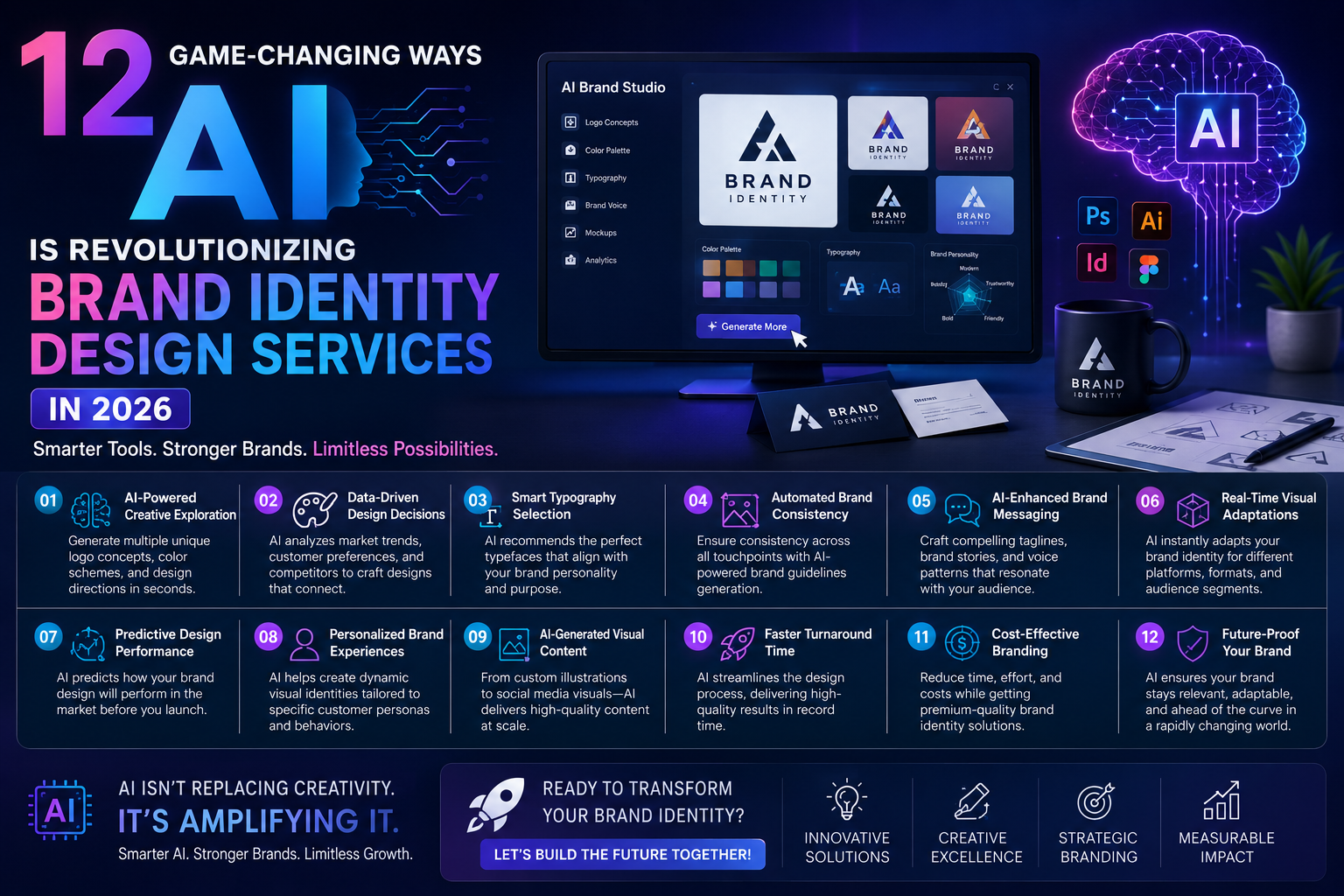
12 Game-Changing Ways AI Is Revolutionizing Brand Identity Design Services in 2026
Table of Contents
- Introduction
- Why AI Is Changing Branding Faster Than Ever
- What Are Brand Identity Design Services?
- 12 Game-Changing Ways AI Is Revolutionizing Brand Identity Design Services
- AI Speeds Up Brand Research
- AI Helps Create Smarter Logo Concepts
- AI Enables Personalized Brand Experiences
- AI Improves Brand Consistency
- AI Predicts Consumer Preferences
- AI Strengthens Content Creation
- AI Enhances Visual Design
- AI Improves Customer Insights
- AI Makes Rebranding Faster
- AI Supports Data-Driven Decisions
- AI Improves Collaboration
- AI Complements Human Creativity
- Challenges of AI in Branding
- Frequently Asked Questions
- Conclusion
Introduction
Artificial intelligence has evolved from a futuristic concept into a practical business tool that influences how companies operate, market, and connect with customers. In 2026, AI is no longer limited to automating repetitive tasks—it has become an integral part of branding, design, customer research, and marketing strategy.
Businesses today face increasing competition across every industry. Customers interact with brands through websites, social media, search engines, mobile apps, emails, advertisements, and even AI-powered chatbots. Maintaining a consistent and memorable identity across all these touchpoints requires more than creativity alone. It requires speed, data, adaptability, and strategic decision-making.
This is where AI is making a significant impact.
Modern Brand Identity Design Services are using artificial intelligence to analyze customer behavior, generate creative ideas, improve design workflows, and create highly personalized brand experiences. Rather than replacing designers, AI is helping creative teams make smarter decisions while reducing repetitive work.
However, successful branding is still built on human understanding, emotional storytelling, and strategic thinking. AI provides valuable support, but it works best when combined with experienced designers who understand business goals and customer psychology.
In this guide, you’ll discover 12 game-changing ways AI is revolutionizing Brand Identity Design Services, why these innovations matter for businesses, and how companies can use AI responsibly without losing their unique brand identity.
Why AI Is Changing Branding Faster Than Ever
Consumers expect personalized, seamless, and visually appealing experiences from every brand they interact with.
Meeting these expectations manually has become increasingly difficult.
Businesses must create:
- Website graphics
- Social media content
- Digital advertisements
- Product packaging
- Email campaigns
- Brand guidelines
- Marketing materials
- Customer experiences
—all while maintaining a consistent visual identity.
Artificial intelligence helps businesses manage these growing demands by analyzing large amounts of data, automating repetitive processes, and providing insights that would otherwise take weeks to uncover.
Professional Brand Identity Design Services are adopting AI not because it replaces creativity, but because it enables creative teams to focus on strategy and innovation instead of repetitive production tasks.
What Are Brand Identity Design Services?
Before exploring AI’s impact, it’s important to understand what Brand Identity Design Services include.
A complete brand identity goes far beyond designing a logo.
Professional branding services typically include:
- Brand strategy
- Logo design
- Color palette development
- Typography selection
- Brand voice
- Visual guidelines
- Business stationery
- Packaging design
- Social media branding
- Website visual identity
- Marketing collateral
- Iconography
- Photography direction
Together, these elements create a consistent personality that customers recognize and trust.
As AI continues to evolve, many of these processes are becoming faster, smarter, and more data-driven.
1. AI Makes Brand Research Faster and More Accurate
Every successful branding project begins with research.
Designers need to understand:
- The target audience
- Market trends
- Competitor positioning
- Customer expectations
- Industry standards
Traditionally, gathering and analyzing this information required days—or even weeks—of manual research.
AI has dramatically accelerated this process.
Modern AI tools can quickly analyze:
- Customer reviews
- Social media conversations
- Search trends
- Industry reports
- Website analytics
- Consumer behavior patterns
Instead of manually reviewing thousands of data points, designers receive organized insights within minutes.
For example, AI can identify recurring themes in customer feedback, highlight common frustrations, and reveal what customers value most in competing brands. These insights help designers create a brand identity that resonates with the intended audience rather than relying on assumptions.
Professional Brand Identity Design Services use AI research as a starting point, allowing strategists to spend more time interpreting the data and developing creative solutions tailored to each business.
The result is a stronger branding strategy supported by real customer insights.
2. AI Helps Generate Smarter Logo Concepts
Logo design remains one of the most recognizable aspects of a brand identity.
AI-powered design tools can now generate multiple logo concepts within minutes based on inputs such as:
- Industry
- Brand personality
- Preferred colors
- Typography styles
- Design preferences
This doesn’t mean AI creates the final logo.
Instead, it provides a variety of starting points that inspire designers and speed up the brainstorming process.
Experienced designers evaluate these concepts, refine them, ensure originality, and adapt them to align with the company’s long-term branding strategy.
Professional Brand Identity Design Services use AI as a creative assistant—not as a replacement for design expertise.
Human designers still make critical decisions regarding:
- Visual balance
- Symbolism
- Scalability
- Memorability
- Cultural relevance
- Brand storytelling
The combination of AI-generated concepts and human creativity often results in stronger, more thoughtful logo designs completed in less time.
3. AI Enables Personalized Brand Experiences
Today’s customers expect brands to understand their preferences.
Generic marketing messages are becoming less effective because consumers respond better to experiences that feel relevant to their needs and interests.
Artificial intelligence makes this level of personalization possible.
AI analyzes customer behavior such as:
- Browsing history
- Purchase patterns
- Location
- Device usage
- Search activity
- Content engagement
Using these insights, businesses can personalize:
- Website content
- Product recommendations
- Email campaigns
- Advertisements
- Landing pages
- Promotional offers
While personalization is often associated with marketing, it also influences branding.
Professional Brand Identity Design Services increasingly consider how brand elements adapt across different customer segments while maintaining consistency.
For example, an e-commerce brand may use the same visual identity but present different messaging and imagery depending on whether visitors are first-time buyers or returning customers.
This balance between consistency and personalization creates stronger customer relationships without weakening the overall brand identity.
4. AI Improves Brand Consistency Across Every Platform
One of the biggest challenges businesses face is maintaining a consistent brand identity across multiple platforms. A customer may discover your business through a Google search, visit your website, follow your Instagram page, receive an email newsletter, and later see a paid advertisement. If each interaction looks or feels different, it weakens brand recognition.
Consistency builds trust. Inconsistent branding creates confusion.
This is where AI has become a valuable asset for modern Brand Identity Design Services.
AI-powered brand management tools can automatically check whether marketing materials follow established brand guidelines. They can detect issues such as:
- Incorrect logo usage
- Unauthorized color variations
- Inconsistent typography
- Off-brand imagery
- Improper spacing and layouts
- Messaging that doesn’t match the brand voice
For businesses with multiple departments or distributed marketing teams, this automation helps maintain a unified brand identity without requiring manual reviews for every asset.
Imagine a retail company launching campaigns across Facebook, LinkedIn, YouTube, email, and print. AI can help ensure that each campaign reflects the same visual identity, making the brand instantly recognizable wherever customers encounter it.
Professional Brand Identity Design Services are increasingly using AI-powered brand management systems to save time while preserving quality and consistency. Designers still create the brand standards, but AI helps enforce them efficiently.
The result is a stronger, more cohesive brand that customers recognize and trust.
5. AI Predicts Consumer Preferences Before Trends Peak
Successful branding isn’t just about reflecting current trends—it involves anticipating what customers will want next.
Traditionally, businesses relied on market research, surveys, and historical sales data to understand consumer preferences. While these methods remain valuable, AI can process much larger datasets in a fraction of the time.
Modern AI systems analyze information from:
- Search engine trends
- Social media conversations
- Product reviews
- Industry reports
- Customer feedback
- Purchase behavior
- Competitor activity
By identifying emerging patterns, AI helps businesses recognize shifts in consumer preferences before they become mainstream.
For example, AI may detect increasing interest in:
- Sustainable packaging
- Minimalist branding
- Bold typography
- Inclusive design
- Accessibility
- Eco-friendly messaging
These insights allow businesses to adapt their branding strategies proactively rather than reacting after competitors have already embraced the trend.
Professional Brand Identity Design Services combine these AI-driven insights with creative expertise to ensure that branding remains relevant without chasing every short-lived design trend.
Rather than making drastic changes, businesses can evolve their visual identity thoughtfully, keeping it modern while preserving the recognition they’ve already built.
This balanced approach strengthens long-term brand value and helps businesses stay ahead in competitive markets.
6. AI Strengthens Content Creation While Preserving Brand Voice
Creating consistent content across multiple platforms can be challenging, especially for growing businesses.
Companies need to produce:
- Blog articles
- Social media posts
- Email newsletters
- Product descriptions
- Website copy
- Advertising campaigns
- Landing pages
- Video scripts
Maintaining the same tone, messaging, and visual identity throughout this content requires careful planning.
AI has become an effective assistant in this process.
Modern AI writing and design tools help generate drafts, suggest headlines, recommend keywords, and organize information more efficiently. However, the most successful businesses understand that AI-generated content should always be reviewed and refined by human writers and marketers.
Professional Brand Identity Design Services ensure that every piece of content reflects the company’s unique personality and values.
For example:
A luxury brand may use elegant, refined language.
A technology startup may communicate with confidence and innovation.
A family-oriented business may prefer a warm and approachable tone.
AI helps maintain this consistency by learning from existing content and suggesting language that aligns with the established brand voice.
Design teams also use AI to create supporting visuals, resize graphics for different platforms, and organize creative assets more efficiently.
Rather than replacing content creators, AI reduces repetitive work, allowing teams to spend more time developing compelling stories that resonate with customers.
The combination of AI efficiency and human creativity leads to stronger communication and a more consistent customer experience.
7. AI Enhances Visual Design Without Replacing Designers
Visual identity remains one of the most important aspects of branding. Logos, color palettes, typography, icons, photography, and illustrations all influence how customers perceive a business.
AI has introduced powerful tools that help designers explore creative possibilities more quickly than ever before.
Today, AI can assist with:
- Color palette suggestions
- Typography pairings
- Mood board creation
- Image enhancement
- Background removal
- Design variations
- Layout recommendations
- Accessibility improvements
These capabilities reduce the time spent on repetitive production tasks.
However, AI cannot replace the strategic thinking required to create an effective brand identity.
A successful visual identity must communicate:
- Company values
- Brand personality
- Target audience expectations
- Market positioning
- Long-term business goals
These decisions require empathy, cultural awareness, creativity, and business understanding—qualities that remain uniquely human.
Professional Brand Identity Design Services use AI as a creative assistant rather than an autonomous designer.
For example, AI may generate several layout options for a brochure, but the designer selects the most appropriate solution based on customer psychology and branding strategy.
This collaboration allows creative teams to deliver higher-quality work more efficiently without sacrificing originality.
Businesses benefit from faster turnaround times while maintaining a distinctive and meaningful brand identity.
8. AI Delivers Deeper Customer Insights for Better Branding
Understanding your audience has always been the foundation of successful branding. The better you understand your customers, the easier it becomes to create a brand identity that speaks to their needs, values, and expectations.
Traditionally, businesses gathered customer insights through surveys, interviews, focus groups, and sales reports. While these methods are still valuable, they often provide only a partial picture.
Artificial intelligence changes that by analyzing millions of data points in real time.
Modern AI tools can evaluate information from:
- Website behavior
- Customer reviews
- Social media engagement
- Purchase history
- Search queries
- Email interactions
- Customer support conversations
- Online discussions
Instead of simply collecting data, AI identifies patterns that humans might overlook.
For example, AI might reveal that customers consistently associate your brand with affordability but not innovation. It may show that younger audiences respond better to bold visuals, while older customers prefer clean, professional designs.
These insights help businesses make informed branding decisions rather than relying on assumptions.
Professional Brand Identity Design Services combine AI-driven analytics with human expertise to build brand strategies that truly connect with customers. Designers and strategists interpret the data, identify meaningful opportunities, and translate those insights into visual identities that resonate with the target audience.
When branding reflects real customer expectations, businesses often experience higher engagement, stronger loyalty, and improved conversion rates.
9. AI Makes Rebranding Faster and More Strategic
Every brand reaches a point where it needs to evolve.
Perhaps the business has expanded into new markets, introduced new products, or shifted its target audience. Sometimes a company’s existing visual identity simply no longer reflects its values or positioning.
Rebranding is a significant undertaking that traditionally requires extensive research, design exploration, stakeholder feedback, and asset updates.
AI helps streamline many parts of this process.
It can quickly analyze:
- Competitor branding
- Industry design trends
- Customer sentiment
- Existing brand assets
- Website performance
- Social media engagement
By gathering and organizing this information, AI provides designers with a clearer understanding of what should remain and what needs improvement.
AI can also assist with updating large libraries of branded materials by resizing graphics, suggesting layout adjustments, and maintaining consistency across multiple platforms.
However, rebranding is not just about changing visuals.
It involves redefining how customers perceive the business.
Professional Brand Identity Design Services ensure that every design decision supports the company’s long-term goals while preserving the trust and recognition already established with existing customers.
AI accelerates the process, but human strategy ensures the rebrand strengthens the business rather than confusing its audience.
10. AI Supports Smarter, Data-Driven Branding Decisions
Branding has traditionally relied on creativity, intuition, and experience. While those qualities remain essential, today’s businesses also benefit from making decisions backed by data.
Artificial intelligence allows branding teams to validate creative ideas using measurable insights.
For example, AI can help evaluate:
- Which color combinations attract more attention
- Which headlines generate higher engagement
- Which landing pages convert more visitors
- Which design layouts improve readability
- Which visual styles resonate with specific audiences
Instead of relying solely on personal preference, businesses can make branding decisions supported by real customer behavior.
This data-driven approach reduces guesswork and increases confidence when launching new campaigns or updating brand assets.
Professional Brand Identity Design Services use AI to test ideas, compare alternatives, and identify opportunities for improvement before major investments are made.
For instance, a company introducing new packaging can analyze customer reactions through AI-powered sentiment analysis before rolling out the design nationwide.
Combining creativity with measurable insights leads to more effective branding and better business outcomes.
11. AI Improves Collaboration Between Creative Teams
Brand identity projects often involve multiple stakeholders.
Designers, marketers, content writers, developers, business owners, and advertising teams all contribute to creating a successful brand.
Coordinating these efforts can become challenging, especially when teams work remotely or across different locations.
AI-powered collaboration tools help organize creative workflows by:
- Managing design assets
- Tracking revisions
- Suggesting file organization
- Automating repetitive approvals
- Identifying duplicate content
- Monitoring project progress
These tools reduce administrative work and improve communication among team members.
For example, AI can automatically categorize brand assets based on their purpose, making it easier for designers and marketers to locate approved logos, icons, typography, and marketing templates.
Professional Brand Identity Design Services benefit from these efficiencies because creative teams spend less time searching for files and more time solving design challenges.
The result is a faster, more organized branding process that maintains quality without sacrificing creativity.
12. AI Enhances Human Creativity Instead of Replacing It
One of the most common concerns surrounding artificial intelligence is whether it will replace designers.
The reality is more balanced.
AI excels at processing information, recognizing patterns, and automating repetitive tasks.
Human designers excel at understanding emotions, storytelling, cultural context, originality, and strategic thinking.
Successful branding requires all of these qualities.
Artificial intelligence cannot fully understand the emotional connection people build with brands over time. It cannot replace the intuition required to create a memorable identity that reflects a company’s mission, personality, and long-term vision.
Instead, AI functions as a creative assistant.
It speeds up research.
It generates ideas.
It automates production tasks.
It provides useful insights.
Human designers then transform those insights into meaningful, authentic brand experiences.
Professional Brand Identity Design Services embrace AI as a tool that strengthens—not replaces—the creative process.
Businesses that combine advanced technology with experienced designers gain the best of both worlds: efficiency and originality.
This collaborative approach represents the future of branding in 2026 and beyond.
Challenges of Using AI in Brand Identity Design
Although AI offers significant advantages, businesses should also understand its limitations.
1. Limited Emotional Understanding
AI analyzes data exceptionally well, but it doesn’t genuinely understand human emotions, cultural nuances, or personal experiences.
Successful branding often depends on empathy, which remains a uniquely human strength.
2. Risk of Generic Designs
Many AI tools are trained on existing design patterns.
Without careful human refinement, businesses may end up with branding that looks similar to competitors rather than truly distinctive.
3. Copyright and Ownership Concerns
AI-generated graphics, illustrations, and design concepts can raise legal and ethical questions regarding originality and intellectual property.
Businesses should always review AI-generated work carefully before using it commercially.
4. Overdependence on Automation
Relying entirely on AI may result in branding that feels efficient but lacks personality.
Customers connect with authentic stories, values, and experiences—not just polished visuals.
5. Human Strategy Remains Essential
A successful brand identity requires clear positioning, business goals, audience understanding, and long-term planning.
These strategic decisions cannot be automated.
That is why leading agencies combine AI tools with experienced branding professionals who understand how design influences customer perception.
Frequently Asked Questions (FAQs)
1. What are Brand Identity Design Services?
Brand Identity Design Services involve creating the visual and strategic elements that define how a business presents itself to the world. These services typically include logo design, typography, color palettes, brand guidelines, marketing materials, packaging, website visuals, and messaging that work together to create a consistent and memorable brand.
2. Can AI replace professional brand designers?
No. AI can automate repetitive tasks, analyze large amounts of data, and generate design ideas, but it cannot replace human creativity, strategic thinking, emotional intelligence, or storytelling. The most effective branding combines AI-powered efficiency with the expertise of experienced designers.
3. How does AI improve Brand Identity Design Services?
AI improves Brand Identity Design Services by speeding up research, analyzing customer behavior, maintaining brand consistency, generating creative concepts, supporting personalization, and providing data-driven insights that help businesses make smarter branding decisions.
4. Is AI-generated branding suitable for small businesses?
Yes, AI can be a valuable resource for startups and small businesses with limited budgets. However, businesses should still work with branding professionals to refine AI-generated ideas and ensure the final identity accurately reflects their goals and values.
5. Will AI make branding less creative?
Not if it’s used correctly. AI handles repetitive and analytical tasks, giving designers more time to focus on creativity, strategy, and innovation. Rather than reducing creativity, AI often expands the range of ideas designers can explore.
6. What industries benefit most from AI-powered branding?
Almost every industry can benefit, including:
- Technology
- Healthcare
- E-commerce
- Real estate
- Finance
- Education
- Hospitality
- Manufacturing
- Professional services
- Retail
Any business looking to strengthen its visual identity and customer experience can benefit from AI-assisted branding.
7. Should businesses completely rely on AI for branding?
No. AI should support the branding process, not replace it. Human designers provide originality, emotional understanding, cultural awareness, and strategic direction that AI cannot replicate.
8. Is AI the future of Brand Identity Design Services?
AI is already shaping the future of Brand Identity Design Services, but it works best as a collaborative tool. Businesses that combine artificial intelligence with human expertise are likely to build stronger, more memorable brands than those relying on either approach alone.
Conclusion
Artificial intelligence is transforming the branding industry at an incredible pace, offering businesses new ways to research audiences, streamline workflows, personalize customer experiences, and maintain brand consistency. What once required weeks of manual effort can now be accomplished in a fraction of the time with the help of AI-powered tools.
However, technology alone cannot build a meaningful brand.
A memorable brand is created through purpose, creativity, empathy, and strategic thinking—qualities that remain deeply human. While AI can analyze data and generate ideas, it cannot fully understand the emotions, values, and stories that inspire people to trust and connect with a business.
This is why the future of Brand Identity Design Services isn’t about choosing between AI and human designers. It’s about combining the strengths of both. AI improves efficiency and provides valuable insights, while designers transform those insights into authentic brand experiences that resonate with real people.
Businesses that embrace this balanced approach will be better positioned to adapt to changing customer expectations, strengthen brand recognition, and stand out in increasingly competitive markets.
Whether you’re launching a startup, refreshing an existing identity, or expanding your business, investing in modern Brand Identity Design Services that intelligently integrate AI can help you create a brand that is not only visually compelling but also strategically built for long-term success.
In 2026 and beyond, the strongest brands won’t be created by AI alone—they’ll be built by creative professionals who know how to use AI as a powerful tool to deliver exceptional results.
Gowenza is a results-driven digital solutions company dedicated to helping businesses build a powerful online presence and achieve sustainable growth. We specialize in Website Development, SEO Services, Google Ads Management, Meta Ads, Brand Identity Design Services, and Graphic Design, delivering customized solutions that align with your business goals. Our approach combines creativity, technology, and data-driven strategies to create digital experiences that attract, engage, and convert customers. Whether you’re a startup building your first online presence or an established business looking to scale, Gowenza provides innovative solutions with a strong focus on quality, transparency, and measurable results. Explore our Website Development Services, SEO Services, Brand Identity Design Services, and Digital Marketing Solutions to discover how we can help your business grow. At Gowenza, our mission is simple: Create. Innovate. Elevate.
Helpful Resources
Use these trusted sources for further reading:
- Google AI – https://ai.google/
- Google Search Central – https://developers.google.com/search
- Adobe Creative Cloud – https://www.adobe.com/creativecloud.html
- Interaction Design Foundation – https://www.interaction-design.org
- Nielsen Norman Group (UX Research) – https://www.nngroup.com
- W3C Web Accessibility Initiative – https://www.w3.org/WAI/
- HubSpot Marketing Blog – https://blog.hubspot.com/marketing
- Canva Design School – https://www.canva.com/designschool/